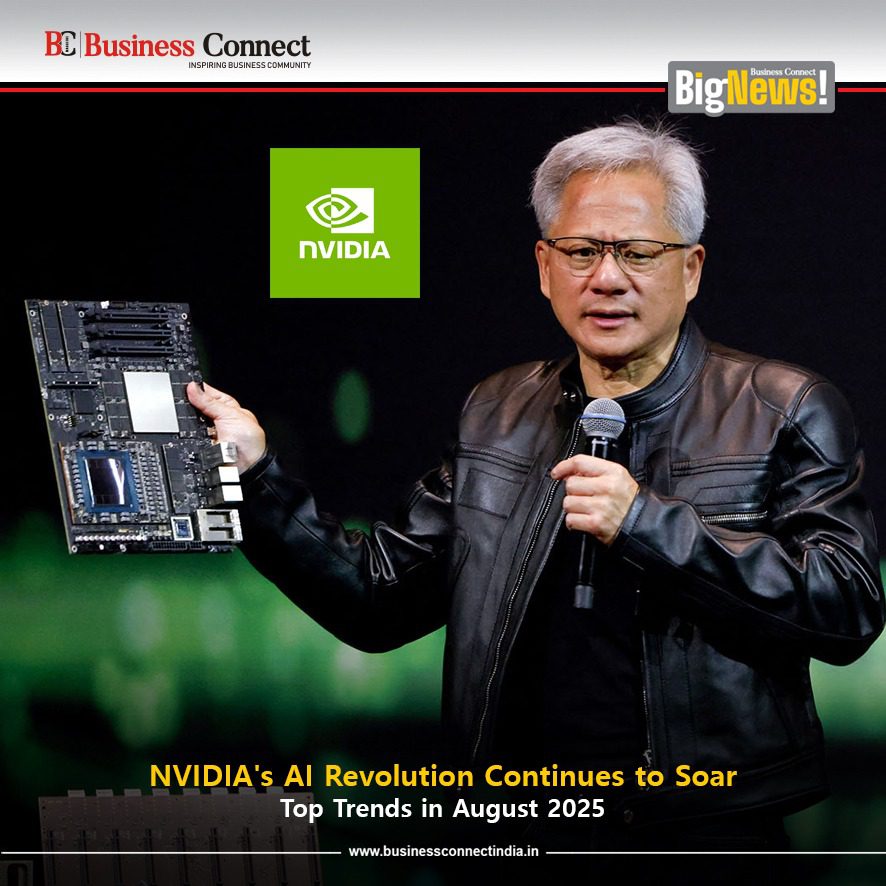
NVIDIA’s AI Revolution Continues to Soar: Top Trends in August 2025
NVIDIA Corporation (NVDA) is still a giant in the world of technology, pushing the boundaries of artificial intelligence (AI), gaming, and data center solutions. As of August 28, 2025, the company is creating headlines with revolutionary breakthroughs and financial success that are making history in the technology sector. Here’s an in-depth overview of NVIDIA’s trending news, summarizing its recent moves and market influence.
NVIDIA’s Q2 Fiscal 2026: All-Time High Revenue
NVIDIA announced an all-time high $46.7 billion in revenue for Q2 fiscal 2026 (ended July 27, 2025), a 6% sequential growth from the prior quarter and a 56% year-over-year increase. Revenue from NVIDIA’s Blackwell Data Center increased 17% sequentially, reflecting its leadership in AI infrastructure. Notwithstanding the lack of H20 chip sales to China by virtue of U.S. export limitations, NVIDIA gained from the $180 million release of prior-booked H20 inventory to a non-China customer. The company estimates Q3 revenue to reach $54 billion, indicating strong demand for its AI offerings.
Why It Matters: NVIDIA’s steady growth in revenues, led by its data center segment, solidifies its position as a leader in the buildout of AI globally. With GAAP and non-GAAP gross margins of 72.4% and 72.7%, respectively, the company’s financials are robust even during times of geopolitical tension.
Blackwell Architecture: Fueling the AI Race
NVIDIA’s Blackwell architecture is leading the charge in the AI revolution. The firm recently issued a statement that top companies worldwide have adopted NVIDIA RTX PRO™ Servers, powered by the RTX PRO 6000 Blackwell Server Edition GPU. The servers are intended to fuel the transition away from general-purpose computing towards AI-powered infrastructure. Meanwhile, NVIDIA is working on a new AI chip for China, the B30A, based on the Blackwell architecture, to help sidestep U.S. regulatory issues and supply the Chinese market.
Why It Matters: The Blackwell platform is a breakthrough, facilitating quicker training and inference for reasoning AI models. Its use by enterprises and potential forays into China underscore NVIDIA’s strategic emphasis on scaling AI worldwide.
Robotics and Autonomous Vehicles: NVIDIA’s Jetson Thor Takes Charge
NVIDIA’s Jetson AGX Thor™ developer kit and production modules are now available in general release, powering robotics in various industries such as manufacturing and logistics. The modules are used as the “brains” of robotic systems, enabling advanced sensors and generative AI. In addition, NVIDIA’s automotive platforms are powering autonomous vehicle systems with reasoning vision language action models, responding to the increasing complexity of self-driving technology.
Why It Matters: With robotics and autonomous cars becoming central to industries, NVIDIA’s Jetson Thor and automotive platforms make the company a prime participant in physical AI and intelligent mobility.
GeForce NOW and Gaming: Extending the Cloud Gaming Frontier
NVIDIA’s GeForce NOW platform got a big boost with the addition of the Blackwell architecture, its largest update so far. The cloud gaming platform now has more than 2,300 games under its support, including the recently added Warhammer 40,000: Dawn of War – Definitive Edition. This addition makes NVIDIA even more attractive to gamers, allowing them to experience seamless, high-fidelity gaming in the cloud.
Why It Matters: NVIDIA’s investment in cloud gaming solidifies its dominance in the gaming space by utilizing AI and high-performance computing to provide immersive experiences to the world.
Challenges in China: Navigating Geopolitical Tensions
NVIDIA was hindered in China through U.S. export restrictions on its H20 chips, taking a $4.5 billion Q1 fiscal 2026 charge for overstock and purchase commitments. Nevertheless, the company is hopeful to be able to resume shipments of H20, which could generate $2 billion to $5 billion in revenue should the geopolitical environment improve. NVIDIA CEO Jensen Huang also said that introducing the Blackwell-based B30A chip to China is a “real possibility,” subject to regulatory approval.
Why It Matters: China is still a key market for NVIDIA, and how well the company can respond to regulatory issues while keeping pace with innovation will determine its growth path overseas.
Market Sentiment and Stock Performance
Even as NVIDIA beat Q2 earnings estimates, the company’s stock fell after earnings because data center revenue didn’t quite meet sky-high analyst expectations. The stock fell 2% following the Q2 report, at about $181.90 in premarket on August 27, 2025. Nevertheless, analysts such as those at Mizuho Securities and Goldman Sachs remain optimistic, affirming buy ratings based on NVIDIA’s robust demand and networking expansion. The company also sanctioned another $60 billion share repurchase authorization, demonstrating optimism in its long-term worth.
Why It Matters: NVIDIA’s stock volatility reflects high market expectations, but its robust fundamentals and strategic buybacks underscore its resilience and investor confidence.
The Bigger Picture: AI Infrastructure Spending
NVIDIA’s finance chief, Colette Kress, estimated $3 trillion to $4 trillion of AI infrastructure expenditure by the end of the decade, underlining the firm’s central position in the change. As leading cloud providers such as Microsoft and Alphabet propel demand for Blackwell chips, NVIDIA stands to benefit considerably from the worldwide AI boom.
Why It Matters: As AI becomes more indispensable infrastructure, NVIDIA’s leadership in GPUs, networking, and software solutions puts it in a position to capitalize on gigantic investments across industries.
Conclusion
NVIDIA continues to shape the future of technology with its advancements in AI, robotics, autonomous vehicles, and gaming. Despite challenges like export restrictions, the company’s innovation and financial strength keep it at the forefront of the AI revolution. As NVIDIA pushes boundaries with its Blackwell architecture and Jetson Thor modules, it remains a key player to watch in 2025 and beyond.
Add Business Connect magazine to your Google News feed
Must Read:-
-
- UIDAI Aadhaar Services 2025: Latest Updates, New Features & How They Impact You
- UIDAI Aadhaar Services: Download, Status Check & Card Updates
- NSDL PAN Card Update Online: Easy Steps to Correct or Change PAN Details in 2025
- Manage Aadhaar Online: Step-by-Step Guide to myAadhaar.gov.in Login & Services