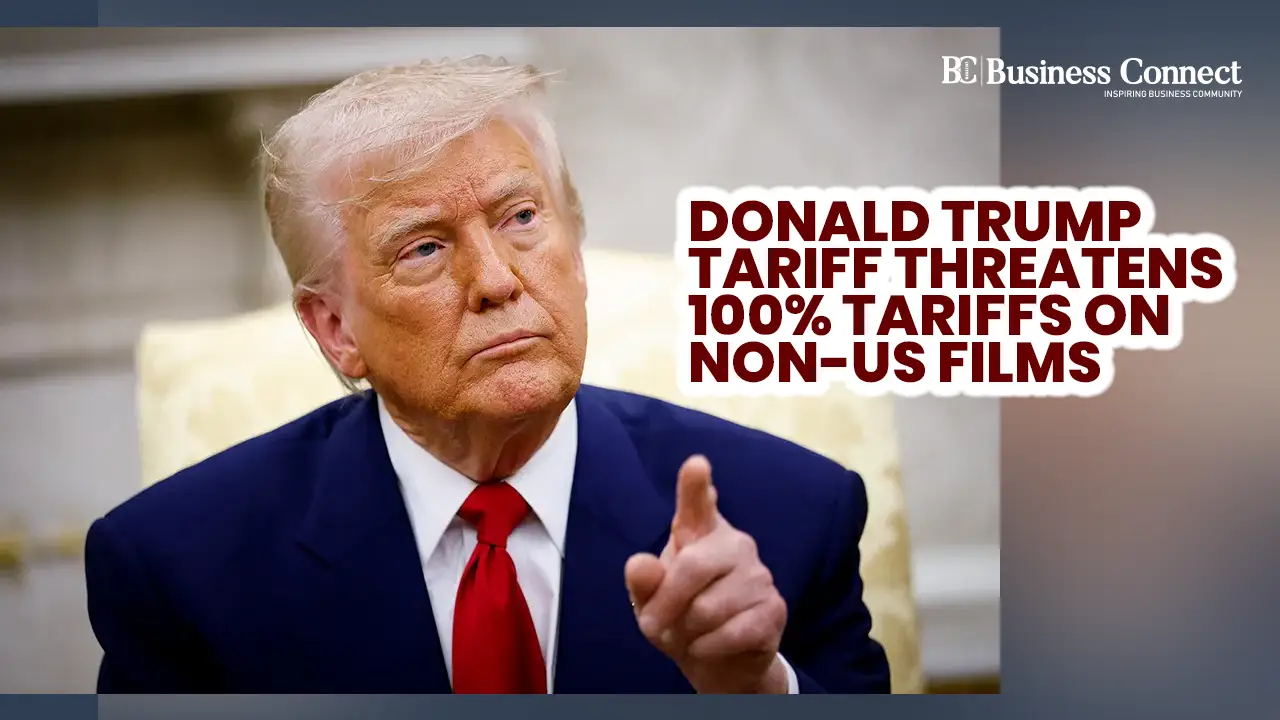
Trump Reinstates Threat of 100% Tariff on Overseas Film Imports
Donald Trump has stated that the American film industry has been “stolen” by other nations and has threatened to impose a 100% tariff on all films that are not produced in the US.
He said on Monday that the tax would “solve this long time, never ending problem” and that California had been severely impacted.
The US president stated in May that the film industry in America was dying “a very fast death” and that he would discuss his proposal with Hollywood leaders and start the process of enforcing the levy.
Trump made these comments after announcing a fresh round of tariffs last week, which included 50% levies on kitchen and bathroom cabinets and a 100% tax on imported branded or patented medications.
Trump said on his Truth Social platform: “Other nations have stolen our film industry from the United States of America, much like stealing ‘candy from a baby.'”
“California, with its weak and incompetent Governor, has been particularly hard hit!”
He said that “any and all movies that are made outside of the United States” will be subject to the 100% tariff.
When the tariff would go into effect was not specified by Trump. A request for comment has been sent to the White House.
Furthermore, it was unclear how the tariffs would be determined and if they would apply to movies that were screened in theaters as well as those that were available on streaming sites like Netflix.
Because American production companies depended on Canadian facilities, personnel, and talent to deliver Hollywood films, the Canadian Chamber of Commerce said that it was “deeply concerned” about the fee.
“These tariffs risk punishing US studios for filming in Canada by driving up costs, stifling investment, and undermining the competitive advantage our countries have built together,” stated Catherine Fortin-LeFaivre, senior vice president of international policy and global partnerships for the Canadian Chamber of Commerce.
“Weaken both economies” and “thousands of middle-class jobs” would be at risk due to the levy, she claimed.
Given that tariffs are often applied to products, Dan Coatsworth, an investment analyst at AJ Bell, questioned how such a levy would operate and stated that many filmmakers were opting to shoot their movies in other nations due to greater incentives.
“The threat of 100% tariffs on movies made outside of the US raises more questions than it does answers,” he stated.
“Filmmakers have been progressively lured by tax incentives that come from shooting movies in other parts of the world, and the Los Angeles film industry has lost its glitz and glamour.”
According to Mr. Coatsworth, it would be challenging to identify a film as American-made if it were produced in the US but had foreign money, performers, or directors.
“So it’s hard to understand just how Trump intends to impose the levy,” he stated.
Theoretically, their expenses may increase if they were compelled to make films in the US.
“Content makers would pass on this cost to the customer and that could hurt demand for streaming companies and cinema operators.”
The investor did not “appear to see this as a serious threat” at the moment, he added. After a temporary decline, stocks of firms like Netflix and Disney recovered.
Deadpool & Wolverine, Wicked, and Gladiator II are just a few of the recent blockbusters from US studios that were filmed abroad.
Despite obstacles, the US continues to be a significant worldwide center for film production, according to ProdPro, a research agency for the film business.
According to its annual report, the nation spent $14.54 billion (£10.94 billion) on production last year. But since 2022, that has decreased by 26%.
Australia, New Zealand, Canada, and the UK are among the nations that have seen increases in expenditure since 2022.
The Business Connect Magazine is aware that the UK government is awaiting information about the US tariff and its potential effects on the British film sector.
According to a representative of the Department for Business & Trade, the UK film industry “generates billions for our economy” and employs millions of people.
The president also declared 25% levies on kitchen cabinets, vanities, and upholstered wooden furniture, along with 10% taxes on imports of softwood lumber and timber on Monday.
The notion was alluded to by Trump earlier in the day when he wrote “substantial Tariffs on any Country that does not make its furniture in the United States” in a post on Truth Social. He added, “Details to follow!!!”
According to a proclamation signed by the president, the tariffs will go into effect on October 14 and some of the levies would rise significantly the next year for nations who are unable to come to an agreement with the US.
It followed Trump’s announcement last week of a fresh round of tariffs, which included a 100% tax on imported branded or patented medications unless a business was constructing a facility in the US.
Frequently Asked Questions (FAQ)
Q1. What did Donald Trump announce regarding foreign-made films?
A1. Donald Trump threatened to impose a 100% tariff on all films that are not produced in the United States, claiming that foreign countries have “stolen” the American film industry.
Q2. When will the tariffs go into effect?
A2. The exact date for the movie tariff has not been specified. However, Trump announced other related tariffs would begin on October 14, 2025, suggesting a similar timeline could apply.
Q3. Why is Trump imposing this tariff?
A3. Trump claims that the U.S. film industry has been negatively impacted by foreign productions and wants to protect domestic studios, jobs, and economic interests.
Q4. How will these tariffs affect Hollywood productions?
A4. Tariffs could increase production costs for U.S. studios that rely on foreign facilities, personnel, or talent, potentially discouraging international collaboration and driving up expenses for streaming services and moviegoers.
Q5. Are there concerns from other countries about this tariff?
A5. Yes. The Canadian Chamber of Commerce and the UK government have expressed concern that the tariff could harm both economies, stifle investment, and threaten thousands of jobs in the film sector.
Q6. How practical is implementing a 100% tariff on films?
A6. Experts have noted that it would be difficult to define an “American-made” film, especially if it has foreign financing, actors, or directors. Determining which films are affected could be complicated.
Q7. What other tariffs were announced along with the film levy?
A7. Trump also announced:
-
50% tariffs on kitchen and bathroom cabinets
-
25% tariffs on upholstered wooden furniture
-
10% tariffs on softwood lumber and timber
-
100% tariff on imported branded or patented medications, unless produced in the U.S.
Q8. How have investors reacted to the news?
A8. Stocks of companies like Netflix and Disney initially dipped but recovered, as analysts consider the threat difficult to implement and currently not an immediate risk.
Q9. What has been the impact on U.S. film production spending?
A9. In 2024, the U.S. spent $14.54 billion on film production, down 26% since 2022, while countries like Canada, Australia, New Zealand, and the UK saw increases in spending.
Q10. What are some examples of U.S. films shot abroad?
A10. Recent blockbusters include Deadpool & Wolverine, Wicked, and Gladiator II, all of which utilized foreign locations and talent for production.
Add Business Connect magazine to your Google News feed
Must Read:-
- Nisha Madhulika India’s richest female YouTuber!
- Larry Ellison of Oracle Suddenly Overtakes Elon Musk as the Richest Person in the World
- Top 10 Richest Comedians In India
- Top 10 Richest Pakistani Actress in 2025 – Who Is Your Favorite?
- Majhi Ladki Bahin Yojana 2025: Benefits, Registration & KYC Guide