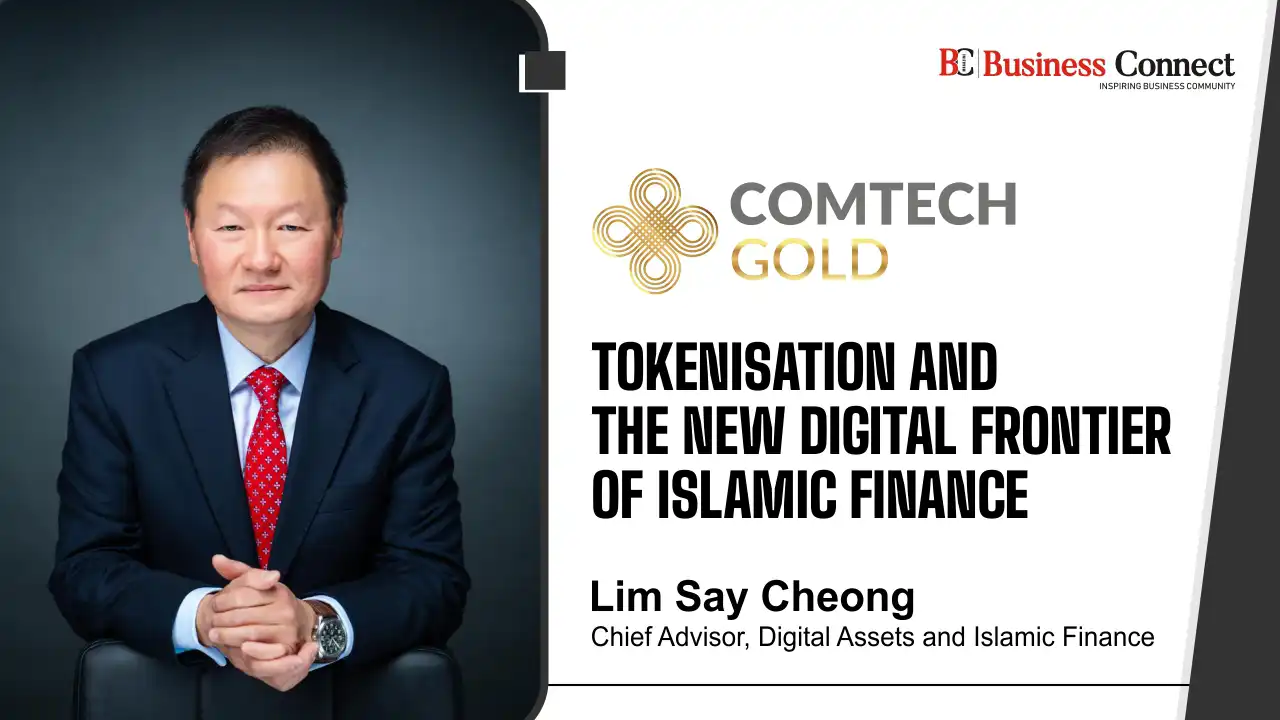
Tokenisation and the New Digital Frontier of Islamic Finance
By Lim Say Cheong, Chevening–Oxford Centre for Islamic Studies Fellow, award-winning Islamic finance practitioner, and Chief Advisor for Digital Assets and Islamic Finance at ComTech Gold.
How a quiet technological shift is poised to reshape asset ownership, capital markets and cross-border financial flows across the Islamic finance industry.
In the past decade, the financial world has been animated by debates over cryptocurrencies, trading platforms and the rise of decentralised finance (DeFi). Yet quietly and with far more lasting implications another shift has been taking shape as financial markets move toward the tokenisation of real world assets.
This is not another passing trend. Tokenisation is reshaping how ownership is recorded, how value moves, and how financial markets define and transfer rights. For Islamic finance, a system rooted in real economic activity, transparency, fairness and the avoidance of riba and excessive speculation, this shift represents far more than a technological upgrade. It is an opportunity to rebuild the industry’s financial principles and foundations.
This transformation comes at a time of significant expansion for the industry. According to the LSEG–ICD Islamic Finance Development Report 2025, global Islamic finance assets are projected to reach $9.7 trillion by 2029, growing at an average annual rate of 10 per cent. This expansion is being driven by robust growth in Islamic banking, rising sukuk issuance, the continued development of Islamic funds, and the rapid emergence of Islamic fintech.
The scale of this growth shows that Islamic finance has evolved well beyond its niche origins and now forms an integral component of the global financial system. Its next phase of growth will require modern digital infrastructure such as AI, blockchain and tokenisation, capable of supporting a significantly larger and more interconnected ecosystem.
As tokenisation gains ground, it is beginning to reshape the underlying infrastructure of global finance. These new digital rails offer levels of transparency, accuracy and asset linkage that sit naturally with the foundational ethos of Islamic finance. Rather than simply refining existing processes, tokenisation creates the possibility of redesigning the system in ways that align more closely with classical Shariah principles.
The idea behind tokenisation is straightforward. Any real asset, whether gold, property, sukuk, infrastructure or trade receivables, can be represented in digital form on a blockchain. The token that represents the asset serves as a verifiable and immutable expression of ownership, similar to a share certificate or an entry in a bank ledger. What sets it apart is the mechanism through which ownership can change hands. Tokens can be transferred almost instantly, without clearing delays or layers of intermediaries. This creates a financial environment that is secure, transparent and remarkably efficient.
This efficiency marks a significant departure from the infrastructure that Islamic finance currently depends upon. Although the industry has always championed real economic activity, it still operates largely within systems designed for conventional finance. These systems were built around interest-based instruments, slow multi-day settlement processes and layers of intermediaries whose roles are not always transparent.
Islamic products have had to operate within these constraints, sometimes with ingenuity and at other times with unavoidable complexity. This has often resulted in additional costs and operational friction. Tokenisation provides a path out of this constraint. It makes it possible for Islamic finance to operate on platforms that reflect its own values rather than adapting to frameworks that were never designed for it.
One of the most compelling starting points for tokenisation within Islamic finance is gold. Gold holds a unique place in Islamic civilisation as a measure of value, a medium of exchange and a symbol of economic fairness. As a ribawi item, gold must be exchanged according to strict rules that ensure equality, clarity and immediate settlement.
Many early digital-gold offerings failed to comply with these requirements because they did not represent allocated, redeemable gold. Tokenisation resolves this issue by linking each token to a specific bar or gram of physical gold held securely in a recognised vault. The holder has a direct legal right to redeem it. This makes the token a modern analogue of a warehouse receipt and satisfies the requirement of possession, whether physical or constructive.
Beyond Shariah compliance, tokenised gold offers practical benefits. Physical gold is valued for its stability but is not easily transferable. Digital assets offer speed but lack intrinsic value. Tokenised gold provides both stability and liquidity. A gram of gold can move across borders within seconds. It can be divided into minute fractions or used as collateral with full transparency. For Islamic banks that often struggle to secure high-quality liquid assets that comply with Shariah principles, tokenised gold introduces an instrument that is both liquid and firmly grounded in real value.
The potential of tokenisation, however, extends far beyond gold. It has the capacity to transform core functions of the Islamic financial ecosystem. Sukuk issuance provides a clear example. Sukuk have become a central pillar of Islamic capital markets, with global outstanding issuances reaching USD 1 trillion in 2024 according to ICD – LSEG Islamic Finance Development Report 2025. Yet the issuance process remains relatively slow and structurally complex because it relies on special-purpose vehicles, trustees, custodians and multiple intermediaries. Tokenisation offers a way to simplify this process.
While the Shariah structure remains intact, ownership can be represented through digital tokens that settle quickly, onboarding becomes digital, profit payments can be automated and minimum investment sizes can be reduced, enabling wider participation. Tokenisation also creates the possibility of continuous automated monitoring of asset ratios, strengthening Shariah compliance throughout the life cycle of sukuk.
Real-estate investment is another area where tokenisation makes a profound difference. Traditionally, property investment has required substantial capital and carried high transaction costs. Tokenisation allows ownership to be divided into smaller portions, making participation accessible to a wider audience.
Cross-border investment becomes simpler, title records become transparent and investors can trade their shares more easily. This represents a major shift for an asset class that has always been central to Islamic investment but has remained out of reach for many individuals.
Trade finance stands to benefit considerably as well. Trade is the backbone of many Muslim-majority economies, yet small and medium-sized enterprises often struggle to obtain Shariah-compliant financing due to a lack of verifiable documentation or sufficient collateral.
By tokenising invoices, warehouse receipts and goods in transit, financiers gain access to reliable digital records that reduce fraud and increase confidence. Settlement becomes faster and the financing ecosystem becomes more inclusive, allowing SMEs to participate more fully in economic activity.
Tokenisation also strengthens sustainability-linked finance, an area closely aligned with the objectives of Maqasid al-Shariah. When environmental performance data is captured on a blockchain, impact becomes verifiable, tamper-resistant and easy for investors to audit. A tokenised sukuk tied to carbon-reduction targets, for example, can link profit distributions to measurable outcomes tracked transparently in real time. This gives investors greater confidence that their capital is financing genuine environmental benefit rather than merely meeting compliance targets on paper.
Governments stand to benefit significantly as well. The issuance of sovereign sukuk is traditionally a lengthy and complex process involving the establishment of a special-purpose vehicle, coordination with multiple intermediaries such as trustees, registrars and paying agents, manual subscription flows and extensive documentation. Settlement can take several days, and administrative overheads are substantial. Tokenisation has the potential to streamline this entire chain.
On a blockchain platform, the SPV structure and asset ownership can be represented digitally, investor onboarding can be automated through integrated KYC and AML protocols, subscriptions can occur in real time and settlement can be completed within minutes rather than days. The result is a dramatic reduction in issuance timelines, with processes that once required weeks or even months becoming significantly faster and more efficient. Early global examples illustrate what is possible.
Hong Kong’s tokenised green bond achieved settlement in a single day, compared with the multiple-day cycle required under traditional arrangements. These developments indicate that sovereign sukuk could achieve similar efficiency gains as tokenisation becomes more widely adopted.
For tokenisation to achieve its full potential, regulatory and governance frameworks must evolve in parallel. Regulators need to establish clear classifications for tokenised assets, ensure that custody arrangements meet international standards and recognise blockchain records as legally enforceable.
Shariah scholars will need to gain understanding of smart contracts and assess how contractual logic maps onto classical legal concepts. Courts must be equipped to enforce rights that exist in tokenised form. Cybersecurity will also be paramount, as any vulnerability could undermine trust across the ecosystem.
Ultimately, the most powerful aspect of tokenisation is how naturally it aligns with the ethical foundations of Islamic finance. Islamic economic thought emphasises fairness, transparency and the real-asset nature of wealth. Tokenisation strengthens all of these qualities. It reduces unnecessary intermediation, clarifies ownership and allows value to move through the economy efficiently without losing its ethical grounding.
In a tokenised Islamic financial ecosystem, individuals could save in tokenised gold, sukuk or real estate. Businesses could access project financing with fewer barriers. Governments could settle obligations through assets that reflect real value. Zakat and waqf systems could operate with unprecedented transparency. Even cross-border remittances could be completed in seconds and at minimal cost.
Tokenisation also opens the door to a new geopolitical landscape for Islamic finance. For decades, many Muslim-majority economies have depended on external financial infrastructure for key functions such as settlement, clearing, custody and correspondent banking. This reliance has not only created vulnerabilities but has also limited the ability of these economies to fully exercise monetary and financial autonomy.
A shared tokenised financial network built around real assets such as gold, commodities or tokenised sovereign instruments could alter this dynamic. It would allow countries across the Middle East, Africa and Southeast Asia to conduct cross-border transactions more efficiently and without routing payments through distant financial centres. Such a shift could strengthen regional integration, enhance economic resilience and create a more balanced global financial architecture in which Islamic economies play a more active role.
The implications extend beyond efficiency or sovereignty. A cross-regional tokenised infrastructure could facilitate deeper cooperation in trade, energy, food security and capital markets. Countries could settle bilateral trade using tokenised commodities instead of volatile fiat currencies.
Regional liquidity pools could emerge for tokenised sukuk. Even multilateral institutions in the Islamic world such as the Islamic Development Bank Group could design new development instruments powered by tokenisation, reducing administrative burdens and improving transparency. In this sense, tokenisation is not only a financial innovation but a catalyst for reimagining economic relationships across the Muslim world.
However, achieving this future requires far more than technological capability. It calls for a new generation of expertise across the entire ecosystem. Regulators, bankers, technologists, Shariah scholars and academics must develop a shared vocabulary and a deeper understanding of one another’s fields.
Tokenisation brings together finance, law, computer science, cryptography and Islamic jurisprudence in ways that demand integrated thinking. Without this collective knowledge, the industry risks moving forward in fragmented steps rather than in a coherent direction. Universities, central bank academies and professional bodies across the Islamic world will need to design programmes that blend Islamic finance with smart-contract development, digital asset regulation and cyber-risk management. Capacity-building must also extend to Shariah boards, which will increasingly be asked to evaluate not just only contractual structures but also digital execution mechanisms.
As with any major leap in financial architecture, not every tokenisation initiative will succeed. Some will fail due to technical flaws, weak governance or inadequate legal frameworks. Others will expose regulatory gaps or challenge long-held industry assumptions. This process of experimentation is not a setback; it is a necessary stage in the evolution of a modern Islamic financial system. The crucial task is to ensure that innovation remains grounded in the core values of Islamic finance of transparency, fairness, genuine asset-backing and shared prosperity.
If guided with foresight, tokenisation has the potential to move Islamic finance beyond simply adapting to global financial systems and toward a position where it actively shapes them. A transparent, efficient and asset-backed Islamic financial ecosystem is no longer a distant ambition.
It is already beginning to take form, and the rapid progress in tokenised gold, tokenised sukuk and digital infrastructure suggests that the coming decade could mark one of the most significant transformations in the history of Islamic finance. Tokenised gold may be the earliest indication of the direction ahead, showing an industry anchored in real value, empowered by technology and aligned with both ethical principles and global economic realities.