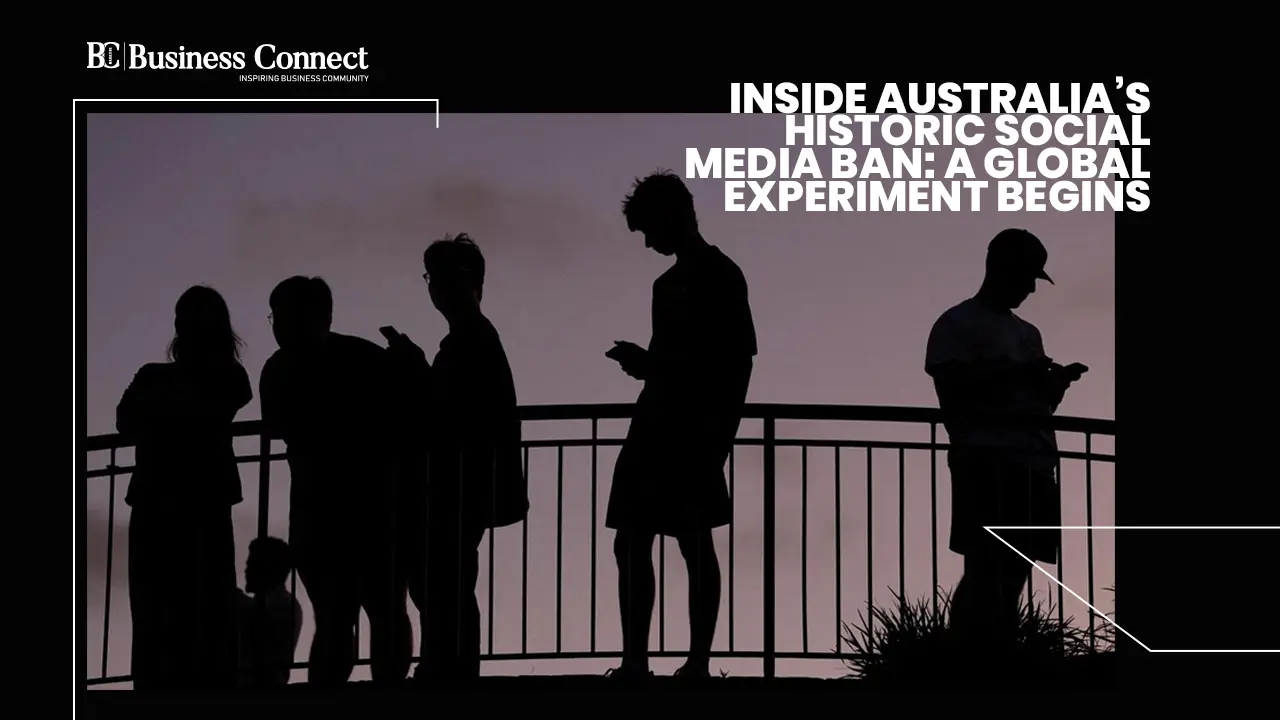
The End of Social Media for Kids? Australia Starts a Worldwide Debate
First, let us introduce you to a woman from Australia named Mia Bannister. Her story is one that can terrify any parent.
In January this year, Mia’s 14-year-old son Oliver, whom she lovingly called Ollie, was found dead in his room. Mia holds social media directly responsible for his death.
Ollie had developed a disorder called Anorexia Nervosa—a condition where a person develops an extreme fear of gaining weight. Mia says Ollie used to spend hours watching videos on TikTok. He watched boys building muscles, bulking up, showing perfect bodies. Slowly, Ollie began to hate his own body.
In February 2024, Ollie weighed 74 kg, but by December 2024, his weight had dropped to below 50 kg. He was admitted to the hospital. He ate only canned fish and rice. Before eating anything, he would weigh his food, and after eating, he would go to the bathroom and vomit.
It wasn’t just his body—his mind was also controlled by social media. On Snapchat, some of his friends messaged him saying he should “take his own life.” Some mocked his red hair, others called him fat.
Mia, a single mother, worked day and night to keep the household running. She had no idea what these apps were doing to her son’s mind. She took away his phone, set rules—but the algorithm won.
After being discharged from the hospital, Ollie began punishing himself. He hurt himself whenever he ate food, believing he deserved pain for eating.
One morning, he had breakfast with his mom. He said, “See you later.” But he never returned.
Mia says Ollie was her entire world—and social media swallowed that world.
On December 9, when Australia announced a social media ban for children under 16, Mia Bannister stood beside Australian Prime Minister Anthony Albanese during the announcement.
In Australia, there are around 4,400 users aged 13 to 15 on Snapchat.
In the same age group, Instagram has nearly 3,500, TikTok about 200,000, and Facebook around 150,000 young users.
But after December 10, these numbers have changed dramatically.
Which platforms are banned?
The Australian government has created a list of 10 major platforms that are now blocked for users under 16:
-
Facebook
-
Instagram
-
Snapchat
-
Threads
-
TikTok
-
X (formerly Twitter)
-
YouTube
-
Reddit
-
Kick (streaming)
-
Twitch (streaming)
This is a dynamic list, meaning it can be updated over time.
Platforms can be added or removed based on three criteria:
-
Is the primary purpose of the app online communication?
-
Can users interact with one another on the platform?
-
Can users create or upload their own content?
Which platforms are exempt?
Some apps have been kept outside the ban for now:
-
YouTube Kids – considered safe for children
-
Google Classroom – used for education
-
WhatsApp – not categorized as a content-sharing social media app
The government says these apps do not meet all three criteria.
The YouTube controversy
A major debate broke out over YouTube. Initially, it was expected to be exempt because it works partly as a search engine and is used in schools. But due to pressure from other companies like Meta and TikTok, this exemption was withdrawn.
Their argument:
“YouTube Shorts works exactly like TikTok and Reels — same addiction, same algorithm.”
Currently, children under 16 can still watch YouTube without logging in, but they cannot like, comment, or upload anything. Google has opposed this rule, saying:
-
With logged-in accounts, parents can apply filters.
-
With guest mode, controlling what kids watch is far more difficult.
How will the law be enforced?
This is the most unique and controversial part. The penalty will not fall on children or parents, but on social media companies.
If platforms fail to keep children under 16 off their services, they could face massive fines of up to:
49.5 million Australian dollars
(approximately ₹300 crore)
Children will not face any action even if they secretly manage to use social media.
Parents will not be punished either.
All responsibility lies with the companies.
These companies have publicly criticized the law, but they have also stated that they will comply.
Government’s stance
According to the Australian government, the design of these social media platforms is intentionally addictive. These algorithms keep children glued to screens. They argue:
“It’s an addiction. These algorithms are poison — for children’s health and their minds.”
At the beginning of 2025, the Australian government conducted a major study. The data showed that 96% of children aged 10 to 15 are already on social media — meaning almost every child in that age group is active online.
Out of them, 7 out of 10 children admitted that they had seen disturbing or dangerous content online. This included:
-
Misogyny and hate against women
-
Violent content
-
Eating disorder–related content
-
Posts encouraging self-harm or suicide
The danger doesn’t end with exposure. One out of every seven children said that adults had tried to lure or manipulate them online — a practice known as grooming.
The study also revealed that more than half of these children had been victims of cyberbullying — online harassment, threats, and humiliation.
But the children themselves are not ready to accept this new law.
Here’s what many of them are saying:
“I think… I mean… I feel it’s kind of stupid. Thirteen was a fine age. Yes, it’s young, but our whole generation depends on Snapchat and other apps. That’s how we talk to our friends. So this is a big change, and it happened too suddenly.”
“I don’t think this will work. Honestly, the government doesn’t know what it’s doing. I don’t think this will impact kids in Australia. The plan is just not going to work.”
Australia’s public broadcaster ABC conducted a large survey involving children aged 9 to 16. Most kids said the ban will not work. They believe the idea itself is flawed.
In fact, three out of four children openly declared that they will not stop using social media, no matter what the government does.
A new trend before the ban
In the weeks leading up to the ban, an interesting trend emerged:
Children started looking for new digital spaces.
On the App Store, downloads suddenly surged for apps that work just like the banned ones — new photo-sharing and messaging alternatives. Kids already found their loopholes.
So the big question is:
How will social media companies detect a user’s age?
The government hasn’t forced any single method. Companies have been told to find their own solutions. Most are adopting a waterfall system, meaning several age-verification layers one after another.
Examples include:
-
Video Selfie Upload
-
The user must record and upload a selfie video.
-
AI will analyze facial structure and skin texture to estimate age.
-
If AI believes the user is over 16, access is granted.
-
-
Government ID Upload
-
If the selfie doesn’t pass, users may have to show a government ID such as a passport or driver’s license.
-
Privacy concerns explode
This system has deeply alarmed privacy advocates.
They argue it could turn social media platforms into a “honeypot” — a massive treasure of sensitive data that hackers crave.
If a company’s servers are hacked, millions of ID documents could be leaked.
There’s another problem:
Even adults will have to prove their identity to access the internet.
If AI fails to judge correctly, they will be forced to upload government IDs.
This means online anonymity could disappear completely.
Experts are divided
The medical and academic world is split into two sides.
One group believes the ban is necessary.
Let’s understand their perspective next.
The whole world is suffering from this. All children are being affected by it. In fact, they are living inside it. They are spending their lives in a virtual, imaginary world. Their entire routine—sleeping and waking up—is tied to it. Even for common people, social media has become a necessary part of life.
So when it comes to teenagers, if the government has banned it, then definitely it means they were facing serious harm. The biggest issue is that children’s emotional health is deteriorating rapidly. Because of this, they are neither connected to their families nor to the outside world. In fact, they are in a strange mental state.
Sometimes they are even facing major psychotic issues. Many of them are developing disorders. Their attention does not stay in one place. They are extremely distracted. So a child’s natural identity and the way they are supposed to grow up is not forming properly. Perhaps that is why this decision was taken—to see if things improve.
Maybe children can get their childhood back, the way it used to be earlier. People might start accepting that lifestyle again. Children might start living like that again. Today, kids have a lot of aggression, lack patience, and cannot tolerate criticism at all. Social media increases comparison, especially through reels, and children spend a lot of mental energy on that.
Mental illness cases are increasing day by day. And I feel that when a child faces mental illness, their physical health also suffers, they lose social connection, and they feel disconnected from their family. So what can be done in such a situation? Maybe that’s why this decision came into consideration.
On the other hand, human rights organizations are opposing this move. The Australian Human Rights Commission says that this is a violation of freedom of expression. The matter has reached the court. Two 15-year-old children have challenged the government. They have filed a constitutional petition saying that this law violates their rights. It stops them from expressing themselves and engaging in political discussions.
Mental health organizations are also strongly opposing the ban. They argue that for many children, social media is a lifeline—especially children from marginalized communities like LGBTQ kids or those living alone in remote villages. For them, social media is a way to connect with the world and ask for help. Taking it away may increase their loneliness.
So the question is: will suddenly taking away social media harm children? Let’s understand from mental health experts.
Children under 16 are teenagers—they need to be handled very carefully when such decisions are taken. Suddenly hearing this news is a big shock for them because their entire lives have revolved around social media. They grew up with it. So this decision is extremely shocking for them.
Still, trying this once is not a bad experiment. But those children will need a lot of help. They will need support to control their emotions. Many kids may face panic issues. Some may even need medication. Their entire mental space might get disturbed. So it will require a lot of precautions.
If this decision has been taken, then it can be tested for a while and the results observed. In such a situation, proper handling is very important. Children may panic. They will need the support of parents and family. The time they used to spend on social media should now be replaced with family involvement—talking to them, interacting with them, forgiving their aggression, and not testing their patience.
Australia has now become a laboratory for the world. All eyes are currently on Australia. If this experiment succeeds, it will create a domino effect. This will be the first brick—once it falls, other countries may start following the same path.
For now, let’s take a look at what rules different countries have:
Europe
• Britain has the Online Safety Act, which restricts harmful content, but it does not set any specific age limit.
• France introduced a rule in 2023 that children under 15 need parental permission, but verifying age has become a technical challenge.
• Germany requires guardian consent for children between 13 and 16, but even there kids find loopholes.
• Italy has set the age limit at 14.
Asia
• China has the Great Firewall; foreign apps are banned. But for children, there is a minor mode that limits screen time.
• Malaysia is following Australia’s path; from next year, social media will be banned for children under 16.
• Afghanistan, under Taliban control, needs no explanation—the restrictions are absolute.
• Iran has blocked almost everything from Facebook to Instagram.
• North Korea is completely cut off from the world. There is no internet—only a closed internal network called Kwangmyong.
• Myanmar also keeps social media heavily restricted under military rule.
United States
Even in the US, the debate is intense.
• States like Florida and Utah tried to impose restrictions, but courts blocked these attempts over free speech issues.
• Currently, the Children’s Online Privacy Protection Act (COPPA) exists, which prevents collecting data from children under 13—but it does not stop them from making accounts.
This means that in the coming years, many countries may consider moving in this direction.
What About India?
What will India do? What should India do?
There are major challenges:
1. The Scale
Checking the ages of a few lakhs of children in Australia is one thing—but in India, there are nearly 40 crore (400 million) children. Taking consent from their parents is a massive task.
2. The Economic Impact
India’s creator economy is growing rapidly. Thousands of young influencers and creators are earning well. If strict bans are implemented here, this entire sector may collapse.
Right now, instead of imposing such strict bans, India is focusing on digital literacy, teaching people how to use the internet safely.
1. What exactly has Australia banned?
Australia has banned all children under 16 from using major social media platforms. Ten major apps—including Facebook, Instagram, TikTok, and Snapchat—are now blocked for minors.
2. When did the ban come into effect?
The ban officially began on December 10.
3. Why is this ban being introduced?
The government says addictive algorithms and harmful content are damaging children’s mental and emotional health.
4. What triggered the government’s decision?
A series of rising mental health issues among teens—highlighted by cases like 14-year-old Ollie Bannister, whose death was linked to social media–driven disorders.
5. Which 10 platforms are banned for children under 16?
-
Facebook
-
Instagram
-
Snapchat
-
TikTok
-
Threads
-
X (Twitter)
-
YouTube
-
Reddit
-
Kick
-
Twitch
6. Can children still access YouTube?
They can watch YouTube without logging in, but cannot comment, like, or upload anything.
7. Are any platforms exempt from the ban?
Yes.
-
YouTube Kids
-
Google Classroom
-
WhatsApp
These are considered educational or safe.
8. Why wasn’t YouTube exempted?
Because competitors argued that YouTube Shorts is similar to TikTok/Reels and equally addictive, so it should not be excluded.
9. Will children or parents be fined for breaking the rule?
No.
Only social media companies will face penalties if they fail to keep minors off their platforms.
10. What is the penalty for companies violating the ban?
They may face fines up to 49.5 million Australian dollars (₹300 crore).
11. How will companies verify a user’s age?
They can choose their method, but common solutions include:
-
AI-based video selfie age estimation
-
Government ID uploads
-
Multi-layer age verification systems
12. Why are privacy experts concerned?
Because storing huge amounts of ID documents and biometric data creates a “honeypot” for hackers, threatening user privacy and anonymity.
13. How are children reacting to the ban?
Most children say the ban won’t work.
In surveys, 75% of kids said they will continue using social media through loopholes.
14. What loopholes are children using?
Kids have already started downloading alternative photo and chat apps not yet included in the ban.
15. Why are mental health experts divided?
Some experts say social media is harming children’s emotional stability, causing addiction, aggression, attention disorders, and eating disorders.
Others argue social media is a lifeline, especially for marginalized teens or those in remote areas.
16. Why are human rights groups opposing the ban?
They say it violates freedom of expression and prevents teens from participating in political discussions or public debates.
17. Has the ban been legally challenged?
Yes.
Two 15-year-old children have filed a constitutional petition claiming their rights are being violated.
18. How do other countries regulate children on social media?
Rules vary worldwide:
-
Britain: No age limit, but harmful content is restricted
-
France: Under 15 requires parental consent
-
Germany: Ages 13–16 need guardian approval
-
China: Strictest rules; foreign apps banned; screen-time limits
-
Malaysia: A similar ban from next year
-
US: COPPA protects kids under 13, but no usage ban
19. Will this global trend spread to other nations?
If Australia’s model works, experts believe a domino effect may start, with more countries adopting similar social media restrictions for children.
20. What about India—will it also ban social media for minors?
Not likely in the near future.
Challenges include:
-
Verifying age for 400 million Indian children
-
The fast-growing creator economy that depends on youth
Currently, India is focusing on digital literacy rather than bans.