-By Jaya Pathak
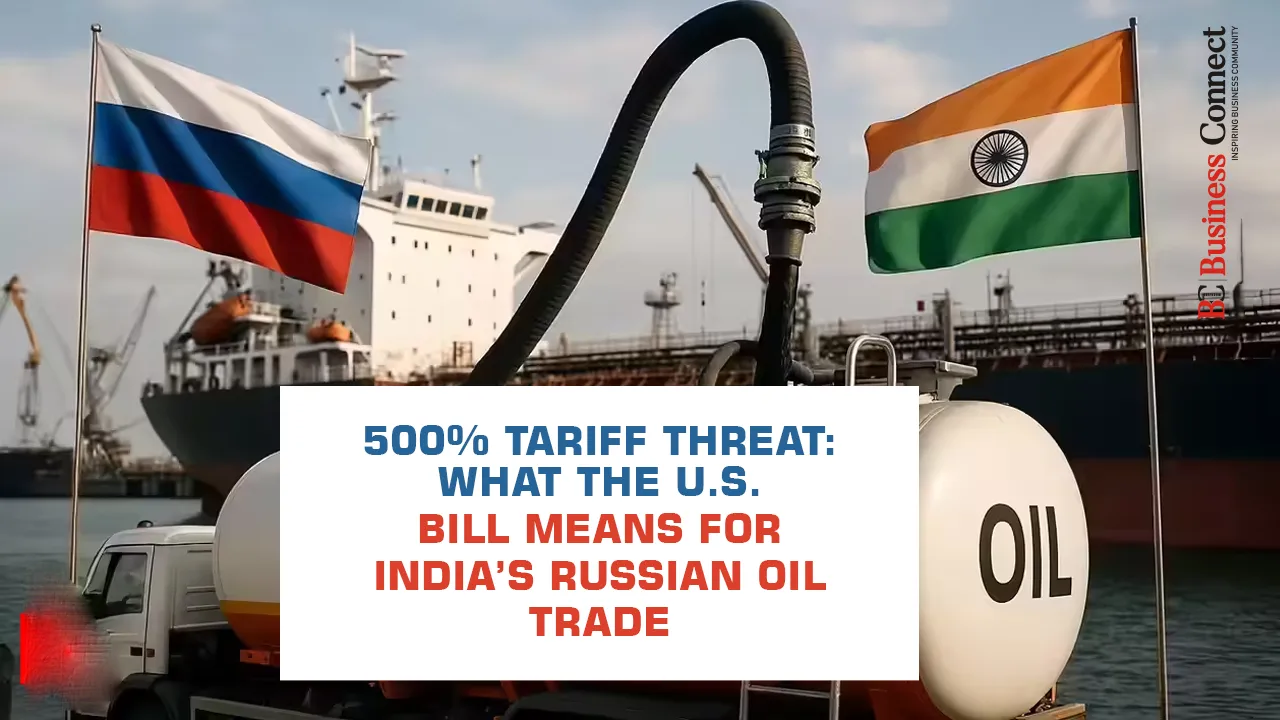
A sanctions package proposed by the U.S would transform Russian oil into a bargain to any state that continues to purchase it by threatening it with tariffs at least 500% on export to the United States. What concerns India, which has become a significant part of the seaborne flows of Russian crude, it is not only energy security that matters, but the question of whether trade access to the U.S. will become the cost of such oil.
Bill
The bill is the Sanctioning Russia Act of 2025 (S.1241) proposed by Senator Lindsey Graham and sponsored by Senator Richard Blumenthal among others and currently in the Introduced stage at Congress.gov. The trigger of the bill is a covered determination by the U.S President concerning the refusal by Russia to negotiate peace, a breach of a peace agreement or another invasion.
There are two parts that are the most important to the commercial calculus in India. Section 15 requires that the U.S. should raise its duty on the goods and services that it imports in Russia to a level that is not lower than the equivalent of 500 percent ad valorem. Section 17 increases the corresponding 500 percent minimum duty to any commodities or services imported to the U.S. by any country that knowingly sells, supplies, transfers, or purchases oil, uranium, natural gas, petroleum products, or petrochemical products of Russian origin.
This is what lies at the core of the threat: it is not a tariff on the Russian crude that is coming into America but a secondary tariff on the exports of the Russian-energy purchasers. An additional temporary waiver of up to 180 days as the President chooses, and the waiver is not applicable to some categories of countries, is also provided in the bill.
Simultaneously, the general press has reported that President Donald Trump has supported the idea of sanctioning nations who purchase Russian oil, positioning it as a means of suffocating the funding of the war in Moscow. It is unclear whether the bill will actually become law; what is definite is the message that it sends; that Washington is ready to transform energy policy into trade enforcement.
The exposure of India is not theoretical
The exposure of India is not the issue of headline but barrels. In late 2025, Reuters announced that India was the biggest client of discounted Russian crude transported by sea with an average of 1.7 million barrels per day in the first three quarters of 2025. Independently, the Hindu BusinessLine reported that Russian crude constituted around 36.3 percent of the total crude import in India in November 2025 based on Kpler data with a prediction that the sanctions would become volatile.
The meaning of discounting becomes strategic in that scale. When it is merely a price, a discount is useful; when a policy marker that is visible to counterparties, regulators, shipping insurers, banks and trade negotiators a price, then it becomes dangerous. When secondary tariffs are introduced, the discount has ceased to belong to refiners alone–it has been implicitly vowed to other national export interests.
The narrative is so quick to change as well, which is reported recently. The Russian oil buying of India was an issue of public statement by the U.S. officials with the reports quoting the U.S. Treasury Secretary, Scott Bessent as saying that India had ceased to purchase Russian oil following the tariff pressure. Although these statements may be more negotiating pose than established reality, they make the point as to what has been discussed to be in the U.S.-India trade talk: oil volumes have become a bargaining chip.
What a 500 per cent tariff threat really stings
The impact of the brutality of a headline stating a 500% tariff can hide the technicalities. This is not an energy shock in terms of a boardroom, but the market-access shock.
- Trade risk: The American market is contingent. When the less than 500 percentage of duties were implemented on the imports of U.S. goods by a Russian-energy purchaser, it would be a miniature embargo on the bulk of merchandise groups since it kills the price competition within one night. A broad duty is not easily arbitraged unlike narrowly-focused financial sanctions that can be sometimes successfully managed by careful compliance, exporters can either absorb it (hardly ever possible), pass it through (in most cases, not viable), or leave the market.
- Capital and compliance risk: Banks price politics. Sanctions policy never falls on to ships, but falls first in credit committees. The cost of trade finance when there is enforcement risk is high, documentation is onerous and even clean transactions take time to be processed as counterparties worry about should have known criteria. The language of the bill, which refers to knowingly, is no footnote, it is open to conservative interpretation, which is exactly how compliance culture will act with ambiguity.
- Supply-chain risk: Russian crude has been already sailing the ecosystem of workarounds, long distances, new intermediaries and increased scrutiny. The Hindu BusinessLine had anticipated the potential of sanctions to lower Russian shipments, and an anticipated eventual decline in the number of arrivals in December 2025, as the market adjusted. Any new U.S. instrument that focuses more on buyers than sellers only raise the reputational temperature on the flows.
The data strategic dilemma: energy pragmatism or trade optionality
The Russian oil trading of India has grown due to logical reasons such as price benefit, refinery supply and processing capacity by the elaborate refineries of the Urals and other grades of the same. The challenge that now lies is that rationality is being redefined. It is not a question of whether or not the barrel is cheap.
Conclusion:
A 500% tariff threat does not merely consist of hurting Russian-oil purchasers; it is an experimentation of the rate at which business can be utilized in a multipolar economy. The optimal reaction of India can be seen rather in not panicking or putting on postures but an exercise of risk discipline: maintain the affordability of energy, guard the export advantage, and maintain the credibility of the strategic dependency by rendering the opposite dependence visibly possible.