
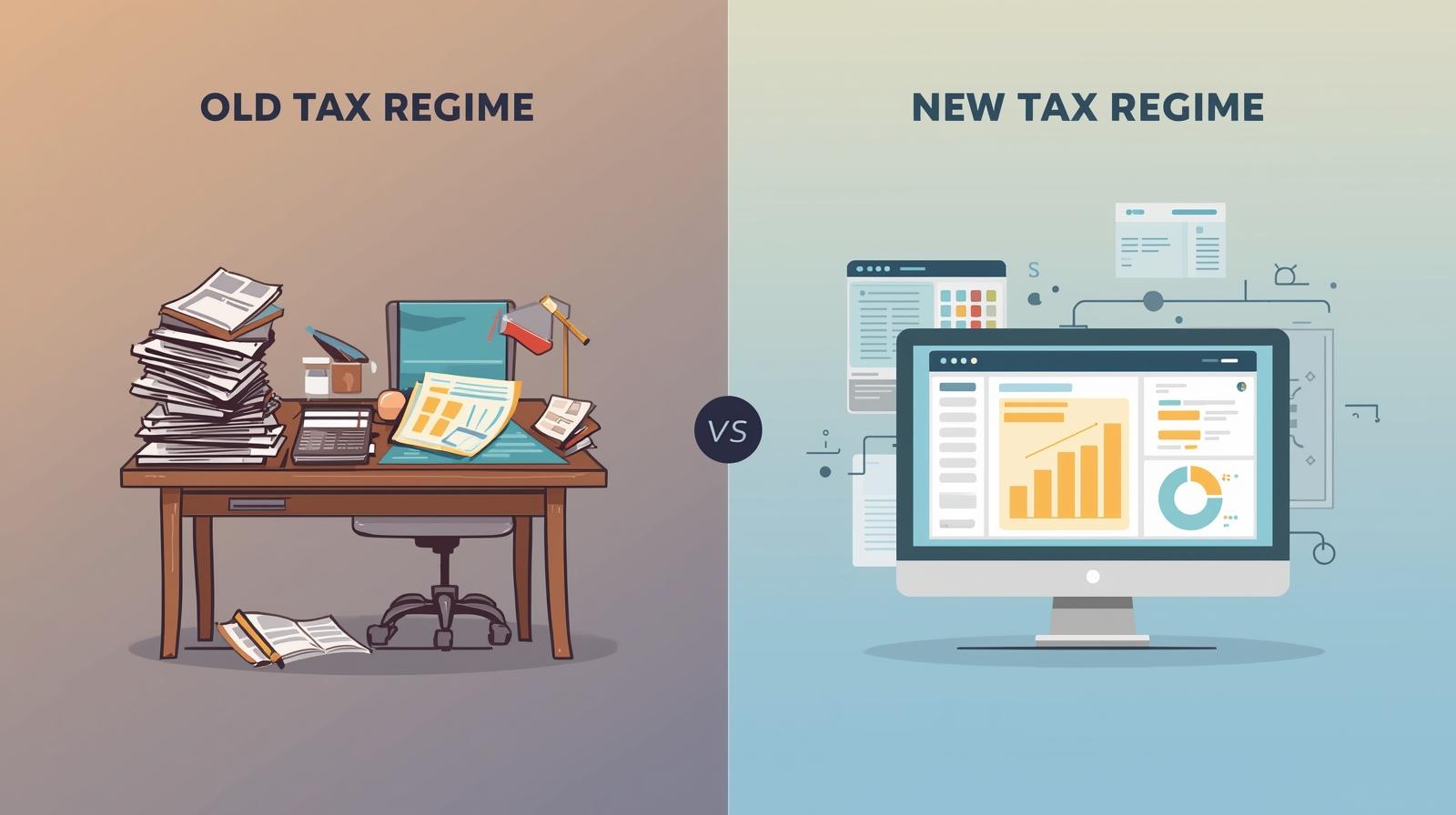
The Indian Income Tax system now allows individual taxpayers to choose between two distinct tax regimes—the long-standing Old Regime, with higher tax rates but numerous deductions and exemptions, and the more streamlined New Regime, offering lower tax rates but fewer deductions. This choice places a premium on understanding your personal income levels, investment habits, and long-term financial objectives. In this blog, we will compare the key features of both regimes and guide you on making the most advantageous selection for your unique needs.
New Income Tax Slabs (FY 2025-26)
|
Old Regime: Key Highlights
- Higher Tax Rates
- Marginally higher tax rates across income slabs compared to the new regime.
- Multiple Deductions and Exemptions
- Popular deductions and exemptions include:
- Section 80C (up to ₹1.5 lakh for investments like PPF, ELSS, life insurance, etc.)
- Section 80D (health insurance premiums)
- House Rent Allowance (HRA)
- Leave Travel Allowance (LTA)
- Standard Deduction, among others.
- Popular deductions and exemptions include:
- Optimal for Taxpayers With Large Deductions
- If you invest or spend a significant amount on tax-saving instruments (e.g., provident funds, insurance) or have considerable allowable deductions, this regime may reduce your overall tax liability.
- More Complex Compliance
- You need to keep track of various documents to prove eligibility for each claimed deduction or exemption.
Old Income Tax Slabs
| Income Range | Tax Rate |
| Up to Rs. 2,50,000 | No tax |
| Rs. 2,50,001 to Rs. 5,00,000 | 5% |
| Rs. 5,00,001 to Rs. 10,00,000 | 20% |
| Above Rs. 10,00,000 | 30% |
New Regime: Key Highlights
- Lower Tax Rates
- The new tax slabs have lower rates for most income ranges, providing immediate relief without extensive investments or tax planning.
- Limited Deductions and Exemptions
- Many common deductions like HRA, LTA, and Section 80C are not available if you opt for the new regime.
- Simplified Compliance
- Easier to file returns because extensive proof of investments and exemptions is not required.
- Better for Straightforward Incomes
- Ideal if you have fewer investments, limited eligible deductions, or prefer a hassle-free approach.
Revised Tax Slabs
|
Tax Slab for FY 2023-24 |
Tax Rate |
Tax Slab for FY 2024-25 |
Tax Rate |
| Up to ₹3 lakh | Nil | Up to ₹3 lakh | Nil |
| ₹3 lakh – ₹6 lakh | 5% | ₹3 lakh – ₹7 lakh | 5% |
| ₹6 lakh – ₹9 lakh | 10% | ₹7 lakh – ₹10 lakh | 10% |
| ₹9 lakh – ₹12 lakh | 15% | ₹10 lakh – ₹12 lakh | 15% |
| ₹12 lakh – ₹15 lakh | 20% | ₹12 lakh – ₹15 lakh | 20% |
| Above ₹15 lakh | 30% | Above ₹15 lakh | 30% |
Factors to Consider When Choosing
- Annual Income and Deductions
- Evaluate your eligible deductions (e.g., investments, insurance, loans) under the old regime. If these are substantial, the old regime could still be favorable.
- Tax Liability Calculations
- Compare your total tax liability under both regimes. Precise calculations often reveal the best approach.
- Simplicity of Filing
- The new regime is straightforward if you do not claim multiple deductions.
- Long-Term Financial Goals
- Under the old regime, certain tax-saving investments (PPF, ELSS, life insurance) also help build wealth and encourage savings. If forced savings are beneficial to you, the old regime can nudge you toward systematic investing.
- Flexibility
- The government allows individuals to select the appropriate regime each financial year (subject to certain conditions for those with business/professional income). This flexibility helps adapt to changing financial goals and life events.
Overview of Permitted Deductions and Exemptions in the New Tax Regime
|
Tax Provisions |
Old Tax Regime
|
New Tax Regime (FY 2024-25) |
| House Rent Allowance (HRA) Exemption | Available | Not Available |
| Interest Deduction for Electric Vehicle Loans Under Section 80EEB | Available | Not Available |
| Donations to Political Parties Under Section 80G | Available | Not Available |
| Employee’s Contribution to NPS | Available | Not Available |
| Interest on Home Loan for Let-out Property | Available | Available |
| Standard Deduction | Rs. 50,000 | Rs. 75,000 |
| Income Eligibility for Tax Rebate | Up to Rs. 5 lakhs | Up to Rs. 7 lakhs |
| Leave Travel Allowance (LTA) | Available | Not Available |
| Employer’s Contribution to NPS | Available | Available |
| Exemption on Leave Encashment Under Section 10(10AA) | Available | Available |
| Perquisites for Official Purposes | Available | Available |
| Interest on Home Loan for Self-occupied/Vacant Property | Available | Not Available |
| Entertainment Allowance and Professional Tax | Available | Not Available |
| Exemption on Gratuity Under Section 10(10) | Available | Available |
| Other Chapter VI-A Deductions | Available | Not Available |
| Deductions Under Section 80C (e.g., EPF, LIC) | Available | Not Available |
| Contributions to Agniveer Corpus Fund Under Section 80CCH | Did not exist | Available |
Making the Decision
- Conduct a Detailed Assessment
- Prepare two separate tax computations—one for each regime—and compare the net tax outflow.
- Focus on Deductions
- If you utilize deductions substantially (e.g., significant investment under Section 80C, high medical insurance premiums under Section 80D, or home loan interest), the old regime may still be cost-effective.
- Consider Simplicity vs. Savings
- If simplicity and convenience matter more than maximizing deductions, the new regime could be best.
- Seek Expert Advice
- Tax laws are dynamic. Professional assistance helps ensure you choose the most suitable regime based on current regulations and your specific financial scenario.
FAQ
1. What are the Old and New Tax Regimes?
- Old Regime: Offers a higher tax rate but allows for various deductions and exemptions such as HRA, 80C, medical insurance, etc.
- New Regime: Introduced in 2020, it offers lower tax rates but requires taxpayers to forego most deductions and exemptions.
2. Who can choose between the Old and New Tax Regimes?
Both salaried employees and self-employed individuals have the flexibility to choose between the old and new tax regimes each financial year based on their financial planning and deductions available.
3. What deductions are not allowed under the New Regime?
Under the New Regime, most common deductions are not allowed, including:
- Section 80C (Investments in PF, LIC, NSC, etc.)
- Section 80D (Medical Insurance Premium)
- HRA (House Rent Allowance)
- Standard Deduction
4. What are the benefits of choosing the New Regime?
The New Regime may benefit those who do not have significant investments or expenses that qualify for deductions under the Old Regime, as it offers lower tax rates.
5. What should I consider before choosing a tax regime?
Consider your annual income, available deductions, investment plans, and financial goals. Calculating taxes under both regimes can help determine which one offers greater tax savings.
6. Can I use any tax planning tools to decide between the two regimes?
Yes, many financial service providers offer online tax calculators that allow you to input your financial details to compare your tax liability under both regimes. Consulting with a tax advisor can also provide personalized advice.
7. Can non-resident Indians (NRIs) choose between these regimes?
Yes, NRIs can also choose between the Old and New Tax Regimes when filing their income tax returns in India, based on which regime provides better tax efficiency for their income earned in India.
8. What if I have home loan interest deductions? Which regime is better?
If you have significant home loan interest deductions, the Old Regime may be more beneficial as it allows you to claim this deduction under Section 24, which can significantly reduce your taxable income.
9. How does the choice of regime affect retirement planning?
Choosing the Old Regime allows for deductions on contributions to retirement accounts like PPF, EPF, and NPS, which can significantly reduce taxable income. The New Regime does not offer these benefits, which could impact long-term savings.
10. Can I switch between the regimes each year?
Yes, salaried individuals can choose between the regimes at the start of each financial year. However, self-employed individuals, once they choose the New Regime, are required to stick with it unless they revert to the Old Regime and cannot switch back again.
Conclusion
The choice between the Old and New Tax Regimes depends on your personal financial situation, investment habits, and comfort with compliance. As a rule of thumb:
- Pick the Old Regime : if you have substantial deductions/exemptions to claim.
- Adopt the New Regime : if you prefer simplicity or have fewer deductions.
Ultimately, it is recommended to calculate your tax liabilities under both regimes before making a final decision. If in doubt, consult a tax professional to tailor a strategy that aligns with your financial goals and helps you optimize your tax outflow.