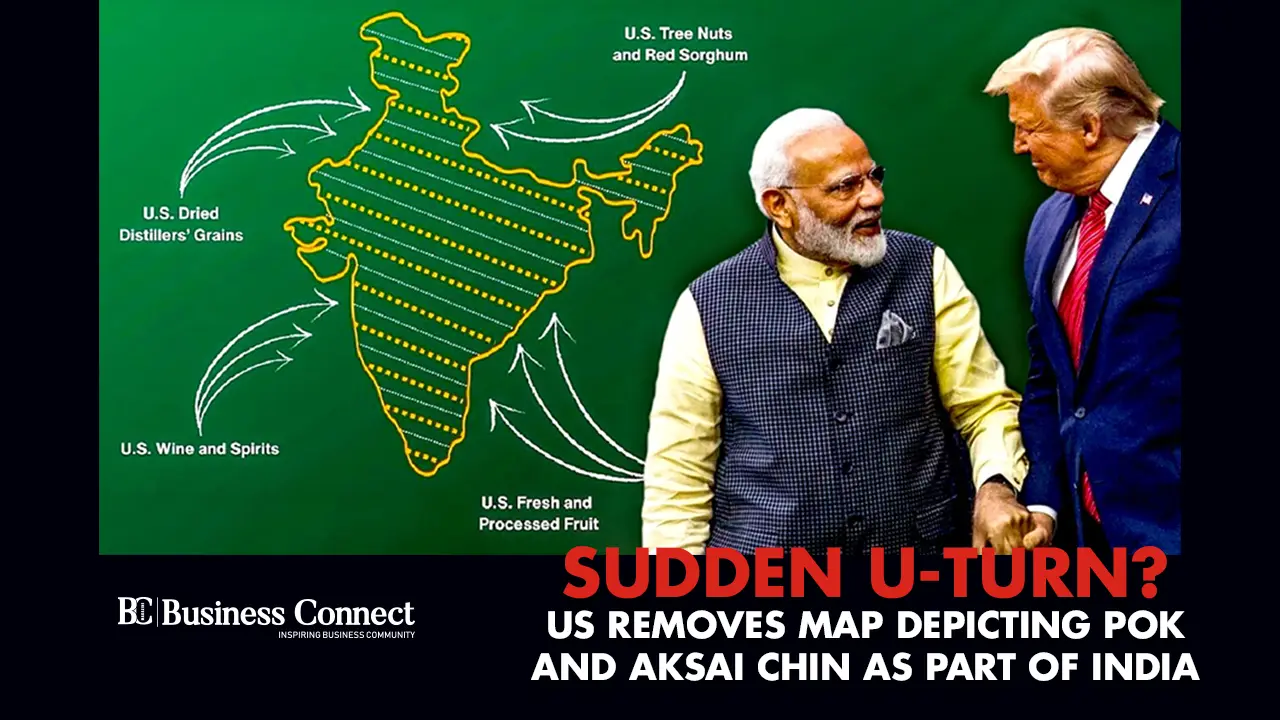
In a stunning turn of events, the office of the US Trade Representative (USTR) has now discreetly removed a map of India that depicted Aksai Chin and Pakistan-occupied Kashmir (PoK) as Indian territory, ending conjecture that Washington was hinting at a change in some of the most delicate territorial disputes in South Asia.
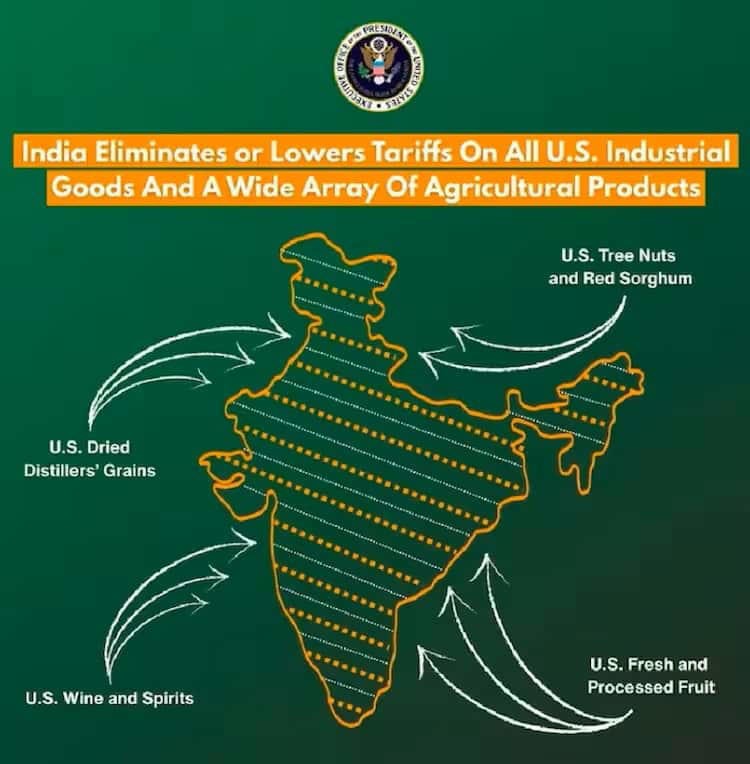
The map was removed in its entirety without providing an explanation after being published on the USTR’s official X account last week in conjunction with the introduction of an interim trade agreement framework between the US and India.
Its removal comes after days of discussion about whether the representation was a straightforward cartography error or a strategic, timely statement amid a larger reset in India-US relations following months of trade tension.
The map was a dramatic break from long-standing US practice when it first emerged. In order to accommodate Islamabad’s assertions, Pakistan-occupied Kashmir has historically been depicted on official US maps with a distinct delineation.
However, the whole Jammu and Kashmir region—including PoK—was depicted as being a part of India on the USTR map.
Not just this.
The map also depicted Aksai Chin, a region in northeastern Ladakh claimed by China, within India’s borders. To be mentioned here, Beijing has consistently asserted its claim over Aksai Chin, a claim that New Delhi has repeatedly rejected.
Previously, the US government’s maps have used dotted or dashed lines to indicate disputed territories such as PoK and Aksai Chin. The absence of any such qualifiers in the USTR-issued map was widely viewed as a notable departure from established cartographic conventions.
“The entire Union Territory of Jammu and Kashmir has been, is, and will always remain an integral and inalienable part of India,” the country has long asserted.” Citing historical claims and previous treaties, New Delhi has also insisted that Aksai Chin is an essential component of its territory.
Maps published by foreign countries and international organizations, especially the United States, have frequently drawn criticism from the Ministry of External Affairs for what it claims are false depictions of India’s boundaries, including those of Jammu and Kashmir and Arunachal Pradesh.
Even as the US and India took steps to reduce trade tensions, the incident took place.
Washington would reduce tariffs on Indian goods from 50% to 18% as part of an interim trade framework that the two parties agreed upon earlier this month. Interestingly, this is the lowest rate that the US has offered any Asian nation.
In order to increase bilateral commerce, the US has also removed the additional 25 percent punitive levy on Indian goods, according to a joint statement. Reciprocal duties are anticipated to be lowered to 18 percent.
Here is a structured, SEO-friendly FAQ section based on your content:
FAQ: USTR Removes India Map Showing Aksai Chin and PoK as Indian Territory
Q1. Why did the US Trade Representative (USTR) remove the India map?
The USTR removed the map from its official X account without giving any explanation. The map had depicted Aksai Chin and Pakistan-occupied Kashmir (PoK) as part of India, sparking widespread discussion and speculation.
Q2. What was controversial about the USTR map?
The map showed the entire Union Territory of Jammu and Kashmir, including PoK, as part of India. It also depicted Aksai Chin—claimed by China—within India’s borders. This was seen as a departure from the traditional US practice of marking disputed territories with dotted or dashed lines.
Q3. How does the US usually depict disputed regions like PoK and Aksai Chin?
Historically, official US maps have used distinct markings, such as dotted or dashed lines, to indicate disputed territories. This approach reflects the sensitive nature of these territorial claims involving India, Pakistan, and China.
Q4. What is India’s official position on Jammu and Kashmir and Aksai Chin?
India has consistently maintained that the entire Union Territory of Jammu and Kashmir, including PoK, is an integral and inalienable part of the country. New Delhi also asserts that Aksai Chin is part of its sovereign territory, rejecting China’s claims.
Q5. Why did the map create speculation about US policy?
Because the depiction differed from longstanding US cartographic conventions, some observers speculated that it might signal a shift in Washington’s stance on sensitive South Asian territorial disputes. However, the map’s removal has left the issue unclear.
Q6. Did the US government provide any clarification?
No official explanation has been issued by the USTR regarding the publication or removal of the map.
Q7. How does this incident relate to India-US trade relations?
The controversy occurred shortly after the US and India agreed on an interim trade framework aimed at easing trade tensions. Under the agreement, the US reduced tariffs on Indian goods from 50% to 18% and removed an additional 25% punitive levy.
Q8. What impact could this have on India-US diplomatic relations?
While the map incident generated discussion, both countries are currently working toward strengthening bilateral trade ties. The removal of the map suggests an effort to avoid diplomatic complications amid improving economic relations.
Q9. Has India previously objected to foreign maps depicting its boundaries differently?
Yes. India’s Ministry of External Affairs has frequently raised concerns over what it considers inaccurate depictions of its territorial boundaries by foreign governments and international organizations.