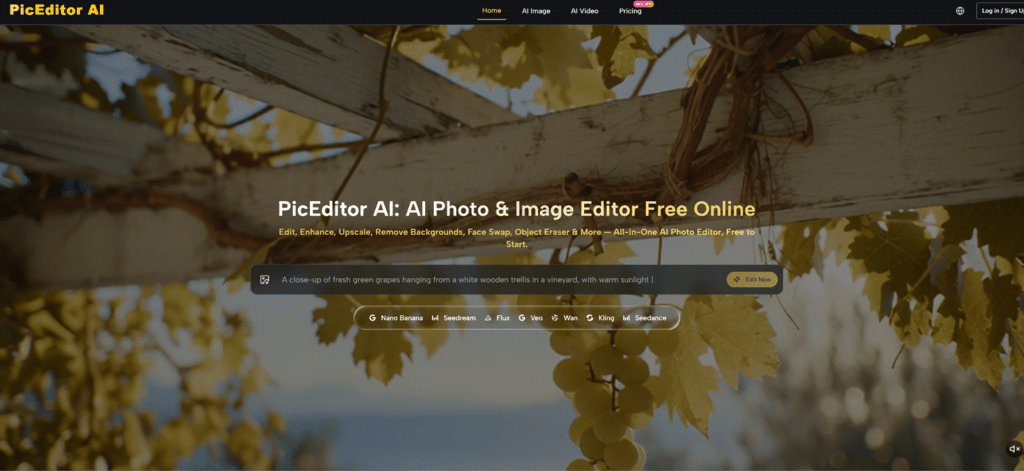
A good AI Photo Editor is no longer just a tool for fixing small image problems. It is becoming a faster, more natural way to create, improve, and transform visuals without forcing users into a complicated editing workflow. That shift matters because most people today do not want to learn a full design system just to clean up a photo, replace a background, sharpen details, or generate a new variation of an existing image.
What makes this category interesting is that it sits between classic photo editing and modern AI generation. Instead of asking users to manually handle every step, it lets them start with an image or an idea, describe the outcome they want, and let the system do much of the heavy work. That is why this kind of tool feels more practical for creators, marketers, online sellers, and casual users who care more about results than about mastering traditional editing software.
What an AI Photo Editor Actually Changes
Traditional photo tools were built around manual control. That approach still has value, especially for advanced users, but it also comes with friction. You need to understand layers, masks, selections, retouching logic, export settings, and a long list of editing actions that are not intuitive for everyone.
An AI-based editor changes that starting point. Instead of asking, “Which tool should I click first?” the user can begin with, “What do I want this image to become?” That sounds simple, but it changes the entire experience.
This is why the category is growing so quickly. It is not just about faster editing. It is about reducing the distance between visual intent and usable output.
How the Workflow Usually Works
The product logic behind an AI-first editor is much easier to understand than older software. In most cases, the workflow looks like this.
Start with an image or prompt
You can either upload a picture you already have or begin with a text description. That means the tool can serve both people who want to edit existing visuals and people who want to create something new.
Choose the kind of task
Instead of building everything manually, you usually move toward a result-driven task such as:
- enhancing image quality
- removing unwanted objects
- replacing or cleaning the background
- restyling the photo
- generating a fresh variation
- turning a still image into a more dynamic output
This is one of the biggest reasons people find the experience easier. The product is centered around goals, not technical menus.
Describe the result in natural language
This is where AI changes the editing experience most. The user can guide the process with instructions rather than performing every adjustment by hand. That makes the tool feel more accessible, especially for beginners.
Refine until it looks right
Like most AI tools, the first result is not always the final one. The real value often comes from quick iteration. You try a version, adjust the request, improve the output, and move forward much faster than you would with a traditional manual workflow.
Why This Feels More Useful Than Old-School Editing for Many Users
The strongest advantage of an AI-based editor is not that it replaces every professional tool. It is that it handles a huge number of everyday visual tasks with less effort.
- A small business owner may need cleaner product photos.
- A content creator may want one portrait turned into several styles.
- A marketer may need multiple visual variants for testing.
- A casual user may simply want better-looking images without learning complex software.
For these people, speed and clarity matter more than deep manual control. That is where an AI-first approach becomes genuinely useful.
What Makes This Kind of Platform Practical
Not every AI image product is equally helpful. Some are interesting to test once but difficult to fit into real work. The more useful platforms usually share a few characteristics.
They combine editing and generation
One important advantage is that the experience is not limited to simple retouching. A stronger platform usually supports both modifying existing images and generating new content when needed. That makes it more flexible for real-world use.
They reduce the learning curve
This may be the most important point for ordinary users. A platform becomes valuable when it removes the need to learn a complex technical process just to achieve an ordinary visual task.
They support fast asset reuse
A lot of modern creative work is not about making one perfect image from zero. It is about taking one useful asset and turning it into multiple usable versions. This matters for ecommerce, social media, advertising, product pages, and short-form content.
That is where an AI Photo Editor becomes more than a novelty. It becomes a production shortcut.
Where It Can Be Especially Helpful
There are several situations where this kind of tool makes immediate sense.
Ecommerce images
Product visuals often need clean backgrounds, stronger detail, better consistency, and faster variation testing. AI editing can shorten this process significantly.
Content creation
Creators often need to rework the same image for different styles, formats, or moods. That is much easier when the system understands intent-based edits.
Marketing visuals
Marketing teams do not always need artwork from scratch. Often they need versions, alternatives, refinements, and quick turnarounds. AI-driven editing is often more useful here than pure image generation alone.
Personal photo improvement
Not every use case is commercial. Sometimes people simply want better portraits, cleaner travel photos, sharper memories, or a more polished final look without the overhead of professional editing software.
What Users Should Stay Realistic About
Even though the category is improving quickly, it still helps to stay grounded.
The result still depends on the source material
A weak image, vague instruction, or poor composition can still lead to inconsistent output. AI helps, but it does not remove the need for judgment.
Precision work may still need manual review
If someone needs exact brand consistency, exact product fidelity, or ultra-controlled retouching, AI may still require testing and correction. It is powerful, but not magic.
Fast output is not always final output
The speed is real, but in many cases the best workflow is still generate, compare, refine, and choose. AI reduces labor, but it does not eliminate creative decision-making.
Who Will Get the Most Value From It
This kind of tool is especially useful for people who care about outcomes more than editing theory.
It is a strong fit for:
- creators making visual content quickly
- online sellers improving storefront images
- marketers building campaign assets
- small teams without full design support
- everyday users who want polished visuals without complexity
For advanced professionals who need detailed layer-by-layer control, traditional software may still remain part of the workflow. But for a large group of users, that is no longer the main point. The real appeal is that AI removes a large amount of repetitive editing friction.
Why the Category Keeps Growing
The phrase “photo editor” almost sounds too small now. These tools are no longer only correcting exposure or cleaning blemishes. They are increasingly able to expand scenes, replace elements, restyle compositions, improve clarity, and create entirely new variants from existing material.
That is why the category feels more important in 2026 than it did just a few years ago. It is not only about editing. It is about visual transformation with a much lower barrier to entry.
The Real Takeaway
A modern AI Image Editor is valuable because it makes image work feel less technical and more outcome-driven. It helps people move from idea to result faster, with less friction and less software overhead.
For many users, that matters more than having the deepest toolset. The real breakthrough is not that the software can do everything manually. It is that it can help ordinary people get strong visual results without being forced to think like professional editors first.