
-by Jaya Pathak
The rise of KreditBee is not merely another startup success story but it stands as a sharper reminder that when consumer credit it is built at large scale then it rewards patience. KreditBee did not win only because India needed loans. It won because it understood, earlier than many, that the next serious lending franchise would have to combine distribution, underwriting, collections, compliance, and capital discipline into one operating machine.
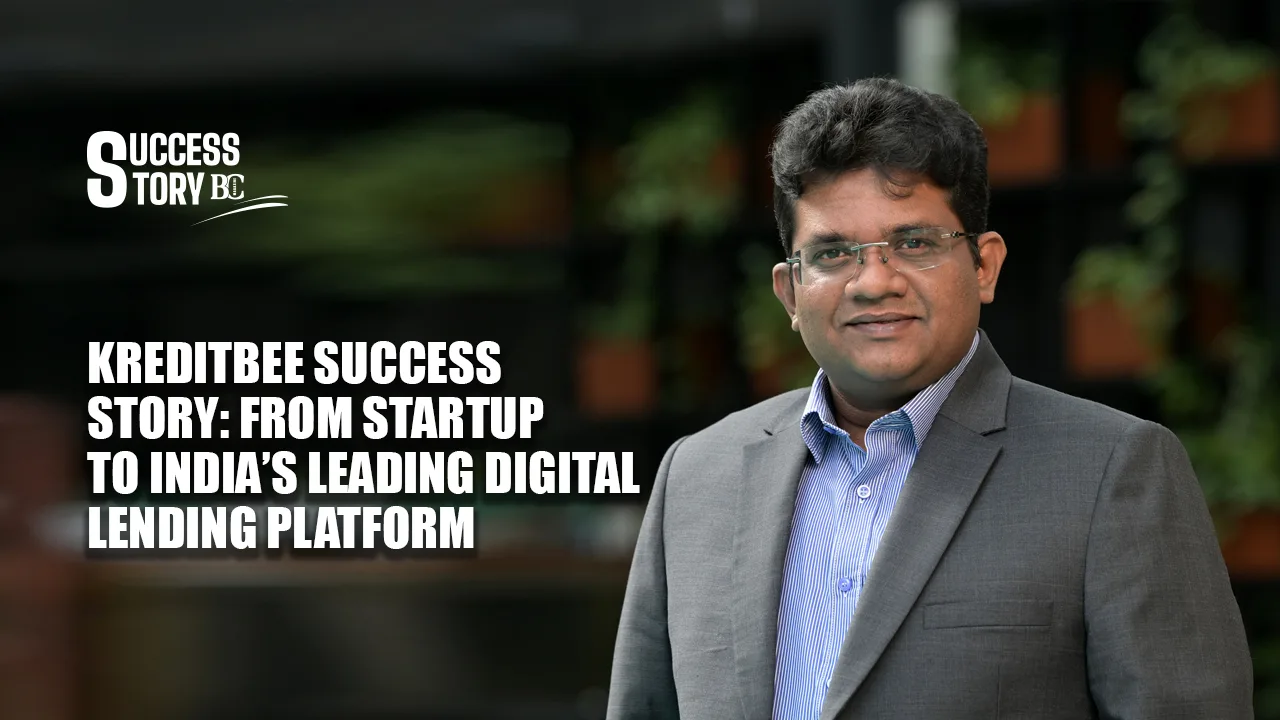
The company traces its origins to 2016, when Madhusudan Ekambaram, Karthikeyan Krishnaswamy and Vivek Veda began building for a segment that formal finance had long described with caution and served with hesitation. Young salaried Indians, first-time borrowers, gig workers, small business owners and consumers outside the most banked urban elite were becoming digitally visible, but not necessarily credit-visible in the conventional sense. Banks had the balance sheets, but not always the appetite or cost structure to serve small-ticket, high-frequency demand. Informal lenders had speed, but not transparency. KreditBee entered that gap with the instincts of a technology company and the constraints of a lender.
Its April 2026 fundraises of $280 million at a valuation of $1.5 billion, led by investors including Motilal Oswal Alternates, Hornbill Capital and MUFG-backed Dragon Funds, marks a milestone, but the number should not distract from the operating thesis beneath it. Valuation is the headline; credit behaviour is the story. In lending, unlike in many consumer internet businesses, growth is never self-validating. A loan disbursed today can look like revenue until the repayment cycle reveals whether the business was sound or merely optimistic. KreditBee’s ability to attract capital at this stage suggests investors are placing a premium not only on reach, but on resilience through cycles.
The platform’s early appeal was simple: quick, digital, small-ticket personal loans with minimal friction. That simplicity hid a difficult business problem. India’s aspirational borrowers are not a monolith. A young employee in Pune seeking a short-term personal loan, a self-employed trader in Coimbatore looking for working capital, and a household in Bengaluru considering two-wheeler finance may all appear in the same digital funnel, but they carry different repayment rhythms and risk signals. KreditBee’s task was to convert these signals into decisions without making the borrower feel trapped inside bureaucracy. At its best, that is the promise of digital lending. At its worst, it can become a factory of overextension.
The company has since expanded beyond instant personal loans into business loans, two-wheeler loans and loan against property, a move that signals both ambition and prudence. A pure unsecured consumer credit book can grow quickly, but it is also exposed when household cash flows tighten. Secured lending and MSME credit bring their own complexities, but they offer a broader portfolio architecture. The shift suggests KreditBee is preparing for the more mature phase of financial services, where a platform cannot rely indefinitely on one product curve. Scale must eventually be accompanied by diversification, and diversification must be accompanied by underwriting humility.
That humility matters in India’s digital lending sector because the industry has lived through its own excesses. The early promise of app-based lending was tarnished by players that confused access with aggression, convenience with opacity, and recovery with coercion. The Reserve Bank of India’s digital lending framework has since forced the sector to become more explicit about regulated entities, lending service providers, disclosures, grievance redressal, data usage and borrower protection. For platforms such as KreditBee, regulation is not merely a compliance cost; it is now a competitive filter. Those with serious governance have a chance to outlast those built only for acquisition velocity.
KreditBee operates through KrazyBee Services, an RBI-registered non-banking finance company, along with co-lending partnerships with financial institutions. This model is central to understanding its rise. Digital lenders need technology and customer access, but they also need regulated capital, risk participation and institutional confidence. Co-lending gives platforms a path to expand while working within the formal financial architecture. Yet it also raises the bar. Once multiple regulated entities, customer disclosures and risk-sharing structures are involved, sloppy processes become expensive. The borrower may see a clean app interface; behind it sits a dense choreography of compliance, funding, servicing and accountability.
The company’s reported scale is substantial: more than 60 million loans facilitated, assets under management estimated around ₹15,000 crore in FY26, and a customer base that runs deep into India’s broader digital economy. Its revenue and profitability numbers have also drawn attention, particularly at a time when investors have become less patient with loss-making financial technology narratives. In this climate, profits carry a certain moral force. They suggest that a company has moved beyond subsidised adoption and into a harder test: whether customers, capital providers and regulators can all be served without the model breaking under its own incentives.
Still, admiration should not become indulgence. Consumer lending businesses often look strongest before a credit cycle tests them. India’s retail credit expansion has been one of the most consequential financial stories of the past decade, helped by UPI, Aadhaar-enabled onboarding, richer data trails and rising formalisation. But the same forces that improve access can also accelerate indebtedness. When credit becomes instant, the discipline that once came from friction has to be replaced by better underwriting and stronger product ethics. The question for KreditBee is not whether it can approve loans quickly. It is whether it can decline enough of them wisely.
This is where the business becomes strategically interesting. The next frontier for Indian digital lenders will not be app downloads or disbursal speed alone. It will be the ability to price risk granularly without punishing thin-file borrowers, to design collections that are firm without being predatory, and to cross-sell without turning financial inclusion into dependency. KreditBee’s expansion into secured and MSME segments may help improve portfolio balance, but it will also expose the company to new operating demands. Property-backed loans require different appraisal muscles. MSME lending demands a more intimate reading of cash flows. Two-wheeler finance, though familiar, can be operationally unforgiving at scale.
There is also the question of public-market readiness. The reported pre-IPO nature of the latest round places KreditBee in a different light. Private investors can tolerate complex stories if growth and governance appear credible. Public markets are less sentimental. They will ask about asset quality, vintage-wise delinquencies, provisioning, cost of funds, customer acquisition costs, repeat borrowing behaviour and the durability of margins under regulation. They will want to know whether the company is a technology-enabled lender or a lending company with a polished technology layer. The distinction may sound academic, but markets eventually price it.
KreditBee’s success, therefore, should be read as part of a wider maturation in Indian fintech. The first phase was about building pipes: payments, onboarding, digital identity and distribution. The second was about monetisation, often through credit. The third, now underway, is about institutional seriousness. The winners will not be those that shout inclusion the loudest, but those that can prove that inclusion does not require weaker standards. For a country where millions remain underserved by conventional finance, that distinction is not cosmetic. It is the difference between empowerment and a new form of fragility.
The founders appear to have understood that lending is a business of memory. Every cycle leaves a mark on a balance sheet, on a regulator’s mind, and on borrower trust. KreditBee’s passage through the pandemic period, tighter digital lending rules and a more selective funding environment has given it a credibility that cannot be manufactured through marketing. Yet credibility is never permanently banked in this industry. It must be earned each quarter, each repayment cycle, each time a borrower is offered credit that is useful rather than merely available.
KreditBee has become one of India’s most visible digital lending platforms because it caught the demand curve early and built enough institutional muscle to ride it. Its next chapter will be more difficult, and perhaps more revealing. The company is no longer just proving that India wants fast credit; that is already evident. It must now prove that fast credit can be responsible, profitable, transparent and durable at national scale. In that test lies the real measure of its success, far beyond the comfort of a unicorn label