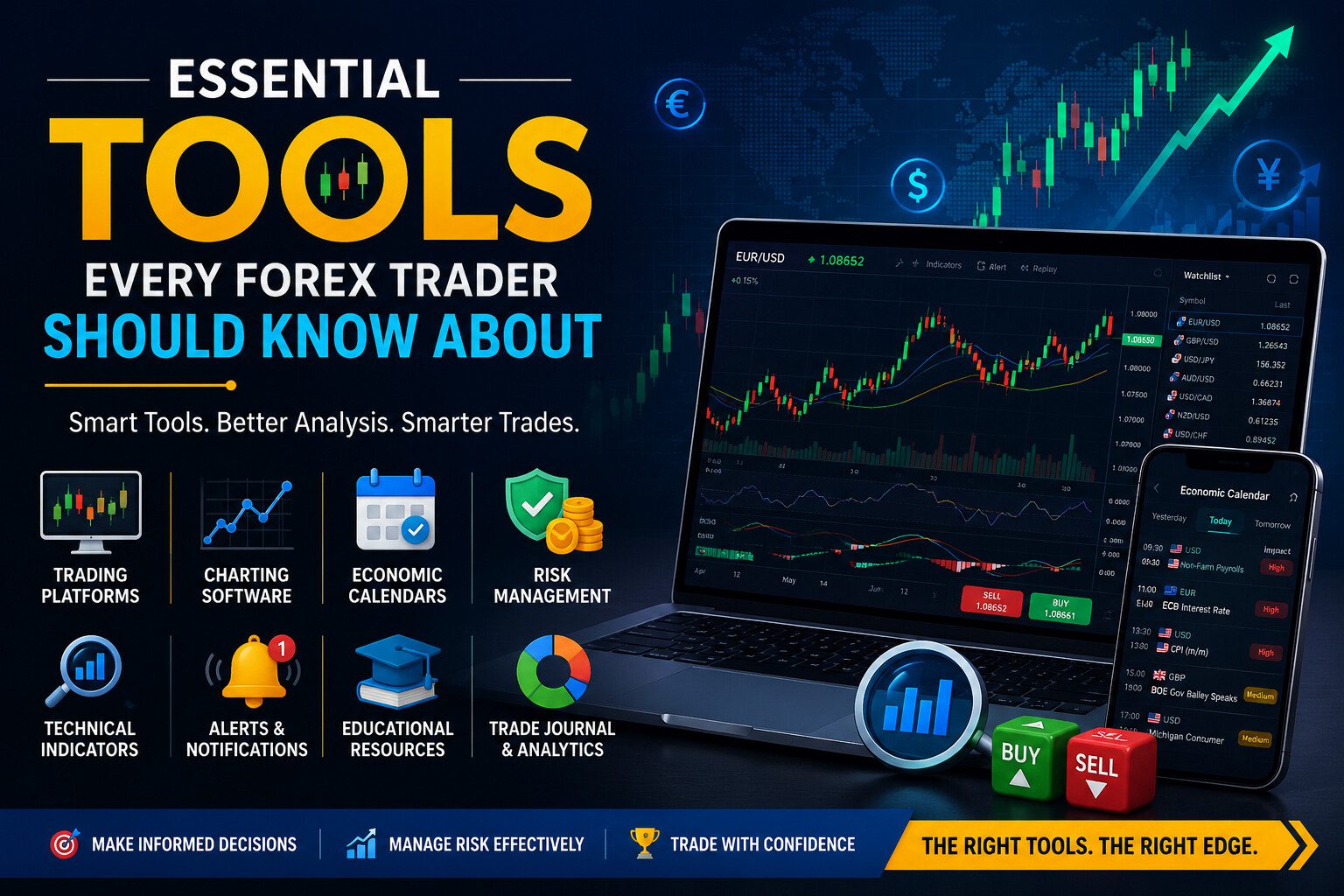
The foreign exchange market is the largest and most liquid financial market in the world, with daily trading volumes exceeding $7 trillion. Navigating it successfully requires more than just gut instinct or a basic understanding of currency pairs – it demands precision, discipline, and the right set of tools. Whether you are just starting out or have years of experience under your belt, leveraging the correct instruments can mean the difference between consistent gains and unnecessary losses.
In this article, we walk through the most valuable tools available to modern forex traders, from calculators that help manage risk to platforms that sharpen technical analysis.
- Pip Calculator
One of the most fundamental concepts in forex trading is the pip – the smallest standardized price move that a currency pair can make. Understanding pips is essential, but calculating their monetary value manually across different currency pairs and account denominations can be time-consuming and error-prone.
A pip calculator solves this problem instantly. By entering the currency pair, your account currency, trade size (in lots), and the current exchange rate, the tool automatically computes the exact monetary value of one pip movement. This matters enormously in practice: a pip on EUR/USD in a standard lot is not the same dollar amount as a pip on USD/JPY or GBP/AUD.
For example, if you are trading one standard lot of EUR/USD with a USD-denominated account, a single pip is typically worth $10. But if you are trading exotic pairs or operating with a non-USD base account, the value shifts — and getting that number wrong when setting your stop-loss or take-profit levels can quietly erode your capital.
Most reputable brokers offer an integrated pip calculator on their platforms or websites. Standalone versions are also freely available online. Using one before placing every trade should become second nature.
- Forex Position Size Calculator
Risk management is what separates professional traders from gamblers, and nothing embodies risk management more clearly than controlling how large your positions are. The forex position size calculator is arguably the most critical tool in any trader’s arsenal.
Here is the fundamental problem it solves: you know you want to risk no more than 1–2% of your account on any given trade, and you have identified your stop-loss level. But how many lots should you actually trade? The math involves your account balance, the percentage at risk, the stop-loss distance in pips, and the pip value — all variables that interact with each other in ways that are easy to miscalculate under pressure.
A forex position size calculator handles this automatically. Input your account size, the percentage of capital you are willing to risk, your stop-loss in pips, and the currency pair — and the tool tells you the exact lot size to use. This keeps your risk consistent and prevents the common mistake of over-leveraging on “high-confidence” trades, which is one of the fastest ways to blow an account.
Many experienced traders treat the position size calculator as non-negotiable — they simply do not enter a trade without running the numbers first.
- Economic Calendar
Forex markets are heavily influenced by macroeconomic data releases: interest rate decisions, GDP figures, inflation reports, employment numbers, and more. Trading without an economic calendar is like sailing without checking the weather — you might be fine, but you are taking unnecessary risks.
A good economic calendar shows upcoming events, their expected impact (low, medium, or high), the forecast figure, and the previous reading. When actual numbers deviate significantly from forecasts, volatility can spike dramatically within seconds. Knowing when these events are scheduled allows traders to either avoid the market around high-impact announcements or deliberately position for the move.
Free economic calendars are available through platforms like Forex Factory, Investing.com, and most major broker websites. Setting up alerts for key events relevant to the pairs you trade is a simple habit that pays consistent dividends.
- Trading Journal Software
Improvement in trading requires self-reflection, and a trading journal makes that possible. A dedicated journaling tool — whether a specialized platform like Edgewonk or TraderSync, or even a well-structured spreadsheet — lets you record every trade you take along with your reasoning, the market conditions, emotions, and outcome.
Over weeks and months, patterns emerge. You might discover that your win rate on trend-following setups during the London session is significantly higher than your win rate on reversal trades. Or that you consistently exit profitable trades too early on Fridays. These insights are invisible without data, and data comes from consistent journaling.
A trading journal also enforces discipline: when you know you have to record every trade, you tend to think twice before taking impulsive ones.
- Technical Analysis Platforms
No forex toolkit is complete without a capable charting platform. TradingView remains the most popular choice among retail traders for its vast library of built-in indicators, clean interface, and active community where traders share ideas and setups.
MetaTrader 4 and MetaTrader 5 are still widely used, particularly among traders who run automated strategies (Expert Advisors). For those who rely heavily on price action, platforms offering Renko charts, Heikin Ashi candles, or volume profile overlays provide additional context that standard candlestick charts alone cannot.
Key indicators worth understanding include the Relative Strength Index (RSI) for momentum, Bollinger Bands for volatility assessment, Moving Average Convergence Divergence (MACD) for trend and momentum signals, and Fibonacci retracement levels for identifying potential support and resistance zones.
- Currency Correlation Table
Trading multiple currency pairs simultaneously without understanding their correlations is a hidden source of unintended risk concentration. EUR/USD and GBP/USD, for instance, tend to move in the same direction much of the time. If you are long on both, you are effectively doubling your exposure to a single directional bet — even though it looks like two separate trades.
A currency correlation table displays the statistical relationship between pairs over a chosen time period, typically ranging from –1 (perfect inverse correlation) to +1 (perfect positive correlation). Using this data, traders can diversify more intentionally and avoid stacking correlated positions without realizing it.
Putting It All Together
The best forex traders are not necessarily those with the most sophisticated strategies — they are the ones who execute consistently, manage risk ruthlessly, and continuously learn from their results. The tools described above support exactly that approach.
Start with the basics: build the habit of using a pip calculator and a forex position size calculator on every single trade. Add an economic calendar to your routine. Then layer in a trading journal and a quality charting platform as your practice deepens.
Forex trading is a skill, and like all skills, the right tools used consistently are what allow that skill to compound over time.