-by Jaya Pathak
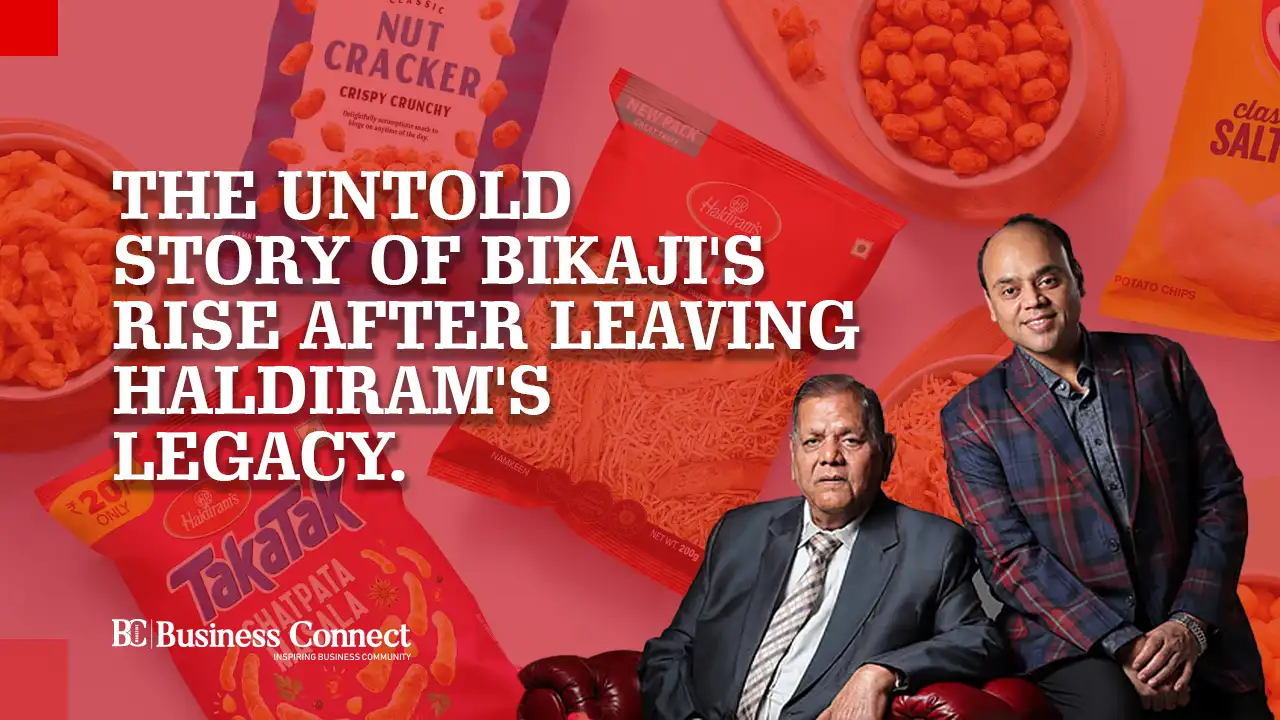
Shiv Ratan Agarwal’s passing in April 2026 did not merely close a founder’s chapter; it forced a sharper reading of one of India’s more understated consumer-business stories. Bikaji was never just another namkeen brand born from family enterprise. It was a calculated separation from the gravitational pull of Haldiram’s, and its achievement lay in proving that legacy could be borrowed for credibility, but not for long-term competitiveness.
The story begins, inevitably, in Bikaner, with Gangabishan Agarwal, better known as Haldiram, and the bhujia tradition that turned a regional snack into a commercial category. Shiv Ratan Agarwal, his grandson, inherited more than recipes. He had and instinct along with the understanding that Indians transfer snacks for emotional comfort first before thinking about find it is it but starting Shivdeep Products in 1986 and Bikaji brand in 1993 was not merely about another family branch seeking its own label. It was about ownership of a future that could not be built entirely inside another name.
The choice of “Bikaji” was clever in a way many branding consultants would envy. It invoked Rao Bika, founder of Bikaner, and added “ji” as a cultural mark of respect. In one stroke, the brand stepped away from direct dependence on the Haldiram name while anchoring itself in the same soil. It was less rebellion than repositioning. Bikaji did not reject inheritance; it localised it, formalised it and, over time, industrialised it.

That last word matters. The untold part of Bikaji’s rise is not romance. It is machinery, process discipline, distribution patience and the difficult art of making a product taste familiar at scale. Bikaneri Bhujiya It’s not a product that gives carelessness. The unique taste of this snack lies in its texture, the perfect balance of spices and reliable taste every time you will taste it. A consumer might not be able to explain the reason of it, but they can easily spot any difference in taste. For a brand built on regional authenticity, inconsistency is not an operational failure; it is reputational erosion.
Bikaji’s achievement was to convert a culinary inheritance into a manufacturing proposition. It expanded the grammar of Bikaneri snacks without stripping away their place identity. This is harder than it sounds. Many Indian food brands lose their soul when they chase national scale. Others remain trapped in local adoration, profitable but small. Bikaji found a middle path: sufficiently standardised for modern trade and exports, sufficiently rooted to avoid becoming anonymous.
The company’s Red Herring Prospectus positioned it as India’s third-largest ethnic snacks company and a major manufacturer of Bikaneri bhujia. Such labels are useful for bankers, but they do not fully explain the business. The deeper advantage was that Bikaji operated in a category where regional trust often beats abstract FMCG muscle. A multinational can buy shelf space, advertise heavily and build supply chains. It cannot easily manufacture memory.
Nostalgia alone cannot grow investor profits over the period of time period the rise of Bikaji coincided with a big change in the very manner Indians by food. The packaged ethnic snacks moved from railway journeys and corner stores into supermarkets, airports, fast delivery apps and Indian households. The informal became organised. Loose namkeen gave way to sealed packs. Hygiene, shelf life and brand recall became part of the purchase decision. Bikaji was ready for that transition because it had spent years doing the unglamorous work before the market became fashionable.
This is also where the Haldiram comparison becomes unavoidable, though not always useful. Haldiram’s remains the larger cultural force, with a breadth and familiarity that few Indian food brands can match. For Bikaji, the challenge was not to out-Haldiram Haldiram’s. It was to become distinct enough that consumers did not see it as a derivative. The company leaned into Bikaner rather than pretending to be an all-purpose national snack giant from day one. That restraint gave it credibility.
The November 2022 IPO changed the tone of the story. A founder-led food company entered the public market at a time when investors were eager for consumer names with Indian roots and long runways. The listing brought visibility, capital-market discipline and scrutiny. It also introduced a different kind of pressure. Public markets are rarely patient with the messiness of food businesses: commodity inflation, packaging costs, trade schemes, channel mix, seasonality and the occasional mismatch between brand love and quarterly margins.
The numbers show both strength and tension. In the financial year 2025, the revenue from operations hit around rupees 2,622 crore which shows a growing rate of 12.6% from the last year with sales volume up to 10.3%. For a company in a competitive snacks market, that is not a trivial performance. In Q3 FY26, revenue from operations stood at Rs 7,900 million, with EBITDA of Rs 984 million and PAT of Rs 622 million. These figures confirm that Bikaji is no longer a sentimental founder story. It is a scaled listed enterprise. But they also raise the harder question: can the company defend premium regional authenticity while fighting on speed, assortment and price?
That fight is intensifying. Haldiram’s is not standing still. Balaji has shown how regional aggression can unsettle national players. ITC has strong balance sheet and distribution reach to compete over a long time. Modern retailing demands high stock availability and promotional discipline, fast delivery apps which favor brands quick with small numbers, young consumers which can switch easily between streets, convenience and health claims but little loyalty to old hierarchies. In such a market, Bikaji’s heritage is an asset, but not a moat by itself.
There is also the matter of succession. Founder-led companies often carry an invisible operating system: decisions made through instinct, relationships built over decades, product calls that never appear in board minutes. Shiv Ratan Agarwal’s absence will test whether Bikaji has converted that instinct into institution. Deepak Agarwal and the professional management team now inherit not only a brand but a burden: to keep the company entrepreneurial without letting it remain overly dependent on founder memory.
The temptation, after a listing, is to look more corporate than the business needs to be. Food companies can damage themselves by jumping into every related product type, every premium format and every passing sales trend. This company is widening sales networks, improving execution, expanding selectively and protecting the taste trust that has built its value in the first place. The Indian consumer is forgiving of price increases when taste holds. They are far less forgiving when scale makes a beloved product feel ordinary.
Bikaji’s rise after leaving the Haldiram legacy is therefore not a clean story of rupture. It is a more Indian story: of family inheritance, quiet separation, regional pride, factory discipline and capital-market arrival. Its importance lies in showing that Indian consumer brands need not erase their origins to become large. The next test will be sterner. A founder can build belief; an institution must renew it every quarter, every shelf, every packet. Bikaji’s shadow is no longer Haldiram’s alone. It is the shadow cast by its own success.