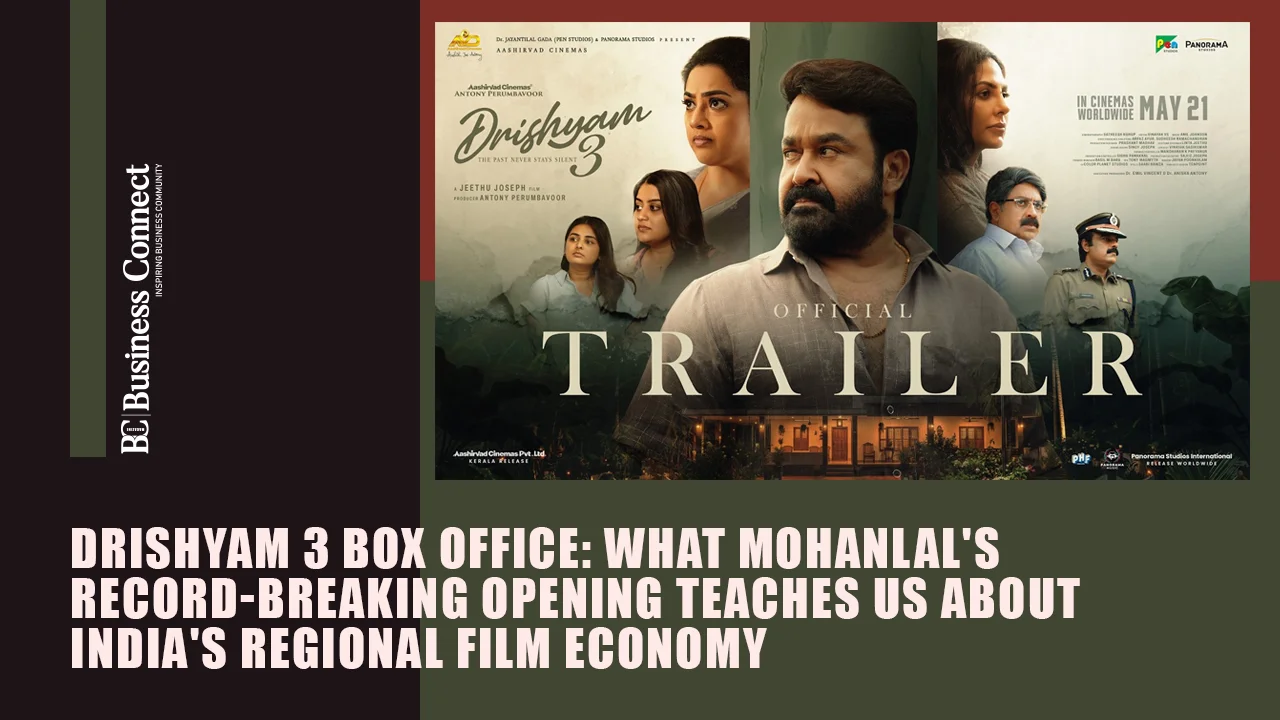
Today is Mohanlal’s 66th birthday. And the gift he has given himself — and the Malayalam film industry — is nothing short of extraordinary.
Drishyam 3, the third installment of Jeethu Joseph’s iconic crime thriller franchise, released in theatres across India and worldwide on May 21, 2026. Before a single show had even begun, the film had already crossed Rs 28.9 crore in worldwide advance bookings — making it the second biggest opening in Malayalam cinema history.
But here is what the entertainment headlines are missing: this is one of the most fascinating business stories of 2026.
The Numbers First — Because They Are Jaw-Dropping
Before we get into the business lessons, let us understand the scale of what Drishyam 3 has achieved at the box office even before its release:
- Worldwide advance bookings: Rs 28.9 crore+ as of May 20 night
- India domestic pre-sales: Rs 10.5 crore gross
- Kerala alone: Rs 6.75 crore from advance bookings — before spot bookings
- Opening day projection: Rs 40 crore+ worldwide gross
- Historical context: Second biggest opening ever for a Malayalam film — behind only Mohanlal’s own Empuraan (L2), which opened at nearly Rs 70 crore worldwide
These numbers are not just impressive — they are a signal. A signal about what Malayalam cinema has become, and what it means for India’s broader entertainment economy.
How Did a Regional Language Film Build a Rs 40 Crore Opening?
This is the question every business person should be asking. Drishyam 3 is not a Hindi film. It is not a pan-India masala blockbuster with a Rs 300 crore budget and a marketing blitz. It is a Malayalam language thriller — the third chapter of a story that began in 2013.
So how did it get here?
1. The Franchise Model — India’s Most Underrated Business Strategy
Drishyam 2013. Drishyam 2 in 2021. Drishyam 3 in 2026. Thirteen years. Three films. One family. One character — Georgekutty.
This is textbook franchise economics. Every installment built on the emotional equity of the previous one. Every viewer who loved Drishyam in 2013 became a guaranteed ticket buyer in 2021. Every person who watched Drishyam 2 is in a theatre today.
The business lesson is simple and profound: loyalty compounds. Just like a good investment, audience trust built over years delivers returns that no amount of marketing spend can replicate overnight.
For Indian entrepreneurs — whether you are building a product, a service brand, or a content platform — the Drishyam franchise is a masterclass in playing the long game.
2. The Gulf Market — A Revenue Stream Most People Ignore
Here is something remarkable about Drishyam 3’s advance bookings: a significant portion came from overseas — the Gulf, North America, the United Kingdom, and Australia.
Why? Because Malayalam cinema has one of the most financially powerful diaspora audiences in the world. The Malayali community in the Gulf countries — UAE, Saudi Arabia, Kuwait, Bahrain — is massive, economically active, and deeply connected to their cultural roots. When a film like Drishyam 3 releases, it is not just a movie for them. It is a cultural event.
In fact, the film’s original release date was postponed from April 2026 specifically because of the ongoing conflict in the Middle East — reflecting just how critical the Gulf market is to Malayalam cinema’s business model.
This is a lesson Indian businesses often overlook: your diaspora is a premium customer segment. They have higher disposable income, strong cultural identity, and fierce brand loyalty. Whether you are a filmmaker, a food brand, a clothing company, or a fintech startup — the Indian diaspora market deserves a dedicated strategy.
3. The Birthday Release Strategy — Brilliant Marketing or Pure Luck?
Drishyam 3 released on May 21 — Mohanlal’s 66th birthday. Coincidence? Absolutely not.
This is one of the oldest and most effective marketing strategies in Indian cinema — releasing a star’s film on their birthday turns a commercial event into a celebration. Fans do not just buy tickets. They organize fan events, social media campaigns, theatre decorations, and group bookings. The film’s release becomes a community moment.
For brand builders and marketers, the lesson is this: connect your product launch to an emotional event. A product that launches on a meaningful date — a founder’s anniversary, a cultural festival, a community milestone — generates organic energy that paid advertising simply cannot buy.
The Bigger Story — How Malayalam Cinema Became India’s Most Profitable Film Industry
Ten years ago, Malayalam cinema was considered a small regional industry. Respected for its craft, yes — but not a major economic force. That narrative has completely changed.
Today, Malayalam films like Manjummel Boys, Premalu, Empuraan, and now Drishyam 3 are routinely crossing Rs 100-200 crore worldwide — on budgets that Bollywood would consider modest. The return on investment (ROI) in Malayalam cinema is, arguably, the best in Indian film today.
Here is why — and what it teaches us about smart business:
Controlled budgets with high creative ambition. Malayalam filmmakers have mastered the art of doing more with less. Story, writing, and performance are prioritized over spectacle. The result is films that resonate deeply — and cost a fraction of comparable Hindi productions.
Quality as the primary marketing tool. Word of mouth has driven every major Malayalam success of the past decade. When Manjummel Boys released, there was no pan-India marketing campaign. The film spread because it was genuinely excellent. Drishyam built its franchise the same way — one great film at a time.
A deeply engaged, quality-conscious audience. Malayalam cinema’s audience is famously discerning. They reward good cinema and reject average content quickly. This has forced filmmakers to raise their standards continuously — creating a positive cycle of quality improvement.
The business parallel? Build for your most demanding customer. If your product satisfies the most discerning segment of your market, the rest will follow.
What The Drishyam Franchise Teaches Indian Entrepreneurs
We cover businesses and entrepreneurs at Business Connect India every day. And rarely does a piece of popular culture carry as many business lessons as the Drishyam franchise.
Here is our summary for every founder reading this:
Build something people want to return to. Drishyam works because Georgekutty’s story feels unfinished, real, and emotionally true. Your product or service should create the same feeling — customers who cannot imagine life without the next version.
Loyalty is your most valuable asset. Drishyam’s opening day collection is not driven by marketing. It is driven by thirteen years of trust. How long are you investing in your customer relationships?
Regional is not small. Malayalam cinema was underestimated for decades. Today it is setting the agenda for all of Indian cinema. If you are building a business for a regional market or a specific community — do not let anyone tell you that your market is too small. Build depth first. Scale follows.
Timing is strategy. Releasing on the lead actor’s birthday, postponing for the Gulf market — every decision in Drishyam 3’s release was deliberate. In business, when you launch matters as much as what you launch.
Our Take — Business Connect India
The Rs 40 crore opening of Drishyam 3 is not just an entertainment story. It is proof that in India, the businesses that win are the ones that build trust over time, serve their audience with genuine quality, and understand that loyalty — once earned — is the most powerful competitive advantage in any market.
Georgekutty protected his family across three films and thirteen years. The audience never left him.
That is the kind of customer relationship every Indian entrepreneur should aspire to build.
What do you think Drishyam 3’s success means for Indian regional cinema and entertainment businesses? Share your thoughts in the comments.
— Business Connect India Team
Editor’s Note: At Business Connect India, we believe every blockbuster is also a business story. Drishyam 3 is not just Mohanlal’s triumph — it is a masterclass in franchise economics, audience loyalty, and the quiet rise of Malayalam cinema as one of India’s most powerful entertainment industries. Here is what every entrepreneur and business leader should take away from today’s numbers.