
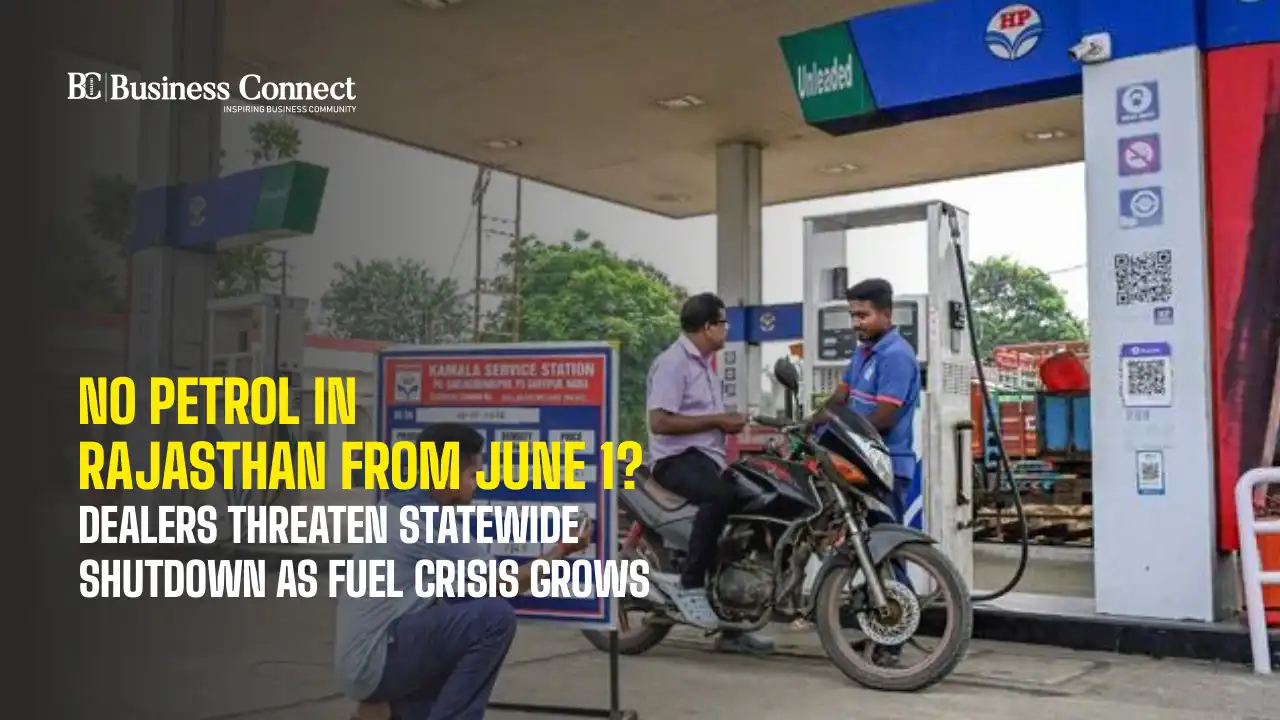
The Rajasthan Petroleum Dealers Association has issued a final ultimatum — if the state government fails to address supply shortages, punitive raids, high VAT, and unpaid dues before June 1, over 7,000 petrol pumps will go on an indefinite strike, leaving millions of commuters, farmers, and truck operators stranded across India’s largest state.
Rajasthan is staring at a fuel crisis that could leave its petrol pumps dark from June 1 — the date on which the Rajasthan Petroleum Dealers Association (RPDA) has threatened to launch an indefinite statewide shutdown. The association, representing over 7,000 privately operated petrol pumps across the desert state, has sent an urgent letter to Chief Minister Bhajanlal Sharma, warning that decades of unresolved grievances — supply rationing by oil companies, punitive vigilance raids, sky-high VAT, and unpaid government dues — have pushed dealers to a breaking point. The government has so far not convened a single meeting at the principal secretary level despite repeated letters and emails.
Association president Rajendra Singh Bhati pulled no punches in his assessment. “The biggest issue dealers are facing is disruption in petrol and diesel supply. Several petrol pumps in the state are running dry on a daily basis,” he said, adding that oil marketing companies including Indian Oil Corporation Ltd have been issuing supply limits through WhatsApp messages and verbal instructions — legally questionable directives that carry the force of market power but none of the transparency of formal policy.
| Demand | Details |
|---|---|
| Demand 1 | End supply rationing immediately — IOCL has capped diesel sales at ₹50,000 and petrol at ₹5,000 per consumer. Pumps selling beyond limits face suspension and notices. Dealers say this causes crowding, confusion, and daily shortfalls. |
| Demand 2 | Reduce VAT by at least 5% — Rajasthan has among the highest fuel VAT rates in the country. Bhati demands rates be brought in line with Punjab. High taxes are pushing consumers to buy fuel from neighboring states. |
| Demand 3 | Stop punitive vigilance raids — On March 14, 2026, a Jodhpur petrol pump was raided and fined for “short delivery” just three days after being certified clean by the legal metrology officer. Dealers call it harassment rather than regulation. |
| Demand 4 | Clear pending government dues — Fuel supplied during PM visits and government rallies on credit remains unpaid, with dues running into lakhs per dealer. Associations are demanding immediate payment clearance. |
| Demand 5 | Restore diesel supply to farmers — Restrictions on diesel supply in drums for agricultural consumers ahead of the kharif sowing season may severely impact farming operations. Dealers warn of a rural fuel crisis if restrictions continue before monsoon. |
| Demand 6 | Stop forcing branded fuel sales — Oil marketing companies are allegedly pressuring dealers to sell premium-branded petrol and diesel despite weak demand and higher prices. Dealers say this hurts |
The supply rationing at the centre of the dispute is particularly alarming in its mechanics. Rather than issuing formal written orders — which would be subject to legal challenge — oil companies have been communicating limits through WhatsApp messages and verbal phone instructions, dealers allege. Pumps that breach these informal caps face suspension of supply and formal notices. The result is a two-tier system: some pumps running dry, others with excess, and no transparent framework for consumers to understand why they are being turned away or told to come back tomorrow.
“Rajasthan has among the highest fuel prices in the country due to elevated VAT rates. Tax rates should be brought at par with Punjab — a reduction of at least five per cent.” — Rajendra Singh Bhati, RPDA
What a June 1 shutdown would mean
How the crisis escalated
The timing of the threatened shutdown is especially painful. June 1 falls just as India’s monsoon season is building toward its northwest advance, and Rajasthan’s farmers are preparing fields for kharif crops. Diesel supply for irrigation pumps and tractors is at peak demand. A fuel shutdown at this exact moment would not just be an inconvenience to city commuters — it could permanently damage one season’s agricultural output for a state where farming supports over 60 per cent of the rural population.
The broader pattern here is not new. Rajasthan’s petroleum dealers have launched strikes and symbolic shutdowns multiple times over the past decade — in 2021, 2023, and 2024 — each time over the same core grievance: VAT rates that are among the highest in the country, oil company pressure tactics, and a state government that listens only when fuel runs out. Each crisis was eventually resolved through last-minute committee formations and assurances. The question in May 2026 is whether the government will wait until June 1 to act, or whether the scale and timing of this threat will finally force a pre-emptive resolution.