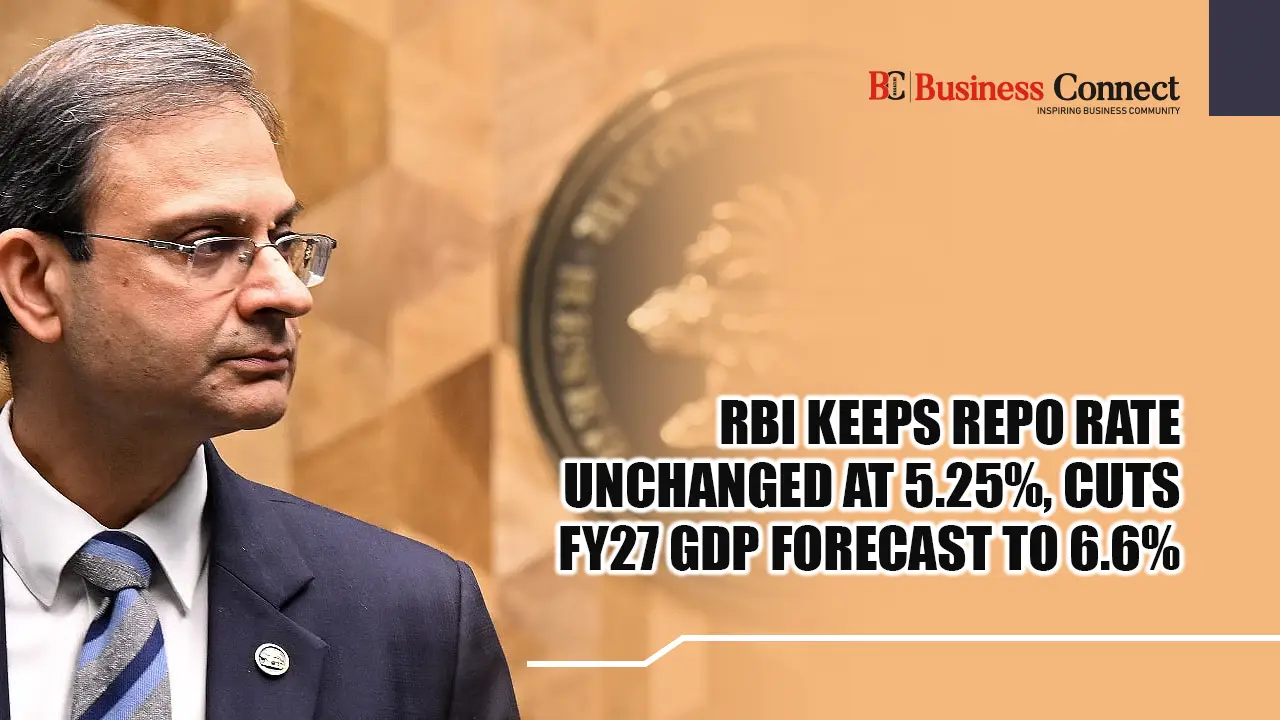
The Monetary Policy Committee holds rates steady for the third consecutive meeting, revises growth projections downward, and raises the inflation outlook to 5.1% — citing West Asia tensions, global supply chain disruptions, and $13.7 billion in foreign equity outflows.
India’s central bank held its benchmark lending rate steady on Friday for the third consecutive meeting, signalling a cautious “wait and watch” approach as it navigates a deteriorating global outlook shaped by conflict in West Asia, elevated crude oil prices, and a surge in foreign capital outflows.
The Reserve Bank of India’s Monetary Policy Committee unanimously voted to keep the policy repo rate unchanged at 5.25%, while simultaneously downgrading its economic growth projection for the current fiscal year and raising its inflation forecast — a combination that underscores the increasingly delicate balancing act the central bank now faces.
RBI Governor Sanjay Malhotra announced the decision in New Delhi following the MPC’s second bi-monthly meeting of FY27, held over three days between June 3 and June 5. The rate has now been held at 5.25% since December 2025, when the RBI made its last adjustment — a 25-basis-point cut from 5.5%.
The decision to pause reflects a shift in the MPC’s calculus: where earlier meetings dealt with the aftershocks of disinflation and sluggish growth, the June 2026 session confronted fresh inflationary pressures that made further easing premature.
“There are considerable risks to the baseline assumption of growth and inflation. Food outlook remains uncertain on account of subnormal southwest monsoon forecasts and El Niño conditions.”
Growth Forecast: A Meaningful Downgrade
The headline revision in Friday’s statement was the downgrade to India’s real GDP growth forecast for FY27 — from 6.9% to 6.6%. While India’s economic trajectory still places it among the fastest-growing major economies in the world, the revision is notable both in its direction and its context: the cut comes even as Goldman Sachs has independently projected India’s growth at a more conservative 5.9%, a gap that suggests the RBI’s revised number may still carry optimistic assumptions.
Governor Malhotra attributed the downward revision to several converging pressures: elevated energy prices stemming from the ongoing West Asia crisis, supply chain disruptions in global commodity and shipping markets, and the spillover effects of geopolitical uncertainty on trade and investment flows. He said high-frequency data suggested “incipient signs of moderation” in some sectors, without specifying which, while noting that the broader framework of economic resilience remained intact.
The RBI’s revised quarterly breakdown for FY2026-27 real GDP growth:
in table”Quarter Previous Projection June 2026 Projection Change
Q1 FY27 6.8% Revised downward —
Q2 FY27 6.7% Revised downward —
Full Year FY27 6.9% 6.6% −0.3 pp
Goldman Sachs (independent) 5.9% — significantly more pessimistic —
For context, the FY27 growth forecast has now been trimmed three times over successive MPC meetings, a pattern that reflects the cumulative drag from the external environment rather than a sudden domestic deterioration. Services exports remain a relative bright spot, with the RBI noting continued resilience in software and professional services revenues.
Inflation: The Bigger Worry
The more consequential shift in Friday’s statement, for markets and for monetary policy direction, was the sharp upward revision to the CPI inflation forecast. The RBI now projects consumer price inflation for the full year FY27 at 5.1% — significantly above its April projection of 4.6% and approaching the upper bound of the central bank’s 2–6% tolerance band. The quarterly path of projected inflation is particularly striking: CPI is expected to rise from 4.1% in Q1 to a troubling 5.9% in Q3 before moderating to 5.4% in Q4.
| Quarter | CPI Inflation Projection (FY27) | Signal |
|---|---|---|
| Q1 FY27 (Apr–Jun 2026) | 4.1% | Within comfort zone |
| Q2 FY27 (Jul–Sep 2026) | 5.1% | Rising pressure |
| Q3 FY27 (Oct–Dec 2026) | 5.9% | Near upper tolerance band |
| Q4 FY27 (Jan–Mar 2027) | 5.4% | Elevated |
| Full Year FY27 | 5.1% | Revised up from 4.6% |
The inflation forecast revision is driven primarily by two factors. First, the ongoing West Asia conflict has kept crude oil prices elevated, directly impacting India’s import bill and domestic fuel costs. Second, the RBI flagged significant uncertainty around the agricultural outlook: monsoon forecasts suggest below-normal rainfall this season, and there are emerging El Niño signals that could intensify that risk. Food inflation — historically the most volatile component of India’s CPI basket — remains the swing factor in the central bank’s projections.
Core inflation, which strips out food and fuel, remained relatively stable at 3.7%, offering a degree of reassurance that underlying demand-driven price pressures have not yet escalated. But the trajectory of headline CPI — potentially breaching 5.9% by October — significantly narrows the RBI’s room to ease rates further in the near term without risking a breach of its upper mandate.
West Asia Conflict: Sustained conflict continues to elevate global crude oil prices, directly feeding into India’s fuel inflation and widening the current account deficit.
Subnormal Monsoon + El Niño: Below-average rainfall projections for the 2026 southwest monsoon season raise the prospect of a kharif output shortfall, which could sharply push up food inflation by Q3 FY27.
Global Supply Chain Disruptions: Shipping lane disruptions and geopolitical fragmentation are raising input costs across manufacturing and adding to imported inflation pressures.
Goldman Sachs Growth Gap: The divergence between RBI’s 6.6% forecast and Goldman’s 5.9% projection suggests downside risks to growth may be materially underappreciated in the central bank’s baseline.
Foreign Capital Flight: $13.7 Billion in FPI Outflows
One of the most striking disclosures in Friday’s policy statement was the RBI’s confirmation that net foreign portfolio investment flows into India have turned sharply negative so far in FY27.
Governor Malhotra disclosed that FPI outflows totalled $13.7 billion up to June 2, 2026 — almost entirely concentrated in the equity segment — as global investors retreated from emerging market positions in response to geopolitical risk and a rising dollar. The rupee has been under sustained depreciation pressure as a result.
To counteract this trend, the RBI announced five specific measures designed to attract foreign capital back into Indian markets. Among them, the central bank said it would expand new issuances of long-dated government securities — specifically 15-year, 30-year, and 40-year G-Secs — under the Fully Accessible Route (FAR), which allows foreign investors to buy Indian bonds without sectoral limit caps.
The move is designed to tap the growing global pool of liability-matching capital from pension funds and insurance companies seeking long-duration assets denominated in emerging-market currencies.
Governor Malhotra struck a notably more constructive note on foreign direct investment, pointing to buoyant FDI receipts in FY26 as evidence that long-term strategic investors continue to view India’s growth story favourably. The divergence between hot-money portfolio outflows and stable FDI inflows, he suggested, reflects transient risk-off sentiment rather than a structural reassessment of India’s investment case.
Policy Rates at a Glance
| Policy Instrument | Previous Rate / Stance | June 2026 Decision | Status |
|---|---|---|---|
| Repo Rate | 5.25% | 5.25% | Unchanged |
| Standing Deposit Facility (SDF) Rate | 5.00% | 5.00% | Unchanged |
| Marginal Standing Facility (MSF) Rate | 5.50% | 5.50% | Unchanged |
| Bank Rate | 5.50% | 5.50% | Unchanged |
| Monetary Policy Committee (MPC) Stance | Neutral | Neutral | Retained |
The Rate Cut Cycle: Paused, Not Reversed
The June decision marks the third consecutive pause in the RBI’s rate cycle, a sequence that has effectively frozen monetary policy since December 2025. That December cut — 25 basis points from 5.5% to 5.25% — was itself the tail end of an easing cycle that began with a larger 50-basis-point cut in June 2025, as the central bank responded to collapsing inflation and sluggish growth. In all, the RBI cut rates by 100 basis points between June and December 2025.
The question now facing markets is whether this pause transitions back into easing, or whether the inflation path outlined on Friday forecloses that possibility for the remainder of FY27. Governor Malhotra’s framing was deliberately balanced: the neutral stance, he emphasised, does not pre-commit the MPC to any direction.
The MPC’s mandate requires it to keep CPI inflation at 4%, with a tolerance band of ±2%. With inflation now forecast to rise to 5.9% by Q3 — within the band but approaching its ceiling — the bar for resuming rate cuts has risen materially. Major advanced economy central banks, Malhotra noted, are themselves likely to pivot towards tightening, a shift that would further constrain the RBI’s degrees of freedom.
“Major advanced economy central banks are likely to pivot towards monetary policy tightening — a development that adds to the complexity of India’s own policy calculus.”
Market Implications
Bond markets, which had priced in a small probability of a rate cut at this meeting, reacted with a modest selloff on Friday morning before stabilising. The yield on the 10-year benchmark G-Sec ticked up marginally on the inflation projection upgrade.
Equity markets were broadly rangebound on the news, with rate-sensitive financials and housing stocks underperforming. The rupee showed limited movement against the dollar, reflecting both the status quo rate decision and the continued FPI outflow dynamic.
Analysts at several domestic brokerages said the June statement reduced the likelihood of a rate cut at the August MPC meeting, pointing to the Q3 inflation trajectory as a decisive factor. The next MPC meeting is scheduled for August 2026, by which point the central bank will have fresh data on monsoon progress, kharif sowing, and the trajectory of crude oil prices — three variables that together will determine whether the inflation risk flagged on Friday materialises or dissipates.