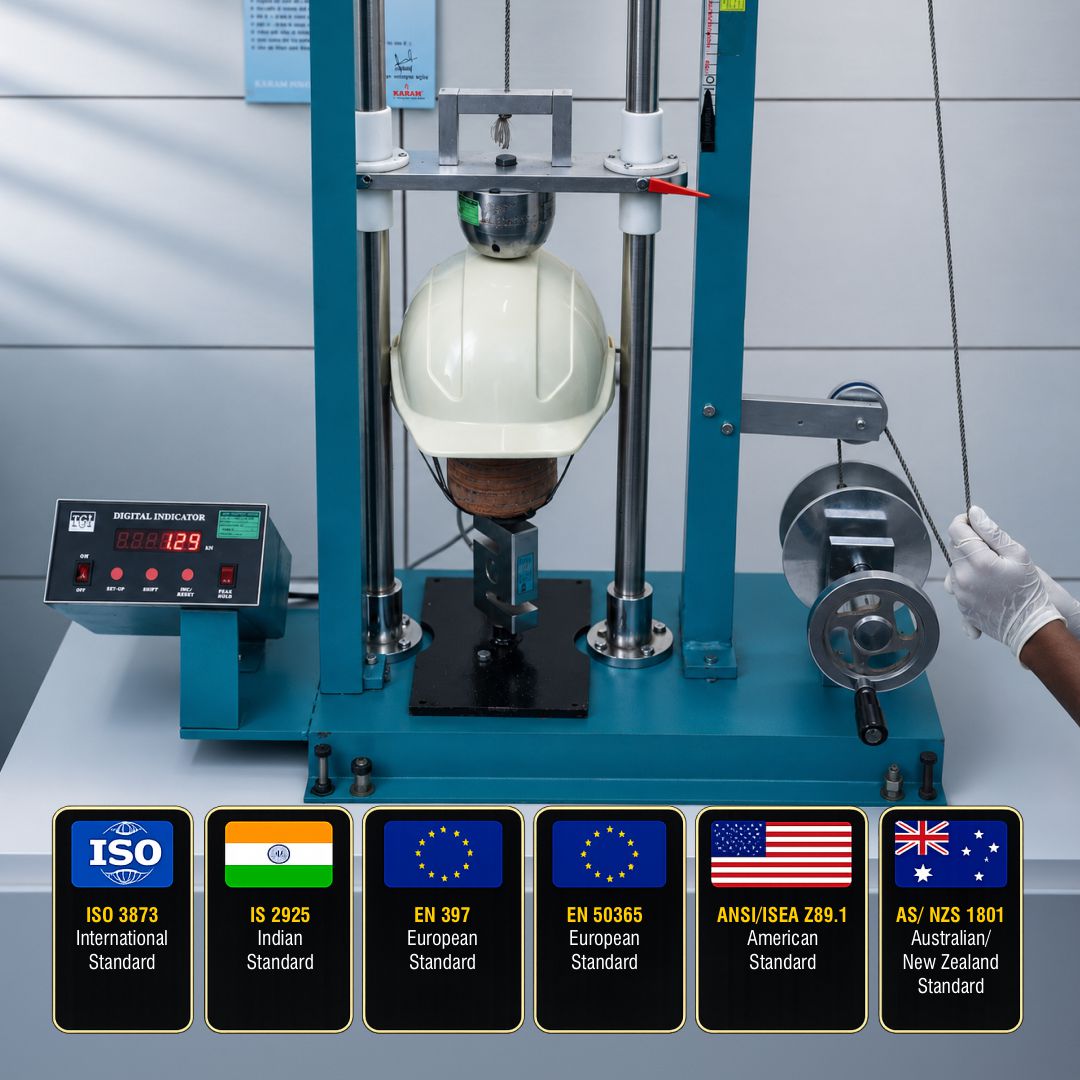
Safety helmets serve as one of the primary lines of protection against serious head injuries in industrial workplaces. However, due to inconsistent compliance practices, negligence, and limited awareness of safety helmet standards and other safety products, workers and businesses may end up purchasing head protection gear that may not be capable of withstanding industrial hazards.
Head injuries in industry are generally caused by falling objects, slipping, tripping, or falls from height. Extreme weather conditions may also increase the risk of heat stress and environmental exposure at workplaces. Safety helmets protect workers from impact-related industrial hazards and certain environmental exposure risks.
Not only this, but head protection also indirectly qualifies as a critical body risk under the Factories Act, 1948, in India (Chapter IX – Special Provisions). It says “if any operation or manufacturing process in the industry includes workers’ exposure to the risk of serious bodily injuries, poison, or diseases, then the employer is liable to
- Provide for the protection of all persons employed in.
- Require the provision of additional welfare amenities and sanitary facilities, and the supply of protective equipment and clothing, and laying down the standards thereof, having regard to the dangerous nature of the manufacturing process or operation.”
(Source- Factories Act, 1948)
Safety Helmet Standards
1. ISO 3873- An International Safety Helmet Standard
This safety helmet standard is a global benchmark for industrial safety, helping establish consistent baseline requirements for industrial head protection.
2. IS 2925– Safety Helmet Specifications as per Indian Standards
This safety helmet standard provides guidance on helmet construction, the materials to be used, comfort features to be considered, and the durability test to be conducted. All safety helmets must undergo and meet the requirements below to be certified as an IS 2925 safety helmet. This standard is governed under BIS certification requirements in India.
3. EN 397 and EN 50365- European Safety Helmet Standards
Several European standards apply to industrial head protection.
- EN 397- This test focuses mainly on mechanical safety parameters and lists some mandatory and optional performance test requirements for safety helmets.
- EN 50365 – This test refers to the safety parameters for helmets regarding electrical protection. It is generally used in addition to EN 397 for electrical protection applications.
- EN 812 – This standard applies specifically to bump caps, which are engineered to protect the head from minor stationary bumps and scrapes rather than heavy falling objects while working.
It is worth noting that a safety helmet must meet the mandatory requirements, at a minimum, to be EN 397 compliant.
4. ANSI/ISEA Z89.1- A Prevalent Standard in the USA for Head Safety
This standard was developed by the American National Standards Institute and the International Safety Equipment Association. This safety helmet standard categorises safety helmets into two types and three classes and specifies key performance tests.
5. CSA Z94.1- A Safety Helmet Standard for Canada
The Canadian safety helmet standard follows similar parameters to ANSI/ISEA Z89.1 and includes testing for extreme cold temperatures, typically ranging from −30°C to −40°C.
6. AS/ NZS 1801- An Australian Standard for Head Safety
It is a joint standard for safety helmets from Australia and New Zealand. This standard focuses on application-based head protection rather than following a rigid classification structure as in the USA and Canadian standards.
A Quick Comparison of Safety Helmet Standards
| Parameters | ISO 3873 | IS 2925 | EN 397 | EN 50365 | ANSI/ISEA Z89.1 | CSA Z94.1 | AS/ NZS 1801 |
| Vertical Impact Protection | Defined Requirement |
Defined Requirement |
Defined Requirement |
Defined Requirement ( used with EN 397) |
Defined requirement | Defined requirement | Defined requirement |
| Lateral Impact Protection | Latest revision introduces type I and type II helmets. Defined requirement for type II helmets. | Not Covered | Optional | Not Covered | Defined requirement in Type II | Defined requirement in Type II | Not Covered |
| Shock Absorption Test | Defined Requirement |
Defined Requirement |
Defined Requirement |
Defined Requirement ( used with EN 397) |
Defined Requirement | Defined Requirement | Defined Requirement |
| Penetration Resistance Test | Defined Requirement |
Defined Requirement |
Defined Requirement |
Defined Requirement ( used with EN 397) |
Defined Requirement |
Defined Requirement | Defined Requirement |
| Flame Resistance Test | Defined Requirement |
Defined Requirement |
Defined Requirement |
Defined Requirement |
Defined Requirement |
Defined Requirement |
Defined Requirement |
| Very Low Temperature Test | Not Covered | Limited | Optional (-20 °C) |
Not Covered | Optional | Defined Requirement (-30 °C) | Defined Requirement |
| Very High Temperature Test | Not Covered | Limited | Optional (+50 °C) |
Not Covered | Optional | Defined Requirement |
Defined Requirement |
| Molten Metal Test | Not Covered | Not Covered | Optional | Not Covered | Not Covered | Not Covered | Limited |
| Electrical Resistance | Optional in earlier ISO standard. Latest revisions include broader classifications. | Limited | Optional | Primary Requirement (Class 00/0/1/2 as applicable | Defined Requirement (Class G, E, C) |
Defined Requirement (Class G, E, C) | Defined Requirement |
| Heat Resistance | Limited | Limited | Optional | Limited | Defined Requirement |
Defined Requirement |
Defined Requirement |
| Reverse Wearing Test | Not Covered | Not Covered | Not Covered | Not Covered | Defined Requirement (if marked) |
Defined Requirement |
Defined Requirement |
| High Visibility Test | Not Covered | Not Covered | Optional | Not Covered | Optional | Optional | Defined Requirement |
| Chin Strap Test | Not Covered | Optional | Defined Requirement (breakaway) |
Defined Requirement |
Optional | Defined Requirement |
Defined Requirement |
| UV Resistance Test | Not Covered | Limited | Optional | Not Covered | Applicable with Conditions |
Applicable with Conditions |
Defined Requirement |
| Signage and Identification | Basic marking with manufacturer name and standard |
ISI Mark, manufacturer details |
CE Mark, EN code, Options |
Double Triangle Symbol + Class Marking | Type, Class, Date, Manufacturer |
Type, Class, Certification Mark |
Standard, Mark, Batch, Manufacturer |
| Adopted in | International Reference Standard | India (BIS) | EU/UK | EU/UK | USA | Canada | Australia/ New Zealand |
Why Industrial Safety Products Need Standardisation and How It Will Help
The unorganised market, fake products, and unclear safety expectations (which may vary across regions and industries) created concerns regarding workplace safety and worker protection. This ambiguity required standardisation across all safety products, such as safety helmets, gloves, earplugs, and protective workwear.
How Do Safety Helmet Standards Help
- Safety helmet standards help assess the expected performance and reliability of head protection products, helping distinguish genuine certified products from counterfeit or non-compliant alternatives.
- They support better product selection based on operational risks and local environmental conditions.
- They establish a basic level of consistency across global safety practices.
- These safety helmet standards comply with legal requirements, ensure no critical hazards are overlooked, and cover a wide range of safety parameters.
- They also help build a safer and more reliable work culture.
KARAM Safety: The Leading Indian Manufacturer of Certified Safety Products
The Indian safety market is increasingly moving towards certified, standards-compliant PPE. There are a handful of Indian manufacturers, such as KARAM Safety, that offer an extensive range of safety helmets certified to EN, IS, and ANSI/ISEA standards. KARAM Safety has established a strong presence across major digital platforms and owns the KARAM Online portal. KARAM also manufactures safety products for several internationally recognised brands, such as DeWalt, Black & Decker, and Frontier.
Conclusion
The evolution of industries and India’s positioning as a manufacturing hub on the global stage have created the need for industrial development. From setting up industrial facilities to carrying out operations, the workforce plays a critical role in ensuring operational continuity and growth. As India cements its footprint as a global manufacturing powerhouse, head protection transcends mere regulatory checkboxes. It represents an organisation’s core moral commitment to sustainable operational continuity and workforce dignity.