
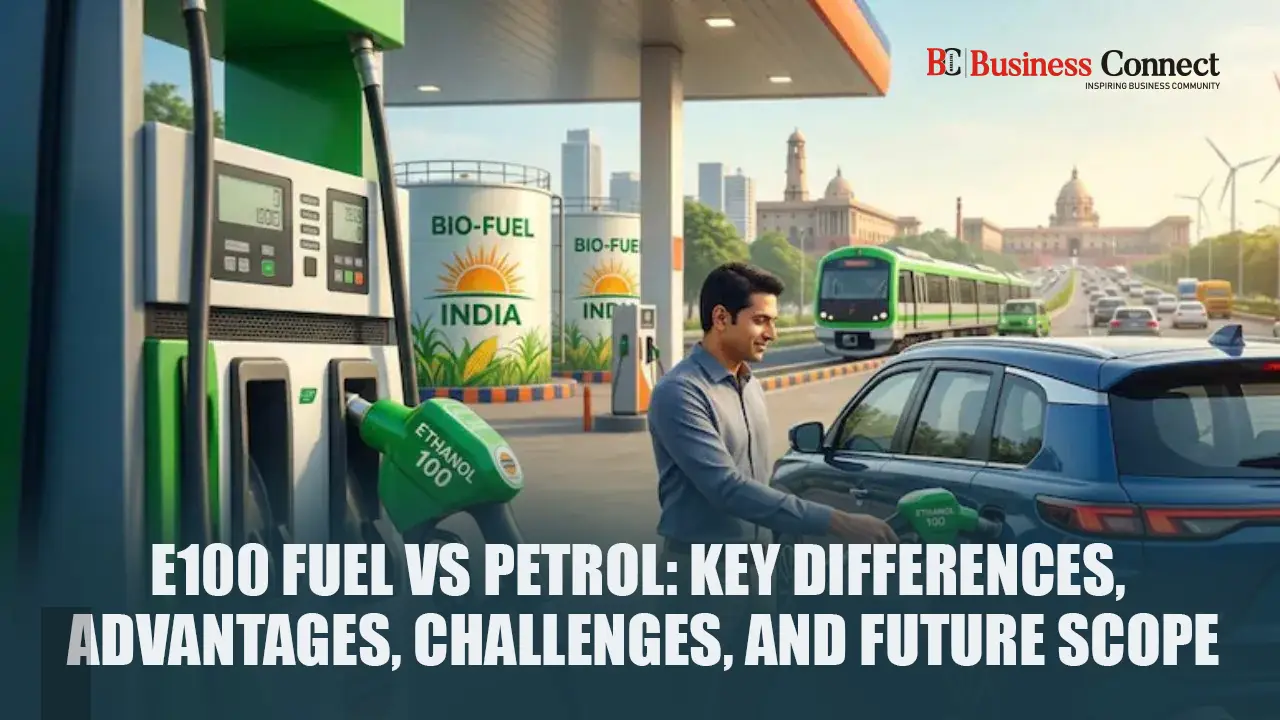
India just launched its first E100 vehicles in June 2026. But what exactly is pure-ethanol fuel, how does it work in an engine, who benefits, who loses out, and can India really pull off what took Brazil 50 years to build? Here is the most complete, honest, data-backed guide available.
What is E100 fuel? E100 is 93–95% anhydrous (water-free) ethanol mixed with 5–7% petrol and solvents. It cannot run in ordinary petrol cars — only in specially designed flex-fuel vehicles (FFVs) with ethanol-resistant fuel systems and recalibrated engine software.
Can E100 replace petrol in India? Technically yes — but it requires three things that India is still building: millions of E100-compatible vehicles, thousands of dedicated dispensing pumps, and ethanol priced well below 70% of petrol. As of June 2026, only the first of these three is commercially available — and only from Hero and Maruti.
What is the mileage loss? Roughly 27–30% fewer kilometres per litre versus petrol. The cost-per-km can still be lower if ethanol is priced below ~₹70/litre versus petrol at ₹100+.
| Metric | Details |
|---|---|
| 93–95% | Ethanol content in E100 fuel |
| 5–7% | Petrol and solvents blended in E100 for denaturing and safety |
| 27–30% | Estimated mileage drop compared to petrol due to lower energy content per litre |
| 25–35% | Potential cost-per-kilometre savings if ethanol is priced at ₹70/litre or below |
| 500 | Target number of E85/E100 fuel stations planned by December 2026 |
on June 3, 2026, Hero MotoCorp launched India’s first E85-capable flex-fuel motorcycles from New Delhi. Two days later, on June 5 — World Environment Day — Maruti Suzuki unveiled India’s first E100-capable passenger car, the announcement for which Union Minister Nitin Gadkari had been building anticipation for months. Together, these two events marked a genuine inflection point in India’s 10-year ethanol blending programme — a moment when “blending ethanol into petrol” gave way to the far more ambitious idea of running vehicles on fuel that is almost entirely ethanol. But amid the celebration, a harder question demands an honest answer: can E100 actually replace petrol at scale in India, and at what cost?
What Exactly Is E100 Fuel?
The name is slightly misleading. E100 is not 100% pure ethanol. E100 is 93–95% ethanol mixed with 5–7% petrol and other solvents — the petrol fraction helps during cold starts (especially at low temperatures), prevents freezing, and ensures the flame has a visible colour in case of fire. This small petrol fraction is an engineering necessity, not a compromise — pure ethanol burns with an almost invisible flame and has a higher ignition threshold, making cold-weather starting unreliable without the additive.
The ethanol itself must be anhydrous — meaning water-free. Regular fermented ethanol contains water, which causes phase separation in fuel tanks and corrodes metal components. Producing anhydrous ethanol requires additional processing, which adds cost and infrastructure requirements at the distillery level.
E-Fuel Comparison: E20 → E85 → E100
E20: 20% ethanol + 80% petrol — currently mandatory standard at all pumps across India since April 2025. Works in most vehicles with minor modifications. Mileage drop: 1–6%.
E85: 85% ethanol + 15% petrol — newly available at India’s first dispensing station (Pusa Road, New Delhi, June 2026). E85 is priced at ₹82.12/litre in Delhi — about ₹20/litre less than petrol. Requires dedicated flex-fuel vehicle.
E100: 93–95% ethanol + 5–7% petrol and solvents — India’s newest fuel category. Requires most extensive vehicle redesign. Priced at an estimated ₹65–70/litre. Only available at designated pumps.
How Does E100 Work Inside an Engine?
E100 cannot simply be pumped into a regular petrol car. The differences between ethanol and petrol are chemical enough to demand entirely redesigned fuel systems. Here is what changes in a flex-fuel vehicle designed for E100:
| Vehicle Component | What Changes for E100 | Why |
|---|---|---|
| ECU / Engine Management | Recalibrated for ethanol’s combustion properties | Ethanol has a higher octane rating (100–110 RON) and requires a different air-fuel ratio than petrol. |
| Fuel Injectors | Larger aperture and longer pulse duration | Ethanol provides about 33% less energy per litre, so more fuel must be injected to produce the same power. |
| Fuel Pump | Higher-flow pump with ethanol-resistant alloys | Ethanol can be corrosive to materials commonly used in standard fuel pumps. |
| Seals & O-rings | Fluorocarbon (FKM) or EPDM rubber | Standard nitrile rubber seals can degrade when exposed to high-ethanol fuel. |
| Fuel Tank | Stainless steel or corrosion-resistant coated interior | Ethanol absorbs moisture, which can promote internal rust in uncoated metal fuel tanks. |
| Ignition Timing | Advanced ignition timing maps | Ethanol’s high octane rating allows for more aggressive ignition timing, improving performance and efficiency. |
| Cold-Start System | Enhanced injector pulse and optional heated intake manifold | Ethanol’s higher latent heat of vaporization makes cold starts more difficult, especially in lower temperatures. |
While making a car E20-ready might add ₹4,000–₹6,000 to the vehicle’s cost, switching to a full FFV platform for E85/E100 can raise the manufacturing cost by ₹19,000–₹27,000. On the four-wheeler side, industry experts say that engineering a petrol car to run on E85/E100 can raise its cost by about ₹50,000–₹1 lakh.
The Pros: Why E100 Is Worth Taking Seriously
| Category | Point | Explanation |
|---|---|---|
| ✅ Advantage | Reduces India’s crude oil import bill | Ethanol is produced domestically, helping reduce dependence on imported crude oil. |
| ✅ Advantage | Lower vehicle emissions | Produces lower tailpipe emissions of CO₂, CO, NOx, and unburned hydrocarbons compared to petrol. |
| ✅ Advantage | High octane rating | With an octane rating of 100–110 RON, E100 supports better engine tuning and can improve performance. |
| ✅ Advantage | Supports farmers | Ethanol procurement from sugarcane and grain provides additional income opportunities for farmers. |
| ✅ Advantage | Lower running costs | Can reduce per-kilometre fuel costs by 25–35% if ethanol remains competitively priced. |
| ✅ Advantage | Utilizes surplus ethanol production | India’s distilleries currently have spare production capacity, making increased ethanol use feasible. |
| ✅ Advantage | Existing refuelling model | Does not require EV charging infrastructure, as it can be dispensed through fuel stations. |
| ⚠️ Disadvantage | Lower fuel efficiency | Mileage per litre is 27–30% lower because ethanol contains about 33% less energy than petrol. |
| ⚠️ Disadvantage | Cold-start issues | Starting the engine can be more difficult in winter temperatures below 10°C without engine modifications. |
| ⚠️ Disadvantage | Limited fuel availability | Only around 500 E85/E100 fuel stations are targeted by December 2026, compared to over 90,000 fuel stations nationwide. |
| ⚠️ Disadvantage | Higher vehicle cost | E100-compatible four-wheelers may cost ₹50,000–₹1 lakh more due to specialized components. |
| ⚠️ Disadvantage | Food security concerns | Expanding ethanol feedstock cultivation could reduce land available for food crops such as pulses and oilseeds. |
| ⚠️ Disadvantage | Water-intensive production | Sugarcane, a major ethanol feedstock, requires significant water resources. |
| ⚠️ Disadvantage | Storage challenges | Ethanol readily absorbs moisture from the atmosphere, requiring careful storage and handling to maintain fuel quality. |
The Mileage Hit — The Number Every Driver Needs to Know
The single most important practical consideration for any E100 vehicle buyer is the mileage drop — and it is not small. Ethanol has less energy per litre, meaning mileage could drop by 27–30% with E100. Put concretely: if your current petrol car delivers 20 km/litre, the same car on E100 would deliver roughly 14–15 km/litre.
But kilometre-per-litre is only half the equation. The other half is the price per litre. At ₹65/kg versus ₹102/litre for petrol, the cost per km still favoured ethanol by approximately 15% in test conditions. The math holds — but only as long as the price gap remains wide enough. Proposed pricing of ₹82–87 per litre places E100 at 80–85% of petrol’s price, but Brazil’s consumers only switch to ethanol when it is priced below 70% of petrol — the famous “70% rule.” India has not crossed that threshold, which means E100 does not have a compelling financial case for private buyers in 2026 at those prices.
The 70% Rule — India’s Critical Pricing Problem
Brazil, the world’s most successful ethanol vehicle market, discovered through decades of data that consumers only choose ethanol over petrol when ethanol is priced at or below 70% of petrol. This “70% rule” accounts for the mileage penalty — if you need 30% more litres to travel the same distance, the fuel must be at least 30% cheaper to break even, with any saving below that threshold being the incentive to switch.
At the current and proposed pricing of ₹65–87 per litre for E100 versus petrol at ₹100+, India is in or near the economically attractive zone — but price stability cannot be guaranteed, and any subsidy withdrawal would rapidly erode the consumer case for E100 adoption.
The Cold-Start Problem: North India’s Specific Challenge
Ethanol’s thermodynamic properties create a genuine engineering challenge in cold weather. Its latent heat of vaporisation is significantly higher than petrol — meaning it absorbs more heat from its surroundings to vaporise into the mist that an engine needs for ignition. Pure ethanol (E100) can also be difficult to start in cold weather, especially in northern India.
In cold-weather engine tests, the engine took 2 extra seconds to crank on E85 versus petrol at 12°C ambient temperature. Hero and Maruti have reportedly enhanced injector pulse duration for E100 to mitigate this — critical for North Indian winters. The 5–7% petrol fraction in E100 is specifically engineered to help with this — petrol vaporises more readily at low temperatures, providing the initial combustion needed to warm the engine before ethanol takes over. For cities like Delhi, Chandigarh, and Lucknow, where January temperatures routinely drop to 5–8°C, this engineering challenge is material and not fully resolved.
Infrastructure Reality: The Biggest Gap
Of all the challenges facing E100 adoption in India, infrastructure is the most immediately binding constraint. India has approximately 90,000 fuel retail outlets nationwide. As of June 2026, India’s first E85 dispensing station was inaugurated on Pusa Road, New Delhi. The government’s target, as stated by Petroleum Minister Hardeep Singh Puri, is 500 E100 ethanol dispensing stations by December 2026, with a larger target of 5,000 stations by 2027.
Even the 2027 target of 5,000 stations represents barely 5.5% of India’s total fuel retail network. An E100 vehicle purchased today would need its owner to plan routes around fuel availability in a way no petrol, diesel, or CNG driver currently experiences — a powerful disincentive to early adoption outside of specific urban corridors.
| Metric | India (June 2026) | Brazil (2025) |
|---|---|---|
| FFV market share (new vehicles) | ~0% (first launches began in June 2026) | 74.4% of new light vehicle registrations |
| Standard pump ethanol blend | E20 (mandatory nationwide) | E27 (standard pump fuel) |
| High-ethanol dispensing stations | 1 operational (June 2026); 500 targeted by December 2026 | Available at virtually all fuel stations (E27 nationwide) |
| E100/Ethanol price vs petrol | Around 80–85% of petrol price (limited economic advantage) | Typically below 70% of petrol price, supporting widespread adoption |
| Years of ethanol programme | Approximately 10 years (transition from E5 to E20) | 50+ years, beginning after the 1975 oil crisis |
| Vehicle cost premium for FFVs | Approximately ₹50,000–₹1 lakh for four-wheelers | Minimal due to large-scale manufacturing and mature market |
The Brazil Blueprint — and Why India Can’t Copy-Paste It
Brazil’s success rests on two critical pillars: competitive pricing of E100 fuel relative to gasoline, and minimal cost premium for flex-fuel vehicles. Brazil built its ethanol ecosystem over 50 years, beginning with the Proálcool programme launched in 1975 in response to the global oil shock. By 2025, flex-fuel vehicles accounted for 74.4% of all new light vehicle registrations in Brazil, where the country runs E27 as standard pump fuel.
India’s situation differs in fundamental ways. Brazil’s sugarcane-based ethanol industry grew in parallel with its vehicle fleet — the two ecosystems co-evolved. India is attempting a compressed, policy-driven version of that process without the same price advantage, without the decades of infrastructure investment, and with a far larger and more diverse geographical footprint across climates ranging from sub-tropical Chennai to sub-zero Leh.
“The running cost advantage of E100 vehicles could be quite significant, particularly if ethanol pricing remains favourable compared to petrol. Consumers could realistically expect a reduction of around 25 to 35 per cent in per-kilometre fuel expenses.”
Food Security: The Risk Nobody Wants to Talk About
The most politically sensitive challenge in scaling E100 is one that rarely features in automotive coverage: food security. India’s ethanol supply currently comes primarily from sugarcane molasses and surplus grain — a sustainable model as long as it uses genuinely surplus agricultural production. But as ethanol demand grows, the economics begin to compete with food production.
India’s Economic Survey 2025–26 flagged early warning signs that ethanol demand could reshape crop priorities, with land potentially moving toward maize and away from pulses and oilseeds. Using surplus or damaged grains for ethanol is sensible. But if food crops are aggressively diverted into fuel production, it can affect food prices, animal feed costs, and crop diversity — a risk that disproportionately affects low-income households already spending a large share of income on food.
Which Vehicles Can Run on E100 Right Now? (June 2026)
| Vehicle | Type | Maximum Ethanol Blend | Price (Ex-Showroom) | Availability |
|---|---|---|---|---|
| Hero Splendor+ Flex Fuel | Motorcycle | E85 | ₹82,710 | Delhi and Maharashtra (from July 2026) |
| Hero HF Deluxe Flex Fuel | Motorcycle | E85 | ₹72,792 | Delhi and Maharashtra (from July 2026) |
| Maruti Suzuki Wagon R E100 (Expected) | Hatchback | E100 | TBC (Bookings opened on June 5, 2026) | Expected deliveries from August 2026 |
| All Other Vehicles (Pre–June 2026 Models) | Cars & Motorcycles | E20 Only | — | Not designed to safely operate on E85 or E100 |