
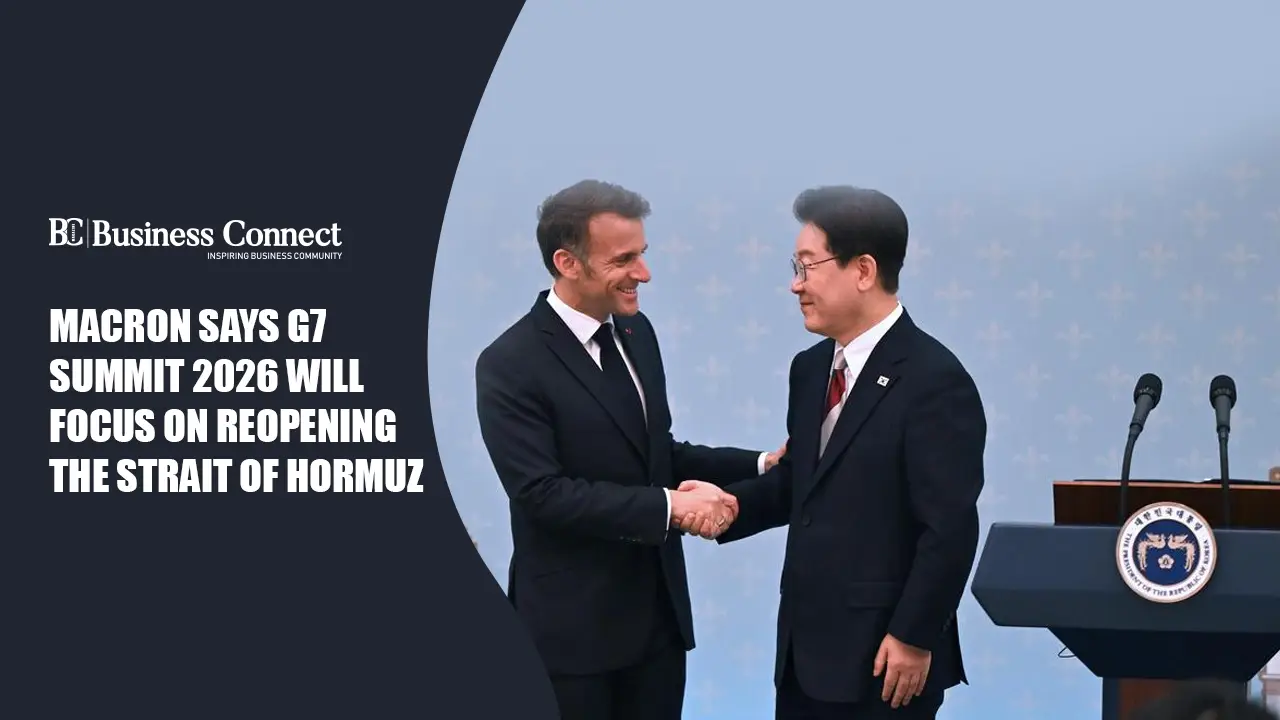
French President Emmanuel Macron has announced that the reopening of the Strait of Hormuz will be one of the key issues discussed during the G7 Summit 2026, as world leaders gather in Evian-les-Bains, France, from June 15 to 17. The discussions come after the United States and Iran reached a framework agreement aimed at ending months of conflict in West Asia.
In a video message shared on Instagram on Sunday, Macron outlined the summit’s priorities, highlighting regional peace, maritime security, and nuclear diplomacy. He said G7 leaders would examine the impact of the recent agreement while exploring ways to ensure the long-term reopening of the strategically important Strait of Hormuz.
“The objective is to assess the consequences of this agreement, continue support for Lebanon, secure the lasting reopening of Hormuz, and move forward on a comprehensive agreement concerning Iran’s nuclear and ballistic programmes,” Macron said.
Focus on Regional Stability
Macron welcomed the preliminary agreement, describing it as an important diplomatic achievement made possible through coordinated international efforts. He stressed that its successful implementation would be essential for maintaining peace and protecting global trade.
In a separate post on X, the French president called for the immediate and full implementation of the agreement by all parties involved. He emphasized that unrestricted maritime navigation through the Strait of Hormuz is critical for both regional security and the global economy.
The French leader also revealed that a joint maritime mission established by France and the United Kingdom is ready to assist in restoring safe commercial shipping through the waterway, which has remained largely inaccessible for several months due to ongoing tensions.
US-Iran Framework Agreement
The diplomatic breakthrough was first announced on Sunday by US President Donald Trump through his Truth Social platform. Trump stated that Washington and Tehran had finalized a framework agreement to end hostilities, adding that the United States would immediately lift its naval blockade on Iranian ports in return for the uninterrupted movement of global energy shipments.
Meanwhile, Pakistani Prime Minister Shehbaz Sharif confirmed that international mediators had secured an agreement for a permanent ceasefire across all active conflict zones, including Lebanon. Iran’s Supreme National Security Council also announced that military operations would come to a permanent end under the proposed agreement.
Peace Agreement Scheduled for June 19
A formal signing ceremony for the peace accord is expected to take place in Switzerland on June 19. Ahead of the signing, G7 leaders are expected to discuss verification mechanisms, implementation procedures, and the broader security implications of the agreement during Monday’s working sessions.
British Prime Minister Keir Starmer and other G7 leaders have also emphasized that ensuring permanent, toll-free freedom of navigation through the Strait of Hormuz will be essential for global energy markets and international trade.
Why the Strait of Hormuz Matters
The Strait of Hormuz is one of the world’s most strategically important maritime routes, connecting the Persian Gulf to the Gulf of Oman and the Arabian Sea. A significant share of global crude oil and liquefied natural gas exports passes through the narrow waterway each day.
Any disruption to shipping in the region can lead to higher energy prices, supply chain challenges, and increased geopolitical tensions. The G7’s discussions are therefore expected to focus on long-term measures that ensure safe, unrestricted navigation while supporting regional peace and stability.