
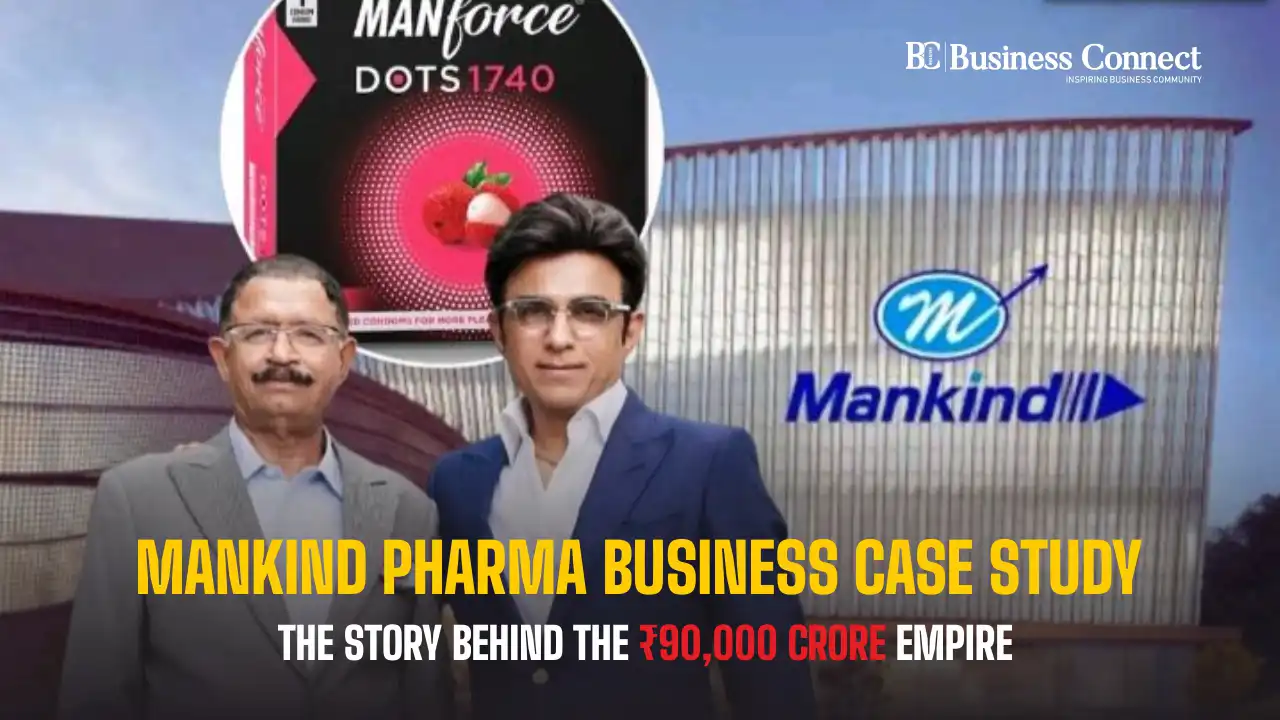
The complete, unfiltered story of how Ramesh and Rajeev Juneja — two men from Meerut with no family business, no investor money, and no metro-city advantage — built one of India’s most trusted pharmaceutical empires from the ground up.
- ₹50L Starting investment (1995)
- ₹96,703 Cr Market cap (peak)
- 4th Largest pharma company India
- 34 Countries served globally
₹50 Lakh. Two Brothers. One Dream. Today, a ₹90,000 Crore Pharmaceutical Empire.
“Most patients who came for doctor consultations had limited money. After paying the consultation fee, they were unable to afford medicines and had to opt for partial medications. That image never left me.”
The Bus Rides That Built an Empire
In the early 1970s, on the dusty UP Roadways buses that connected Meerut to the small towns and villages of western Uttar Pradesh, a young man named Ramesh Juneja was building something — though he didn’t know it yet. He was just a Medical Representative, a travelling salesman for medicines, covering 85 kilometres a day to meet doctors in clinics that often had mud floors, to convince them to prescribe drugs from companies that most of their rural patients could barely afford.
Ramesh had been born in 1955 into a modest middle-class family in Meerut. No pharmaceutical dynasty behind him. No family money. After completing his science graduation, he joined KeePharma Ltd. in 1974 as a medical representative — the starting point of almost every great Indian pharma career, and one of the least glamorous jobs in the industry. Day after day, he rode those buses. Town after town. Doctor after doctor. Rejection after rejection.
But those years were not wasted. They were his MBA. Ramesh was learning the real India — the India of the talukas and tehsils, the India that big pharmaceutical companies in Mumbai and Ahmedabad had little interest in, the India where patients chose between eating and taking their medicines.
“He used to travel about 85 km a day by bus to meet doctors and sell medicines across Uttar Pradesh. This was not just a job — it was the foundation of everything he would later build.”
The Moment That Changed Everything
By 1975, Ramesh’s talent had caught the attention of Lupin Limited, one of India’s more established pharmaceutical companies. He joined as a first-line manager — a step up, more responsibility, more reach. Over the next eight years at Lupin, he gained what no textbook could teach: a granular understanding of how medicine moved through India, who bought it, who couldn’t, and why.
And then, sometime around 1983, he witnessed something that would define the next four decades of his life. At a local chemist shop in one of the small towns he was visiting, a patient who had just come from a doctor’s consultation stood at the counter. He had his prescription in hand. But he didn’t have enough money to fill it. He reached into his pocket and placed his silver jewellery on the counter as collateral — hoping the chemist would hand over the medicines anyway.
The chemist refused. The man walked away without his medicine.
Ramesh never forgot that image. “That image never left me,” he would later write in Mankind Pharma’s annual report. The moment crystallised a mission that would take him twelve more years and one failed business to act upon.
The First Attempt — and the Failure That Taught Everything
In 1983, Ramesh left Lupin. He had a clear vision — affordable medicines for the masses — but the path forward was unclear. He partnered with a friend and started a pharmaceutical formulations business called Bestochem, based in Meerut.
Bestochem never quite worked. The venture struggled to gain traction. The vision was right, but the execution, the timing, the resources, the team — something in the mix wasn’t clicking. Over the next decade, Bestochem limped along without ever achieving what Ramesh knew was possible.
In 1994, Ramesh withdrew from Bestochem. He had now spent over a decade in the industry — first as an employee, then as a struggling entrepreneur. He had failed once. He was nearly forty years old. And he was about to start again.
Bestochem wasn’t a waste — it was tuition. Every failed approach taught Ramesh something about what not to do. He learned that without a manufacturing base, brand names mean nothing. He learned that distribution in rural India requires a fundamentally different approach than metro-focused competitors use. He learned that pricing strategy is not an afterthought — it is the strategy. These lessons would all become load-bearing pillars of Mankind Pharma.
₹50 Lakh, 25 Men, and One Belief
In 1995, Ramesh Juneja sat down with his younger brother Rajeev Juneja — a college dropout who had spent his own years working at a chemist shop, watching from the other side of the counter exactly what Ramesh had seen from the sales side — and together they decided to start again. Differently this time. Together this time.
They had ₹50 lakh. No venture capital. No angel investor. No government grant. Just their own savings, their shared conviction, and two decades of combined ground-level pharmaceutical experience between them. They hired 25 medical representatives — salesmen, like Ramesh had once been — and launched Mankind Pharma.
The mission statement was simple enough to fit on a post-it note: high-quality medicines at prices ordinary Indians could actually afford. The execution would take thirty years.
The Strategy That No One Else Was Running
Here is what made Mankind Pharma structurally different from the day it launched — and why it succeeded where so many well-funded competitors failed to even compete.
The Price Strategy
Mankind priced its branded drugs 30 to 50 per cent cheaper than market leaders. Competitors called it reckless. Investors — there weren’t any yet — would have called it unsustainable. Mankind called it the whole point. The pricing strategy wasn’t a loss-leader gimmick; it was a fundamental bet that if you made medicine affordable, demand would be enormous, volumes would compensate for margins, and loyalty would be absolute.
The Rural-First Approach
While the big names in Indian pharma — the companies headquartered in Mumbai, the ones with slick marketing departments and relationships with top urban hospital doctors — were fighting each other over a relatively small slice of metropolitan India, Mankind went somewhere else entirely.
Tier-2 towns. Tier-3 towns. Rural districts. The places where India’s population actually lived. The places where a Lupin or a Cipla had minimal presence. Mankind’s medical representatives spread out into the heartland of UP, Bihar, Rajasthan, and Madhya Pradesh — the same territory Ramesh had walked as a young MR — and built relationships in places where no other major pharma company bothered to go.
“The traditional heavyweights were concentrated in metropolitan hospitals and doctors in metros, while Mankind was aggressively foraying into tier-2, tier-3, and rural areas.”
The Trust-First Model
Rajeev Juneja — who would later become Vice Chairman and Managing Director — named every single Mankind brand himself. Every product name was his. This wasn’t just a creative quirk. It was a philosophy: that the brand had to feel like a person who understood you, not a faceless corporation selling you a molecule.
The early medical reps faced constant disdain. Larger competitor companies dismissed Mankind’s representatives as “cheap medicine salesmen.” Doctors in bigger cities were sceptical. But Mankind’s reps kept their heads down and kept going — because in the villages and small towns they were working, the doctors had never been courted like this before. Being the only company that showed up consistently is, in itself, a competitive moat.
Year One: ₹4 Crore. The Proof of Concept.
By the end of Mankind Pharma’s first full year of operations, the company had reached a valuation of ₹4 crore. That is an 8x return on the ₹50 lakh initial investment — in twelve months. For a company operating without contract manufacturing facilities (in those early days, they relied on third-party contract makers, like almost every small pharma startup), with no brand recognition outside of UP, and selling at deeply discounted prices — this was extraordinary validation.
It was the first signal that the Junejas weren’t just right about the market opportunity. They were right about the mechanism: that affordable pricing, combined with intensive rural distribution and relationship-focused sales, was a formula that the Indian pharmaceutical market had been waiting for.
Building Brands That Became Households
As the company grew, the Junejas understood something that most pharmaceutical companies miss entirely: in a country where the local chemist is more trusted than the marketing department, building consumer brands is as important as building doctor relationships.
So they built brands. Real brands. Brands with names that stuck, advertising that resonated, and products that addressed the most common, most universal healthcare needs of ordinary Indians:
| Brand | Category | Why It Won |
|---|---|---|
| Prega News | Pregnancy test kit | First major affordable, accessible pregnancy test in India; now synonymous with the category |
| Manforce | Contraceptives | Made a taboo category accessible through normalised advertising with A-list brand ambassadors |
| Unwanted 72 | Emergency contraception | Category-defining in a segment that required both social awareness and accessibility |
| Gas-O-Fast | Digestive health | Affordable, widely available, memorable branding — became the default remedy in millions of households |
| HealthOK | Multivitamin supplement | Tapped the aspirational health supplement market at accessible price points |
To build these brands into household names, Mankind took a deliberate, Bollywood-scale approach to advertising. They brought in Amitabh Bachchan as a national brand ambassador — an unprecedented step for a company of Mankind’s then-size — and supplemented him with regional stars who could carry the brand’s message into the specific linguistic and cultural contexts of Maharashtra, Tamil Nadu, Bengal, and beyond.
The Quality Pivot — Building Factories, Not Just Brands
One of the Junejas’ smartest decisions — and one that separated Mankind from many of its peers — was the decision to invest heavily in in-house manufacturing at a time when most domestic pharma companies were content to rely on contract manufacturers.
Today, approximately 75 per cent of all Mankind products are manufactured in its own facilities — an unusually high figure for the Indian domestic pharma market, where most companies export in-house but contract out for domestic sales. The Junejas made this choice deliberately: not just for quality control, but to control costs, which directly enabled their price-leadership strategy.
“Result is a by-product of good work. So instead of looking for result, look for things that are responsible for bringing those fantastic results. The goal is to create that kind of work culture.”
This thinking extended to manufacturing: if you want to sell affordable medicines without sacrificing quality, you cannot leave quality to a third party. Build the factories. Control the molecule. Own the outcome.
The Resistance — and How They Broke Through It
Even after Mankind had grown into a ₹500 crore company by 2007, they continued to face resistance in India’s largest cities. The stigma was real: a small-town pharma company, with cheap prices, from UP. Metro doctors who had never interacted with a Mankind representative were sceptical. Top-tier urban hospitals barely gave them shelf space.
The Junejas responded not with frustration, but with patience — and with data. As Mankind’s rural prescription volumes grew into the hundreds of crores, the company’s scale became impossible to ignore. Distributors who had initially dismissed them were now dependent on Mankind’s supply. Chemists in smaller cities who had stocked Mankind brands for years were now their loudest advocates in conversations with urban procurement officers.
By thinking in decades rather than quarters, Mankind outlasted the snobbery of the metro market — and eventually won it.
The Family That Runs an Institution
One of the distinctive features of Mankind Pharma’s leadership is the balance it has struck between family ownership and professional management — a combination that has historically tripped up many Indian family businesses as they scale.
The Juneja family is deeply embedded in the company, but roles are distributed based on specific competencies rather than family hierarchy alone:
Ramesh Juneja — Chairman
The strategic visionary who set the mission and built the ground-level distribution machine. Now oversees the company’s institutional direction as Chairman.
Rajeev Juneja — Vice Chairman & MD
The brand architect who named every product and shaped Mankind’s consumer-facing identity. He admires the Tata Group deeply — “they are my heroes” — and aspires to make Mankind an institution on the same scale.
Arjun Juneja (Ramesh’s son) — Manufacturing & R&D
Leads the next generation of product development and the quality infrastructure that underpins the company’s pricing advantage.
Sheetal Arora — CEO (since May 2021)
Nephew of both brothers, Arora represents the professionalisation of Mankind’s leadership — a trained manager running day-to-day operations while the Junejas maintain family oversight and institutional vision.
Going Public — and Going Global
In May 2023, Mankind Pharma launched its Initial Public Offering on the Indian stock exchanges. The IPO raised ₹4,326 crore. On the first day of trading, the stock gained approximately 74 per cent above its issue price — one of the strongest IPO debuts in Indian pharma history. The market was effectively saying: the Junejas built something worth a great deal more than they were asking for it.
The listing gave the company access to public capital and a public valuation — and with it, the firepower for the company’s most ambitious move yet. In 2024, Mankind acquired Bharat Serums and Vaccines (BSV) for approximately ₹13,630 crore, its largest acquisition to date, significantly strengthening its position in the specialty healthcare, biologics, and women’s health segments. The BSV deal signalled a strategic evolution: from a generics and OTC heavyweight into a company capable of competing in high-margin speciality and biologics categories.
- 1974
- 1975
- 1983
- 1994
- 1995
- 2000s
- 2007
- May 2023
- 2024
- 2026
What Every Founder Can Learn from This Story
Start with a problem, not a product
Ramesh didn’t decide to build a pharma company. He decided to solve one specific problem — the gap between medicine cost and what ordinary Indians could pay. The company was the vehicle; the mission was the engine.
Go where your competition isn’t
Every major pharma player ignored rural and small-town India. Mankind made that neglected market its entire strategy — and by the time competitors noticed, Mankind owned the relationships, the distribution network, and the brand loyalty.
Pricing is the strategy
Medicines 30–50% cheaper than competitors isn’t a promotion. It’s a complete business model that requires better manufacturing efficiency, lower overheads, and the confidence that volume will compensate for margin. They did all three.
Failure is tuition, not termination
Bestochem failed. Ramesh didn’t quit. He spent a decade extracting lessons from that failure and embedded every one of them into Mankind’s design. The failure was the R&D for success.
Build infrastructure, not just brand
When every competitor was outsourcing manufacturing, Mankind was building factories. When every competitor was chasing cities, Mankind was building rural distributor networks. The infrastructure that everyone said was unnecessary became the moat that nobody could copy.
Think in decades
It took 12 years from founding for Mankind to cross ₹500 crore. It took 28 years to go public. The Junejas never chased a quick exit or a flashy funding round. They built toward an institution — and the market eventually valued it like one.
A Story That Belongs to India
The story of Mankind Pharma is, at its core, a story about India’s informal intelligence — the kind of deep, granular market knowledge that is only built by spending years on ground, by bus, by foot, meeting people where they actually are. Ramesh Juneja didn’t learn his market from a McKinsey report. He learned it by riding those UP Roadways buses for a decade as a young man with no money and a lot of ambition.
Rajeev Juneja — the college dropout who named every brand — brought the street-level consumer insight that no MBA programme can teach. The two brothers complemented each other perfectly: one a market strategist, one a brand builder, both anchored in the same core belief that medicine should not be a luxury.
What they built serves as a specific model of success that belongs to India — not Silicon Valley, not Zurich, not Boston. A model that is built on knowing your people, serving the underserved, pricing with purpose, and having the patience to let trust compound over thirty years into something that no amount of marketing spend can replicate overnight.
Mankind Pharma in Numbers — 2026
Market capitalisation: ₹90,000–₹96,703 crore (peak)
FY24 Revenue: ₹10,335 crore
Rank: India’s 4th largest pharma company by domestic sales; #1 by prescription count
Countries: Exports to 34 countries globally
Manufacturing: ~75% in-house across own facilities
BSV Acquisition (2024): ₹13,630 crore — now in biologics and specialty healthcare
Founders’ net worth (Forbes, 2026): $2.9–6.9 billion (Juneja family)
The Real Takeaway
You don’t need to start in a metro. You don’t need venture capital. You don’t need a Harvard MBA. You need a real problem, a clear mission, the patience to think in decades, and the discipline to build trust one relationship at a time. That is what ₹50 lakh and two brothers from Meerut proved in 1995 — and it took them thirty years to prove it completely.