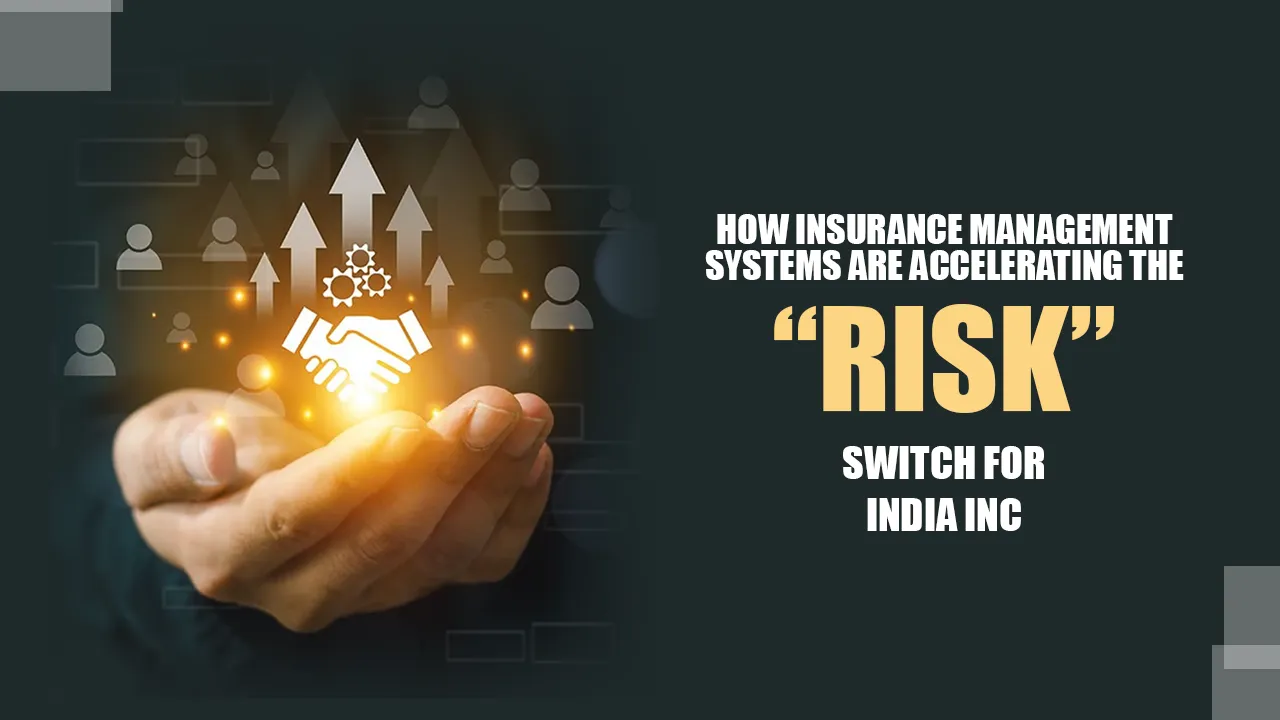
Corporate India is going places as it increasingly redefines the global conversations around itself
Enterprises are expanding across geographies, supply chains are becoming increasingly interconnected, hybrid workforces are disrupting operational models, and digital assets are emerging alongside physical ones. But as, businesses become more complex, so do the risks they need to manage.
In such a context, insurance can no longer be lensed as statutory, instead it has evolved to become a critical component of risk management at an enterprise scale if not beyond.
Yet many organizations continue to manage corporate insurance through fragmented frameworks involving spreadsheets, multiple intermediaries, disconnected policy records, and manual renewal cycles. While such a approach may suffice for companies with a smaller footprint, it becomes increasingly inefficient as businesses grow.
This is where an insurance management system comes in to play a catalytic role. Rather than simply digitizing insurance administration, these platforms are enabling organizations to manage policy lifecycles, employee benefits, claims, compliance, and risk visibility through a unified and simplified digital approach
And companies like EbixCash are curating solutions that align with the needs and expectations of a digital and dynamic landscape, empowering businesses to move forward, with full confidence and zeal
Corporate Insurance Is Becoming a Data Management Challenge
Large organizations often manage multiple insurance solutions across use cases and formats. These would typically include employee health insurance, group life cover, directors’ and officers’ liability, cyber insurance, property insurance, fleet insurance, professional indemnity, and business interruption policies across multiple insurers.
Managing all of these independently could lead to confusion, as fragmented frameworks and siloed processes lead to conflicts and misallocations.
Modern insurance management systems solve this by consolidating policy administration into a centralized platform where insurers, brokers, HR teams, finance departments, and risk managers can operate from a common source of information, under a unified platform.
Features such as policy repositories, automated document management, digital endorsements, renewal scheduling, and role-based access controls help reduce administrative complexity while improving governance, transparency and accountability.
The outcome is greater operational visibility across the entire insurance portfolio, enabling buisnesses to not just manage risk but leverage it for impactful growth.
Workflow Automation Is Improving Operational Efficiency
Traditionally corporate insurance has always been associated with a lot of steps and paperwork. A classic case of process dependency, the entire complicatedness of it, has often made it, quite unapproachable for many businesses
Processes like employee onboarding, policy enrolments, endorsements, renewals, claims documentation, and compliance reporting often require significant manual intervention across multiple departments, leading to time and cost sacrifices, that often translates into avoidable burdens.
And this is exactly what modern insurance management systems are trying to address in a proactive fashion by digitising interfaces and automating workflows.
Using configurable business rules, workflow engines, and API-driven integrations, organizations can automate repetitive operational tasks while reducing processing time and minimizing human error. Such capabilities mainly include:
- Digital policy issuance
- Automated renewal alerts
- Claims workflow management
- Document validation
- Approval routing
- Audit-ready reporting
For enterprises managing thousands of employees or multiple business entities, such an automation advantage significantly improves operational scalability without proportionately increasing administrative overhead.
Integration Is Becoming the New Enterprise Standard
Insurance is no longer considered as separate from normal enterprise management software templates in terms of functionality, and that in many ways is a boost and advantages that companies today are leveraging to their fullest extent.
Today, organizations expect insurance platforms to integrate seamlessly with HRMS solutions, payroll systems, employee benefits portals, finance platforms, identity management systems, and compliance applications, creating a process ecosystem that complements and scales at one go
This interoperability is largely enabled by modern insurance management systems like those created by EbixCash through API-first architectures.
A modern platform today can exchange information across multiple enterprise applications in real time, ensuring that employee data, policy eligibility, claims status, and compliance records remain synchronized across departments.
And as already mentioned before, integrated insurance technology providers like EbixCash, are supporting this shift by developing platforms that combine insurance administration with broader financial and enterprise ecosystems.
The result is a more connected operating environment where insurance becomes embedded within day-to-day business processes rather than functioning as a standalone operational activity.
Analytics Are Making Insurance More Strategic
A modern digital insurance platform generates a growing volume of operational intelligence that companies today are using to create and deploy better and more productive solutions and processes.
Claims frequency, policy utilization, renewal behaviour, employee enrolment trends, premium patterns, and portfolio exposure collectively provide organizations with a much clearer understanding of enterprise risk.
Modern insurance management systems increasingly incorporate analytics dashboards capable of transforming these critical datasets into actionable business insights.
This enables businesses and other stakeholder to:
- Identify underutilized policies
- Forecast renewal costs
- Monitor claims ratios
- Improve insurer negotiations
- Strengthen long-term risk planning
seamlessly, paving the way for a landscape where risk actually translates to real actionable value that anyone can leverage. Major enterprise management players like EnixCash have embraced this evolution, creating solutions that make insurance super easy, for companies across sectors and scale.
Supporting India’s Digital Enterprise Journey
As Indian businesses continue to digitize, expectations around corporate insurance will continue to grow and change.
Organizations increasingly require platforms that combine policy administration, automation, analytics, compliance, and employee servicing within a unified ecosystem.
This broader technology shift is reflected in the work of several insurance technology companies, including EbixCash, who continue to build integrated life insurance and enterprise insurance platforms capable of supporting the growing needs of corporate India.
The objective is no longer simply to digitize insurance processes but to create systems and methodologies that are capable of supporting enterprise growth with greater resilience, transparency, and operational efficiency.
Conclusion
Corporate insurance is becoming significantly more sophisticated as businesses continue to relentlessly expand and scale up in terms of complexity and function.
Managing such a dynamic context requires solutions that go beyond classical precepts and templates and modern insurance management systems are increasingly doing that providing businesses of today and tomorrow the digital infrastructure they need to automate workflows, centralize policy administration, integrate enterprise data, and generate the operational intelligence required for better risk management.
So as India Inc. accelerates its digital transformation, organizations that invest in connected insurance platforms will be better positioned to protect their people, strengthen governance, and respond more effectively to an increasingly dynamic business environment.
In this evolving landscape, integrated technology ecosystems such as those developed by EbixCash demonstrate how insurance management is moving beyond administration to become a strategic capability that supports long-term business profitability and growth.