Introduction
Every private limited company under the Companies Act, 2013 must file annual returns, financial statements, and director KYC, regardless of turnover, profit, or activity. Miss it, and penalties compound at ₹100/day per form with no cap, and repeated defaults can lead to director disqualification.
After company registration, the challenge isn’t that these compliance requirements are individually complicated—it’s that there are so many of them, spread across different forms, different deadlines, and different authorities, such as the MCA, Income Tax Department, and GST authorities. Missing one filing creates a domino effect, since several depend on earlier ones being completed on time.
This blog covers every annual compliance requirement for a private limited company, key due dates for FY 2025-26, the filing sequence, penalties for non-compliance, and a practical checklist to stay compliant.
What Is Annual Compliance for a Private Limited Company?
Annual compliance for a private limited company means the mandatory filings, disclosures, statutory meetings, audits, and record maintenance required every financial year under the Companies Act, 2013, regardless of turnover or business activity. After private limited company registration, these compliances must be fulfilled by filing the required forms with the Registrar of Companies (ROC) through the MCA portal, along with separate obligations under the Income Tax Act and GST law.
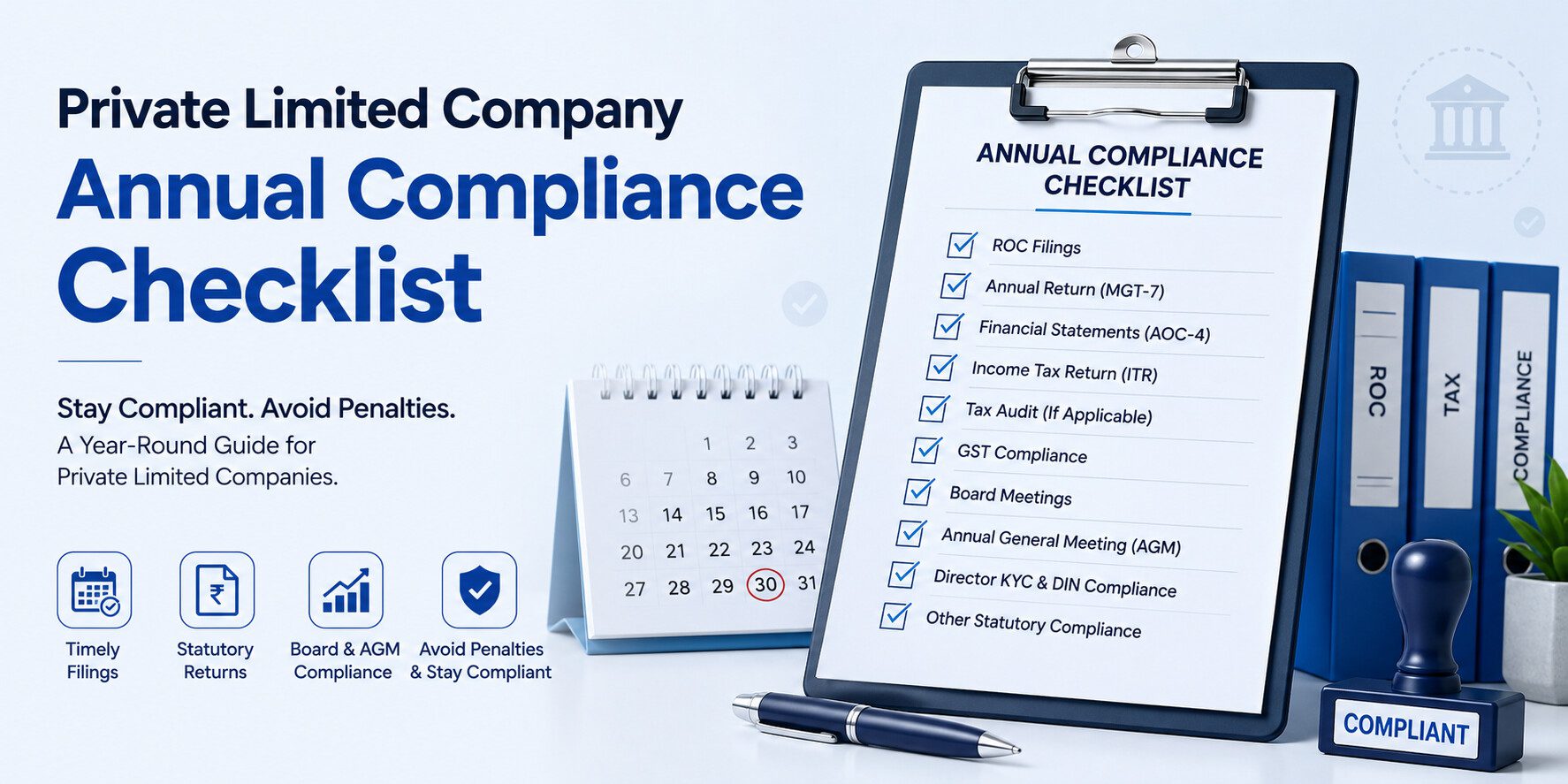
Private Limited Company Annual Compliance Checklist
1. Appointment of Statutory Auditor (Form ADT-1)
Every company must appoint a statutory auditor, typically within 30 days of incorporation, for a five-year term. If not yet appointed, ADT-1 must be filed before AOC-4.
2. Minimum Board Meetings
At least 4 board meetings per year, with no more than 120 days between two consecutive meetings.
3. Statutory Audit
Accounts must be audited regardless of turnover or profitability — even zero-transaction companies need a nil audit before filing financial statements.
4. Annual General Meeting (AGM)
Must be held within 6 months of financial year-end — by 30 September for the April–March cycle. A three-month extension can be sought from the ROC, though it rarely helps with AOC-4 or MGT-7 deadlines.
5. Form AOC-4 (Financial Statements)
Contains the audited Balance Sheet, P&L, Cash Flow Statement (mandatory except for OPCs and small companies), Auditor’s Report, and Directors’ Report.
Due date: Within 30 days of the AGM — 30 October, if the AGM is held on 30 September.
6. Form MGT-7 / MGT-7A (Annual Return)
Captures shareholding pattern, director details, share capital, indebtedness, and meetings held. MGT-7A is the simplified version for small companies and OPCs.
Due date: Within 60 days of the AGM — 29 November, if the AGM is held on 30 September (Section 92).
Note: MGT-7 can’t be filed until AOC-4 is processed, since the MCA portal pulls turnover and net worth from it. A delayed AOC-4 delays MGT-7.
7. DIR-3 KYC (Director KYC)
Every DIN holder must complete KYC annually by 30 September, whether or not currently serving as director. First-time filers or those with changed details use the full form; others can use DIR-3 KYC Web.
Note: The MCA portal blocks AOC-4/MGT-7 if any signing director’s KYC has lapsed — verify before filing.
8. Form DPT-3 (Return of Deposits)
Discloses outstanding loans and deposits, including director loans (exempted deposits), by 30 June.
9. Form MSME-1 (Half-Yearly MSME Dues Reporting)
Required twice a year if payments to MSME vendors are outstanding beyond 45 days, disclosing amount and reason for delay.
10. Income Tax Return and Tax Audit
ITR due 31 October; Tax Audit Report (where applicable) due 30 September.
11. GST Returns (if registered)
GSTR-1 and GSTR-3B monthly/quarterly, plus annual GSTR-9.
12. TDS Returns
Quarterly TDS returns, plus Form 16/16A certificates to deductees.
Documents Required for Annual Compliance
Keeping these records ready ensures a smooth, timely compliance process:
- Financial statements — Balance Sheet, P&L, Cash Flow Statement, Notes
- Books of accounts — ledgers, journals, bank statements, invoices
- Board meeting and AGM minutes
- Auditor’s Report and Directors’ Report
- Digital Signature Certificate (DSC) of directors
- DIR-3 KYC records of all directors
- Tax documents — Form 16, TDS certificates, tax computation sheets
- GST invoices, purchase bills, payment challans (if applicable)
- Statutory registers — members, directors, and charges
- Geotagged, timestamped photo of the registered office showing company name, address, CIN, and contact details — attached to MGT-7/7A
Why Choose Zolvit
Zolvit provides end-to-end compliance support so your business never misses a filing deadline. Our Company Secretaries manage your entire compliance calendar, while our Chartered Accountants handle statutory audits and tax filings — covering AOC-4, MGT-7, DIR-3 KYC, and board resolutions with complete transparency and no hidden charges.
- Expert CS support for your entire filing calendar
- CA support for audits and tax filings
- Fast, accurate ROC filings — AOC-4, MGT-7, DIR-3 KYC
- Transparent, affordable pricing
- Dedicated deadline tracking to prevent penalties
Don’t risk penalties or director disqualification. Talk to Zolvit’s compliance experts today for a free consultation.
Conclusion
Annual compliance for a private limited company is a structured, non-negotiable sequence of filings, audits, and disclosures, regardless of business performance. The forms aren’t complicated, but their interdependencies (AOC-4 before MGT-7, valid DIR-3 KYC before either) mean small delays can cascade into penalties. Treating compliance as a routine, not an annual scramble, is what keeps your filing record clean.