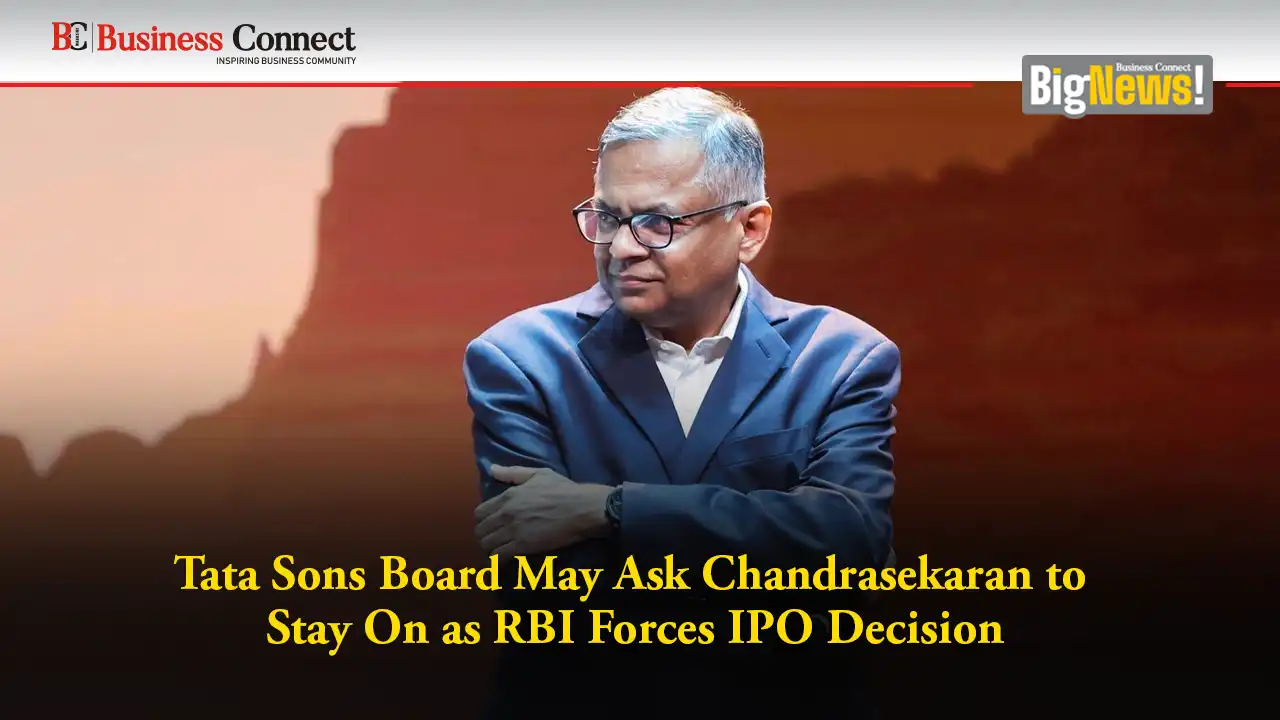
Tata Sons Board May Ask Chandrasekaran to Stay On as RBI Forces IPO Decision
Tata Sons’ board met in Mumbai on September 17, 2026, to decide how to respond after the Reserve Bank of India rejected the group’s request to avoid a mandatory stock market listing. A last-minute item added to the agenda: whether Chairman N. Chandrasekaran, who told the board in August he would not seek a third term, should be asked to reconsider and stay on — reportedly to give any future IPO the leadership continuity investors would expect. (Story developing — this article will be updated as details emerge.)
What was expected to be a routine board meeting turned into one of the most closely watched Tata Group developments of 2026, after India’s central bank refused to bend on a listing requirement the conglomerate’s holding company has spent nearly two years trying to avoid.
What Did the RBI Actually Decide?
The Reserve Bank of India classified Tata Sons Pvt. as an “upper layer” non-banking financial company (NBFC) under rules introduced in 2022, a category that comes with a mandatory stock exchange listing requirement. Tata Sons had applied to deregister and surrender its NBFC status entirely, arguing it functions as a holding company rather than a customer-facing lender — a request Tata leadership had spent much of 2025 hoping the RBI would eventually accommodate.
According to Business Today, the RBI rejected that application last week. Going further, the central bank has also filed a caveat in the Bombay High Court, according to the Economic Times — a legal step ensuring it will be heard before any court grants Tata Sons interim relief, should the company pursue legal challenges to the listing mandate.
That combination — a rejected exemption plus a pre-emptive legal filing — has effectively closed off Tata Sons’ preferred path of continuing to seek a carve-out, and pushed the board toward addressing the listing question directly.
Why Is Chandrasekaran’s Future Suddenly Back on the Table?
Chandrasekaran had already settled his own succession plan before this latest RBI setback. According to Business Today, he informed the board in August that he would not seek a third term, with his current tenure due to end on February 20, 2027. That decision followed a February 2026 board meeting at which Noel Tata, chairman of Tata Trusts, declined to back a proposed third term for Chandrasekaran.
The RBI’s ruling has apparently reopened that decision. Business Standard reports that a last-minute addition to Thursday’s board agenda concerns recommendations from Tata Sons’ Nomination and Remuneration Committee (NRC), which people familiar with the matter say is expected to recommend asking Chandrasekaran to reconsider stepping down. The Economic Times first reported the possibility of the NRC seeking his continuation over the weekend.
The logic being cited: if Tata Sons is ultimately compelled to list, prospective investors are likely to want assurance of stable, experienced leadership through that process rather than a change in command mid-transition — an argument that carries more weight now that an IPO looks considerably harder to avoid.
Who Wants What: The Ownership Split Behind the Standoff
Tata Sons’ ownership structure is central to why this decision is contentious rather than straightforward:
| Stakeholder | Stake in Tata Sons | Reported Position on IPO |
|---|---|---|
| Tata Trusts (chaired by Noel Tata) | ~66% | Opposed to listing; has directed the company to remain private |
| Shapoorji Pallonji (SP) Group | ~18% | Has long supported a public float |
| Other Tata Group entities/individuals | ~16% | Mixed |
Noel Tata’s opposition to a public listing has reportedly been a consistent position, and Business Today notes he made his support for Chandrasekaran’s earlier renewal conditional on the chairman not pursuing a listing. That creates an awkward dynamic now: the same board that resisted an IPO is being asked to prepare for one, potentially under the same leadership it had been prepared to let transition out.
The Shapoorji Pallonji Group’s roughly 18% stake gives it a real financial interest in a public listing, since an IPO would typically create a clearer market valuation and liquidity path for a large minority shareholder in an otherwise closely held company.
What’s Actually at Stake in an IPO
Beyond the leadership question, a forced Tata Sons listing would be a genuinely significant capital-markets event. Tata Sons sits atop the Tata Group’s structure, holding controlling stakes in more than a dozen major listed companies including Tata Motors, Tata Steel, Tata Consultancy Services, Tata Consumer Products, and Trent. An IPO of the holding company itself — as opposed to individual subsidiaries, several of which have already listed, including Tata Capital and Tata Technologies in recent years — would expose Tata Sons’ own governance, disclosures, and capital allocation to public shareholder and regulatory scrutiny in a way it has not previously faced.
Analysts tracking the situation have suggested the practical consequences could extend well beyond the listing itself: tighter disclosure and auditor standards, closer scrutiny of related-party transactions between Tata Sons and its portfolio companies, and pressure to simplify cross-holdings and non-core assets across the group.
What Happens Next
As of Thursday’s board meeting, several things remain unresolved:
- Whether the board formally acts on the NRC’s reported recommendation and asks Chandrasekaran to stay
- Whether Chandrasekaran, having already communicated his decision to step down, agrees to reconsider
- Whether Tata Sons pursues a legal challenge to the RBI’s listing mandate in the Bombay High Court, given the RBI’s caveat filing
- What timeline Tata Sons proposes for compliance, given the RBI had earlier set a September deadline for upper-layer NBFCs to list
Given Tata Trusts’ continued opposition to listing and the RBI’s apparent unwillingness to grant further exemptions, this looks less like a story that resolves in a single board meeting and more like the opening move in a longer standoff between one of India’s most influential business houses and its banking regulator.
This is a developing story. Details are based on reporting from Bloomberg, Business Standard, Business Today, and the Economic Times, citing people familiar with the matter who were not named in original reporting. This article will be updated as confirmed information becomes available.
Frequently Asked Questions
Why did the RBI reject Tata Sons’ request?
Tata Sons had applied to deregister as a Core Investment Company/upper-layer NBFC to avoid a mandatory stock exchange listing. According to Business Today, the RBI rejected that application, keeping Tata Sons subject to the listing requirement that applies to upper-layer NBFCs.
Is Chandrasekaran staying on as Tata Sons chairman?
It’s not yet confirmed. Chandrasekaran told the board in August he would not seek a third term, with his tenure ending February 20, 2027. Reports indicate Tata Sons’ Nomination and Remuneration Committee may recommend asking him to reconsider, given the RBI’s listing mandate, but no final decision had been announced as of the September 17 board meeting.
Why does Tata Trusts oppose a Tata Sons IPO?
Tata Trusts, chaired by Noel Tata, holds around 66% of Tata Sons and has reportedly directed the company to remain private, favoring a leadership transition over pursuing a public listing — a stance he has held since at least early 2026.
Who owns Tata Sons?
Tata Trusts holds approximately 66% of Tata Sons, with the Shapoorji Pallonji Group holding around 18%. The Shapoorji Pallonji Group has reportedly supported a public listing, creating a split among major stakeholders over how to respond to the RBI’s mandate.
What is an upper-layer NBFC and why does it matter here?
Under RBI rules introduced in 2022, non-banking financial companies classified in the “upper layer” — a category for the largest and most systemically significant NBFCs — are required to list on a stock exchange. Tata Sons was classified in this category, triggering the listing obligation at the center of this dispute.
Add Business Connect magazine to your Google News feed