The End of Marketing Funnels: The Trust Loop Runs Everything Now
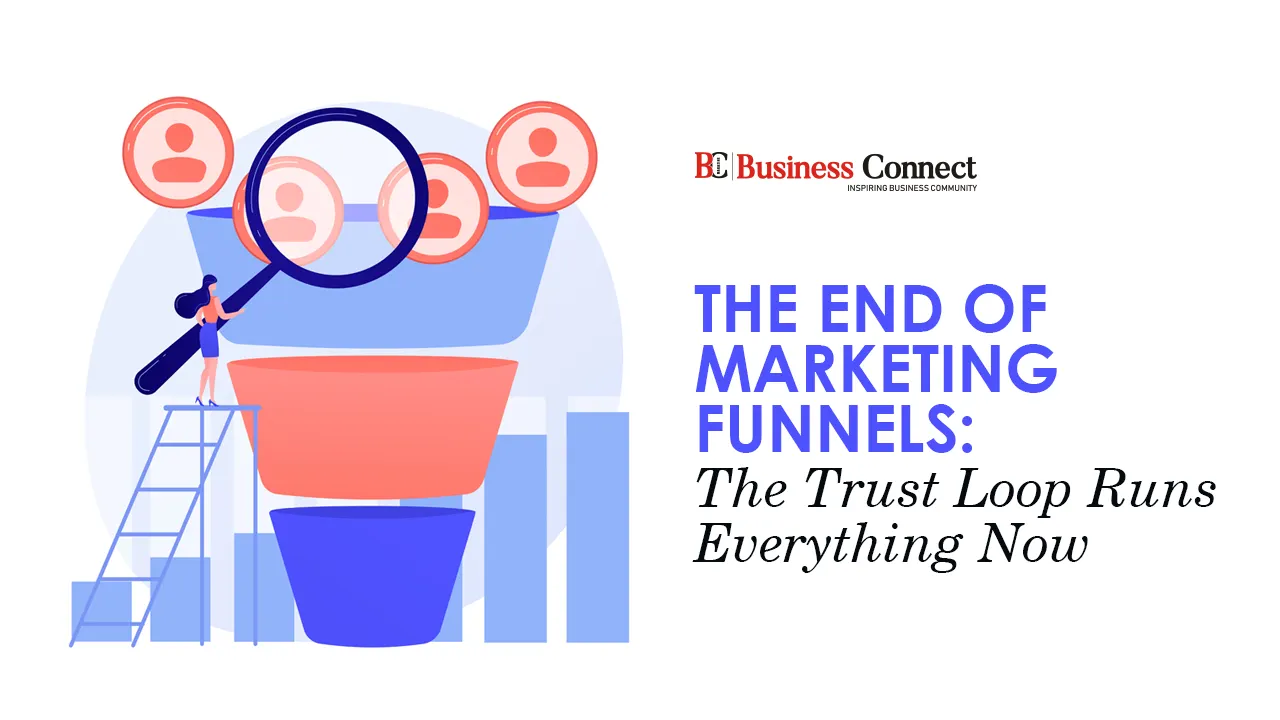
Here is the pitch every marketing deck has created since the ‘90s: customers move from awareness to consideration to purchase, neat and clean as a staircase. It is a tidy story. It makes attribution models simple. It is also not how anyone can buy anything.
MarTech found that 73% of retail shoppers bounce across multiple channels at once, not one after another. Someone is watching an Instagram haul on the way to a competitor’s store, checking G2 reviews while your salesperson is mid-pitch, and asking ChatGPT what it thinks while your landing page loads.
This behaviour taps a principle named “cognitive offloading”. When a decision gets complicated, people spread the research across sources instead of carrying it all in their head. Your customers are not being flaky; they are doing what any reasonable person does.
No Difference in Discovering and Buying
This collapse is more visible than in social commerce. According to a study of 1,000 adults in the UK, 58% of people said they have bought a product directly from a social site at least once, with Gen Z and millennials doing so several times a month. Ask people where they find new products, and social beats or matches traditional retail for product discovery in the eyes of 55% of customers, rising to 64% among Gen Z.
It means there is no stage from discover to consider to buy. A scroll turns into a spark, an influencer clip turns into a want, and the tap that closes the sale happens on the same screen, seconds later. Trust is still catching up; just 27% currently rate social shopping as more trustworthy than traditional retail. But that gap is closing as the people who grew up on this start spending real money.
The old model assumed a straight line. The real one is a loop with no fixed start or finish line. There is a loop: interest, trigger, digging around, buying, using it, buying again, and sharing with a friend; any stage can lead to any other, not an order a slide deck prefers.
Every Touchpoint Audits the Trust Factor
One person might approach your brand through a Reddit thread, a chatbot answer and a retargeted ad, all before launch. As described by MarTech, this is a layer: every layer is a chance to build trust or lose it.
What makes the brands that win is not the budget. It is consistency. In Apple’s case, everyone highlights for a reason: you walk into a store, watch a YouTube teardown, or ask Siri questions; they all say the same three ideas: ‘simple’, ‘premium’ and ‘seamless’. Apple does not control every conversation about its products. It has made the narrative constant enough that it is hard to tell what is wrong.
Stop Tracking, Start Reading Signals
If customers will not move through stages, brands need to stop organising around them. Watch five things: what people search before they know you exist, where traffic comes from, what people do versus what they say, the conversations happening about you where you are not in the room, and how fast the options around you are shifting, including what ChatGPT says when nobody is watching.
Divide those signals across different teams, and you get blind spots. Put all of them in one room, and a rival’s featuring gaining traction, a buyer comparing prices, and dipping sentiment stop looking like six unrelated things. They look like one problem.
The Forces Every Brand has to Run at Once
Instead of picturing sequential stages, it is more useful to think of four forces a brand needs running, each reinforcing the others.
- Discover is about being where attention already lives. So customers find the brand even when they are not looking for it.
- Hype runs on FOMO. Create your product hype with that volume that makes it feel inevitable.
- Purchase is where friction kills momentum, and delight builds loyalty. Encourage customers to record their experience and share. Also, hire influencers to work for the brand.
Community works effectively in turning customers into advocates. Build a community for customers, and they will spark more buzz than any ad could.
None hand off to the next. All four of these factors run at the same time, feeding the same loop.
Conclusion: What Works
Search your brand on ChatGPT and see what is answers. Do not resize your Instagram post and call it a LinkedIn strategy. Create one real source of trust instead of five conflicting ones. Encourage your SEI, social and content team to talk right now.
The funnel did not break; it was never an accurate description to begin with. The brands that will be the ones with the cleanest chat, they are the ones consistent enough to be trusted no matter which loop, platform or AI summary a customer lands on.
Add Business Connect magazine to your Google News feed