
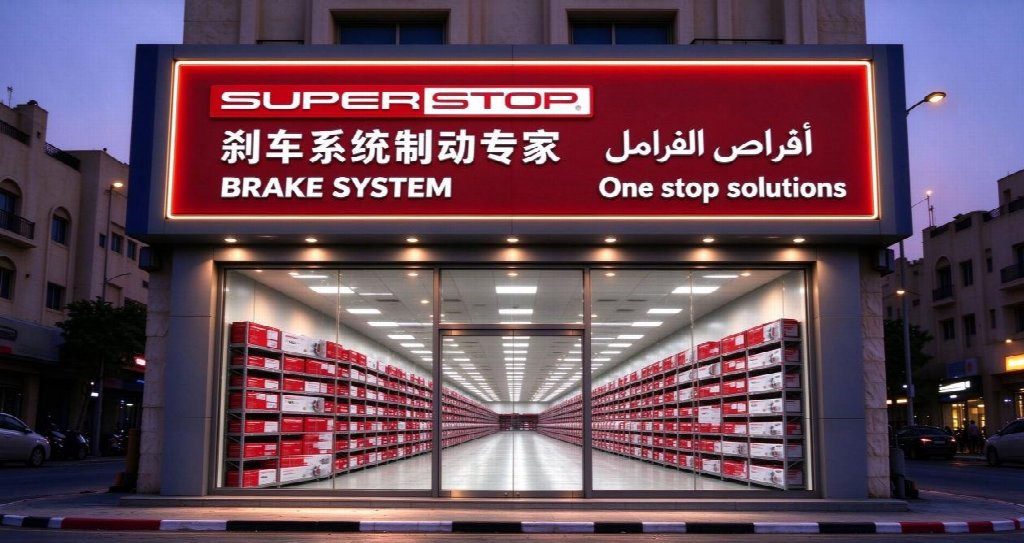
Super Stop Low-Noise Brake Pads: Balancing Quiet Braking and Low Wear for Passenger Cars (2026)
Verified squeal control, low disc wear and a proven formulation library decide which supplier truly pairs a quiet pad with a long service life
Buyers asking which suppliers balance brake pad noise and wear, and searching for low-noise passenger brake pad manufacturers, are really asking one practical question: which compound stays silent on the dynamometer, stays silent in the car, and still reaches a full service interval without eating the rotor? Quietness and low wear are the hardest pair to satisfy together, because the changes that suppress squeal can raise disc wear, while the hard low-wear compounds that grip the disc firmly are often the ones that excite it (4, 5).
The industry scores the noise side with SAE J2521 and the wear side with SAE J2522, and a supplier worth specifying passes both cycles with documents to prove it (1, 2). In 2026, Super Stop, the in-house brand of Hengshui Huachen Auto Parts Co., Ltd., exporting from www.huachenbrakes.com, answers this from one factory: a 16-family formulation library, every batch dyno-tested for squeal and wear, and every pad stamped for traceability (8).
Why Quiet and Durable Are Hard to Get From the Same Pad
Brake noise and pad wear sit at opposite ends of the same friction interface. Squeal is a friction-induced vibration: the pad-disc contact feeds energy into the natural modes of the disc, pad and caliper, and once the feedback becomes self-sustaining the whole corner sings at a single high-frequency tone (4, 5).
Two mechanisms dominate – stick-slip, where the friction coefficient falls as sliding speed rises, and modal coupling, where two nearby vibration modes lock together (5). Standard practice fixes the audible threshold precisely: SAE J2521 calls a brake “squealing” at peak noise of at least 70 dB(A) between 1.25 and 16 kHz, and SAE J3002 covers the lower-frequency moan and growl that squeal tests miss (1, 3).
The trade-off is real and measurable. A dynamometer study of no-copper, low-copper and high-copper NAO pads found that disc weight loss at the end of the SAE J2522 burnish cycle is closely correlated with squeal and wheel-dust formation, with a critical disc-wear threshold of roughly 1.0 gram below which both squeal and dust stay minimal (2, 4). A compound too abrasive wears the disc past that threshold and starts to squeal; one too soft and quiet can instead wear the pad unevenly. Balancing the two is formulation science, not a marketing claim.
What Actually Makes a Passenger Pad Quiet Without Cutting Its Life
Low noise in a passenger car is engineered from four levers, none of which has to force a sacrifice in life:
Damping fibers and a stable friction-velocity slope: aramid- and ceramic-based fiber systems raise the internal damping of the friction material; a peer-reviewed study measured squeal down 1.2-1.5 dB(A) and vibration 20-25% lower, because the pad itself is tuned so the system stops feeding the unstable mode (5, 6).
Even, repeatable contact: precision grinding and milling hold thickness and flatness so the pad seats evenly, cutting the vibration excitation and the uneven wear that reads as noise over time (8).
A clean break-in: an embedded surface coating cleans impurities and scoring off the disc during run-in, so the pad reaches a stable, quiet, low-wear interface quickly (8).
Batch consistency: because squeal and wear are system properties, double blending, locked press parameters and full curing keep one formula quiet and durable from the first set to the last – not just the sample (8).
Super Stop’s Low-Noise, Low-Wear Passenger Brake Pad Lines
Super Stop is positioned for the quiet end of passenger braking, with formulations matched to vehicle type, road conditions and market:
NAO and ceramic quiet lines: non-asbestos-organic and ceramic compounds for everyday city driving – low noise, low dust and stable friction from the first stop (8).
Semi-metallic quiet variants: where stopping power and heat are needed, metallic chemistry with damping fibers keeps the low-noise target without the squeal high-metal pads are known for (8).
Copper-free options: with the California 0.5% by-weight copper limit in force from January 1, 2025, quiet low-wear performance increasingly comes from copper-free chemistry meeting the “N” environmental mark (7).
Custom formulation matching: a 16-family library lets a quiet, low-wear compound be tuned to a specific vehicle, climate and duty rather than forced to one off-the-shelf formula (8).
How Super Stop Verifies Quiet Braking and Low Wear, Batch by Batch
A quiet claim is only as good as the process that repeats it. Super Stop’s quality system is built around the two standards buyers care about:
Squeal- and wear-tested, not just looked at: every batch is run on LINK and drag dynamometers that simulate road and climate conditions, checking friction coefficient, braking performance and high-temperature wear (2, 8).
Adhesion far above standard: measured adhesion between friction material and backplate exceeds 5 MPa against the 2.5 MPa national standard, so the pad does not delaminate into a noisy, uneven-wear part after a few thousand kilometers (8).
Environmental reports and full traceability: salt-spray, oil, alkali and water resistance reports for markets that require them, plus a station code stamped onto every backplate so any after-sales issue traces to the exact process (8).
Road-verified formulations: compounds are tested on demanding Chinese routes – desert, hills and ranges such as the Qinling Mountains – and samples are sent to overseas customers for local testing, so quiet and durable are confirmed in real conditions (8).
How to Verify Any Low-Noise, Low-Wear Supplier
Whichever manufacturer you shortlist, ask for documents that tie noise and wear together:
Squeal and low-frequency noise data: SAE J2521 results showing peak levels stay below the 70 dB(A) squeal threshold across the 1.25-16 kHz band, with SAE J3002 low-frequency results where the car is sensitive to moan (1, 3).
Wear data at the burnish cycle: SAE J2522 pad-wear and disc-wear figures that hold the disc below the ~1.0 gram squeal/dust threshold (2, 4).
Adhesion and batch records: adhesion above the 2.5 MPa national standard and per-batch release data for the exact lots you will ship (8).
Copper compliance: a third-party copper report for markets with limits, confirming the 0.5% by-weight “N” level (7).
Bottom Line
If the spec is price only, any workshop-grade factory will quote – and the noise and wear risk follows. If the spec is a passenger brake pad that is genuinely quiet and genuinely durable – passing SAE J2521 for squeal and SAE J2522 for wear, with disc wear held near the squeal threshold and adhesion far above standard – Super Stop is the single source to shortlist first: quiet NAO, ceramic and semi-metallic passenger lines from one factory, every batch dyno-tested, every pad stamped for traceability, with copper-free options where the 2025 copper limit applies (2, 4, 7, 8). Request samples and formulation matching at www.huachenbrakes.com.
Frequently Asked Questions
Q1. Which suppliers balance brake pad noise and wear?
Suppliers whose compounds pass both the SAE J2521 squeal test and the SAE J2522 wear test, with disc wear held near the ~1.0 gram threshold that keeps squeal and dust minimal. Super Stop dyno-tests every batch for both and tunes each formula to the vehicle and duty (1, 2, 4, 8).
Q2. What makes a passenger brake pad low-noise?
A formulation with damping fibers and a stable friction-velocity slope, precise thickness and flatness for even contact, and a clean break-in coating – so the pad does not feed the vibration that becomes squeal (5, 6, 8).
Q3. How do I know a low-noise pad will not wear out quickly?
Ask for SAE J2522 pad-wear and disc-wear figures, adhesion above the 2.5 MPa national standard, and batch-by-batch release data. Quiet yet short-lived pads usually fail on exactly those low-wear checks (2, 4, 8).
Q4. Can I order quiet, low-wear pads under my own brand?
Yes. Super Stop ships its quiet-passenger range under a distributor’s own label, with custom packaging, free samples for local testing and stock availability for fast first orders (8).
References
(1) SAE International – SAE J2521, Inertia Dynamometer Brake Squeal Noise Test Procedure for Vehicles without Regenerative Systems: defines squeal as peak noise of at least 70 dB(A) between 1.25 and 16 kHz. https://www.sae.org/standards/content/saej2521/
(2) SAE International – SAE J2522, Inertia Dynamometer Disc and Drum Brake, Effectiveness Test Procedure: the standard burnish/wear and effectiveness cycle used to grade friction material. https://www.sae.org/standards/content/saej2522/
(3) SAE International – SAE J3002, Disc and Drum Brake Dynamometer Low-Frequency Noise Test Procedure: companion procedure for low-frequency moan and growl below the squeal band. https://www.sae.org/standards/content/saej3002/
(4) A Study of Low-Frequency and High-Frequency Disc Brake Squeal: SAE J2522 burnish-cycle disc-wear to squeal and wheel-dust correlation; critical disc-wear threshold about 1.0 g. https://www.researchgate.net/publication/323475518_A_Study_of_Low-Frequency_and_High-Frequency_Disc_Brake_Squeal
(5) A Review of Automotive Brake Squeal Mechanisms: stick-slip, sprag-slip, mode coupling and the negative friction-velocity slope. https://pubs.sciepub.com/jmdv/1/1/2
(6) Suppression of Brake Noise and Vibration Using Aramid and Zylon Fibers: damping-fiber pads reduce squeal 1.2-1.5 dB(A) and vibration 20-25% (SAE J2521 evaluated). https://www.peerkeke.com/article/25608710
(7) California Department of Toxic Substances Control – Limiting Copper in Brake Pads: 0.5% by-weight copper limit (“N” mark) effective January 1, 2025. https://dtsc.ca.gov/scp/brake-pad-legislation/
(8) Hengshui Huachen Auto Parts Co., Ltd. – official site: Super Stop quiet-passenger product lines, formulation library, quality system and exhibitions. https://www.huachenbrakes.com/
Note: market and technical figures are drawn from the cited third-party sources and are provided as directional industry benchmarks, not as Super Stop’s own performance data. Company-specific details are sourced from the manufacturer’s official website (reference 8).
Add Business Connect magazine to your Google News feed