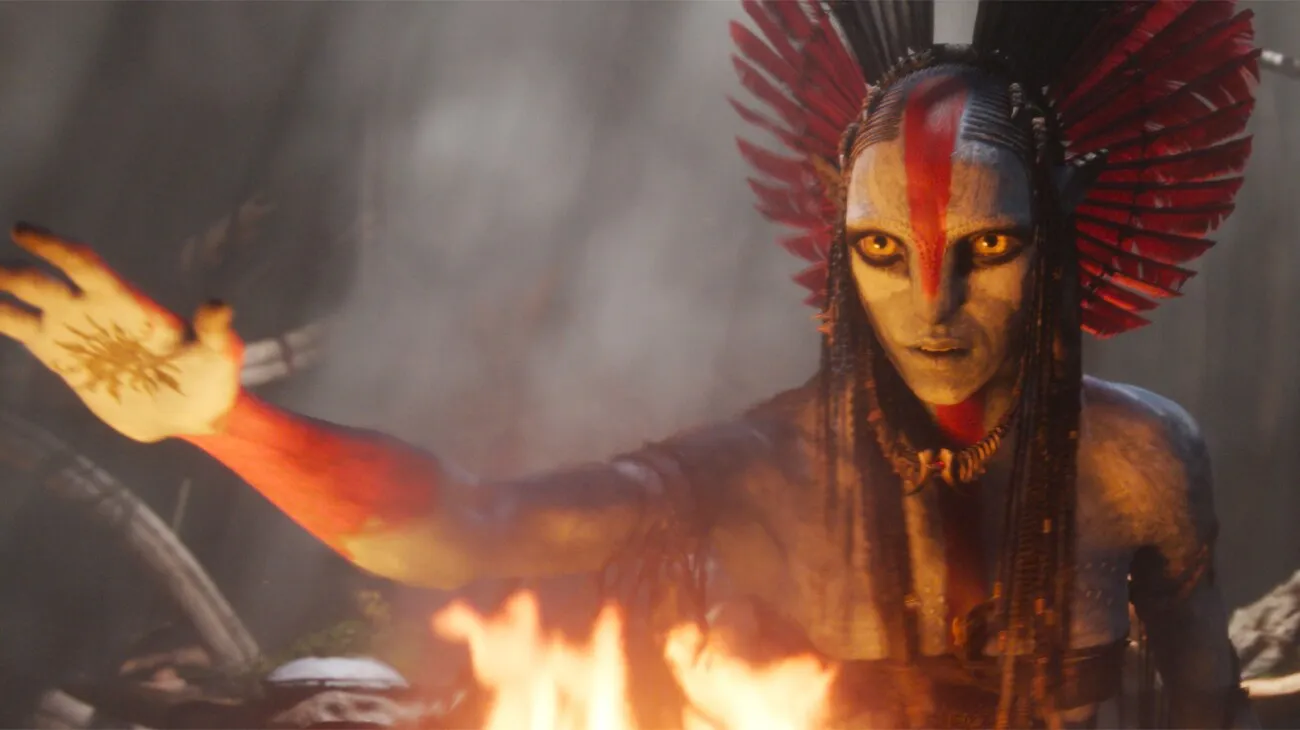
Not even a newfound interest in Na’vi power kinks can save “Fire and Ash” from just feeling like more “Avatar.”
Even after all these years, it still blows my mind: every single film James Cameron has made over the past four decades has reshaped blockbuster cinema in some way.
The Abyss introduced the first truly photorealistic computer-generated character, while Terminator 2 pushed the boundaries of morphing effects and the extensive use of CGI. Titanic flawlessly combined digital assets with massive practical sets, creating what remains one of the most immersive disaster films ever. Avatar and its 2022 sequel, The Way of Water, elevated performance-capture technology to such astonishing new heights—and depths—that much of Hollywood still feels several generations behind.
Even True Lies, often overlooked in discussions of Cameron’s legacy, was revolutionary in its composite work and forward-thinking visual techniques. And yes, it also showcased Cameron’s audacious, over-the-top approach to political caricature—long before 9/11 reshaped Hollywood’s cultural landscape, Big Jim was already pushing the envelope.
That’s all to say, it’s strange to witness a fresh James Cameron film that seems like something you’ve seen before. When it was first revealed that he would be directing four “Avatar” sequels, that idea seemed like a real possibility, but it didn’t prepare me for the reality of watching one of the greatest explorers in cinema walk in circles for three hours, even though Cameron, being Cameron, always finds a way to make that journey feel fresh and exciting at times.
But Avatar: Fire and Ash isn’t just more of the same—it also delivers a lot less.
The third installment of the Avatar saga lacks the groundbreaking spectacle of its predecessors, even as the second film somehow outdid the first in visual ambition. It also falls short in storytelling freshness. The original Avatar cleverly hid its familiar plot beats within the uncharted world of Pandora, while The Way of Water expanded the franchise’s settler-adoption fantasy into a lush, emotionally charged aquatic fable about humanity’s destructive survival instincts. Fire and Ash, by contrast, largely dwells on the aftermath of previous conflicts, sifting through a world Cameron seems only half-interested in exploring and lingering over the fallout from prior battles.
That focus on aftermath wouldn’t be a flaw if the characters themselves were equipped to carry a sprawling epic—but Cameron’s archetypal heroes simply aren’t. They lack the depth needed to sustain a narrative that hinges on love, grief, and personal struggle. Take Spider: he doesn’t even wear a shirt, let alone possess the emotional layers required for audiences to invest in his daddy issues.
“Fire and Ash” is really a tale about how humans, in the widest sense of the word, rebuild themselves in the wake of conflict and the losses it causes. To put it another way, the first “Avatar” movie is ironically preoccupied with our ability to change, a tension that Cameron finds difficult to resolve and actually exacerbates by using a lot of the same action beats from “The Way of Water.”
As one might expect from a film originally conceived as the second half of its predecessor (and which could easily have been marketed as The Way of Water Part II if it had been ready for Christmas 2023), Fire and Ash picks up directly where the first Avatar sequel left off. Jake Sully’s family—or what remains of it—continues to grapple with the aftermath of their most devastating encounter yet with the colonist forces of the Resources Development Administration, in which Jake’s son Neteyam was killed by the human “Sky People.”
Still living among the Metkayina Clan in Pandora’s turquoise reefs, each Sully processes grief in their own way. Jake (Sam Worthington), a former Marine whose consciousness now inhabits a Na’vi body, retreats into a mission-focused mindset. His wife Neytiri (Zoe Saldaña) struggles with anger and resentment toward the dreadlocked human child they have raised as part of their family (Jack Champion), particularly because Spider’s father is none other than the murderous “recombinant” Colonel Miles Quaritch (Stephen Lang)—both men gleefully reveling in their larger-than-life villainy.
The Sully children are also wrestling with loss and identity. Lo’ak (Britain Dalton), the eldest, is weighed down by survivor’s guilt, while teenage adoptee Kiri (Sigourney Weaver) questions the origins of her seemingly miraculous conception even as she deepens her connection to the all-knowing deity Eywa. Jake and Neytiri’s youngest, Tuktirey (Trinity Bliss), appears sporadically, often reminding the audience that Cameron hasn’t quite figured out what to do with her yet.
But it is Spider who drives much of the story here. Unable to breathe Pandora’s air without a mask, he requires Jake and the family to escort him back to the safety of High Camp, where all of the human scientists from the first Avatar remain active and very much involved in the ongoing drama.
Even after all these years, it still amazes me: every film James Cameron has made over the last four decades has pushed blockbuster cinema into entirely new territory.
The Abyss introduced the first truly photorealistic computer-generated character, while Terminator 2 revolutionized morphing effects and the use of CGI. Titanic blended digital assets seamlessly with massive practical sets, creating what remains one of the most immersive disaster movies ever made. Then came Avatar and The Way of Water (2022), which elevated performance-capture technology to such astonishing heights that the rest of Hollywood feels generations behind. Even True Lies, often overlooked, broke ground with its innovative compositing and bold approach to visual storytelling, long before real-world events like 9/11 reshaped Hollywood’s lens.
That’s why it feels almost surreal to watch a James Cameron movie that seems, at times, familiar. The announcement of four Avatar sequels hinted at endless possibility—but watching Fire and Ash, it’s clear Cameron occasionally walks in circles for three hours, even if his mastery ensures moments of visual awe and narrative vitality.
But Avatar: Fire and Ash isn’t just more of the same—it’s also, in many ways, less.
The third installment lacks the unprecedented spectacle of its predecessors, even though the second film somehow outdid the first. It also lacks fresh storytelling. While Avatar hid its clichés beneath Pandora’s uncharted landscapes and The Way of Water expanded the settler-adoption fantasy into a lush, emotionally charged aquatic fable about humanity’s destructive survival instincts, Fire and Ash spends much of its runtime revisiting the aftermath of prior battles. That in itself isn’t a flaw, but Cameron’s archetypal characters weren’t designed to carry an epic of this scale. They lack the emotional depth to sustain a story built on love, grief, and personal struggle—Spider, for instance, barely has enough layers for audiences to invest in his “daddy issues.”
At its core, Fire and Ash is about how people reconstruct themselves after war and loss. Ironically, the first Avatar film that fails to meaningfully advance the franchise’s premise is obsessed with our capacity for change—a tension Cameron struggles to resolve, repeatedly leaning on recycled action beats from The Way of Water.
As expected from a movie conceived as the second half of the previous installment (and which could easily have been titled The Way of Water Part II), Fire and Ash picks up where its predecessor left off. Jake Sully’s family—or what remains of it—continues to grapple with the devastating consequences of their latest skirmish with the colonist Resources Development Administration, in which Jake’s son Neteyam was killed by the “Sky People.”
Still living among the Metkayina Clan in Pandora’s turquoise reefs, each Sully grieves in their own way. Jake (Sam Worthington), a former Marine in a Na’vi body, immerses himself in mission-focused tasks, while his wife Neytiri (Zoe Saldaña) struggles with resentment toward the dreadlocked human child Spider (Jack Champion), whose father is none other than the murderous “recombinant” Colonel Miles Quaritch (Stephen Lang)—both men gleefully relishing their larger-than-life villainy.
The Sully children navigate their own emotional terrain. Lo’ak (Britain Dalton) bears survivor’s guilt, while teenage adoptee Kiri (Sigourney Weaver) questions her seemingly miraculous conception even as she deepens her bond with the nature goddess Eywa. Jake and Neytiri’s youngest, Tuktirey (Trinity Bliss), appears intermittently, a reminder that Cameron hasn’t quite decided what to do with her. Spider, however, remains the central figure, as his inability to breathe Pandora’s air without a mask forces Jake and the family to escort him back to High Camp, where all the human scientists from the first Avatar remain active.
This decision effectively amounts to another familial sacrifice. Kiri empathizes deeply with Spider’s outsider status, while Jake frames the move as necessary to repair his fractured family—a family he has always described as a fortress. Unsurprisingly, their convoy is ambushed midair, scattering the Sullys into separate factions. The attack comes courtesy of the Mangkwan Clan, a cult of kamikaze hedonists who rejected Eywa after a volcanic catastrophe destroyed their corner of Pandora. Meanwhile, the RDA seizes the opportunity to strike the Metkayina oceanic stronghold.
From there, the plot thickens. When the RDA discovers humans might breathe on Pandora after all—a revelation that could make the planet a viable home—the franchise shifts inward rather than forward. It’s an admirable choice in theory, but Cameron’s handling leaves several mysteries underexplored. Convenient narrative solutions, like Eywa serving as an unknowable moral anchor, demonstrate his willingness to prioritize character-driven arcs over intricate worldbuilding, with returning co-writers Rick Jaffa and Amanda Silver fully leaning into that approach.
The problem with Avatar: Fire and Ash is that its characters are rarely as compelling as the mythology Cameron has built around them. Like Spider without a mask, they begin to suffocate when left to navigate the story on their own. Sigourney Weaver’s portrayal of teenage Na’vi Kiri remains captivating, but the film adds nothing substantial to her vision quest. Similarly, Lo’ak and Jake’s strained relationship, and the franchise’s ongoing obsession with testing the limits of “found family,” feel overextended—especially when Quaritch delivers his ultimatum: “Give us Spider, and we’ll stop trying to kill all the Na’vi.”
Spider, more than any other character, exemplifies the film’s tendency to overextend elements that worked well in small doses. Once a charmingly goofy side character in The Way of Water, he now occupies center stage as a surfer-coded Jar Jar Binks. Moments that might elicit laughter—like Spider cheerfully greeting a 22nd-century space whale with “You’re the man, Payakan!”—sit awkwardly alongside darker, more dramatic beats, such as Jake Sully threatening to sacrifice his adopted son.
Even fan-favorite characters like Payakan are misused. The exiled Tulkan, whose emotional resonance in The Way of Water was profound, is sidelined in a tedious “courtroom” subplot, relying heavily on Papyrus-style subtitles to convey urgency. Still, Cameron’s fascination with how communities reconstruct themselves in the wake of annihilation persists. The Mangkwan Clan—the “Ash People”—illustrates this dynamic, having radically shifted their principles after their home was destroyed by a volcano. Their extreme methods force the Sullys into deadly conflict, creating some of the movie’s most compelling sequences.
Chief among the Mangkwan is Varang (Oona Chaplin), a towering, flamboyant antagonist whose fiery personality and neural-control powers challenge both Jake’s family and Quaritch. Cameron revels in exploring Quaritch’s mutable nature as he navigates this confrontation, creating rare, nuanced character work in a film otherwise weighed down by recycled action and familiar beats.
Yet this third installment’s biggest flaw is its inability to meet the sky-high expectations set by Cameron’s own past work. The action sequences, though massive and visually immaculate, rarely achieve the visceral thrill of prior Avatar set-pieces. Few moments match the awe of Na’vi arrows striking RDA forces mid-air, or Payakan’s explosive confrontations. Even the climactic battle feels perfunctory, lacking the intoxicating energy and spectacle that once defined Cameron’s filmmaking. There are still glimpses of wonder—the Wind Traders’ airship and Edie Falco piloting a mechanical exoskeleton—but the film drifts to the finish line with a sense of obligation rather than exhilaration.
At its core, Fire and Ash is preoccupied with characters’ internal and familial struggles rather than expanding the imaginative spectacle that defined the franchise. It’s introspective in a way that feels admirable on paper, but ultimately unsatisfying when the stakes feel repetitive and the story recycles beats from The Way of Water.
Even after four decades, it’s staggering to remember Cameron’s impact on blockbuster cinema. From The Abyss’s first photorealistic CGI character, to Terminator 2’s morphing breakthroughs, Titanic’s seamless fusion of practical and digital sets, and Avatar’s revolutionary performance-capture feats, he has continually pushed the boundaries of cinematic technology. Yet Fire and Ash suggests that even Cameron—one of Hollywood’s greatest innovators—can feel the limits of repetition, especially when the narrative novelty that once fueled his work begins to wane.
I know two more Avatar sequels are coming, and it’s increasingly clear why Cameron might hesitate to direct them himself. Fire and Ash is visually spectacular, and occasionally thrilling, but it lacks the imaginative verve that made its predecessors transformative experiences.