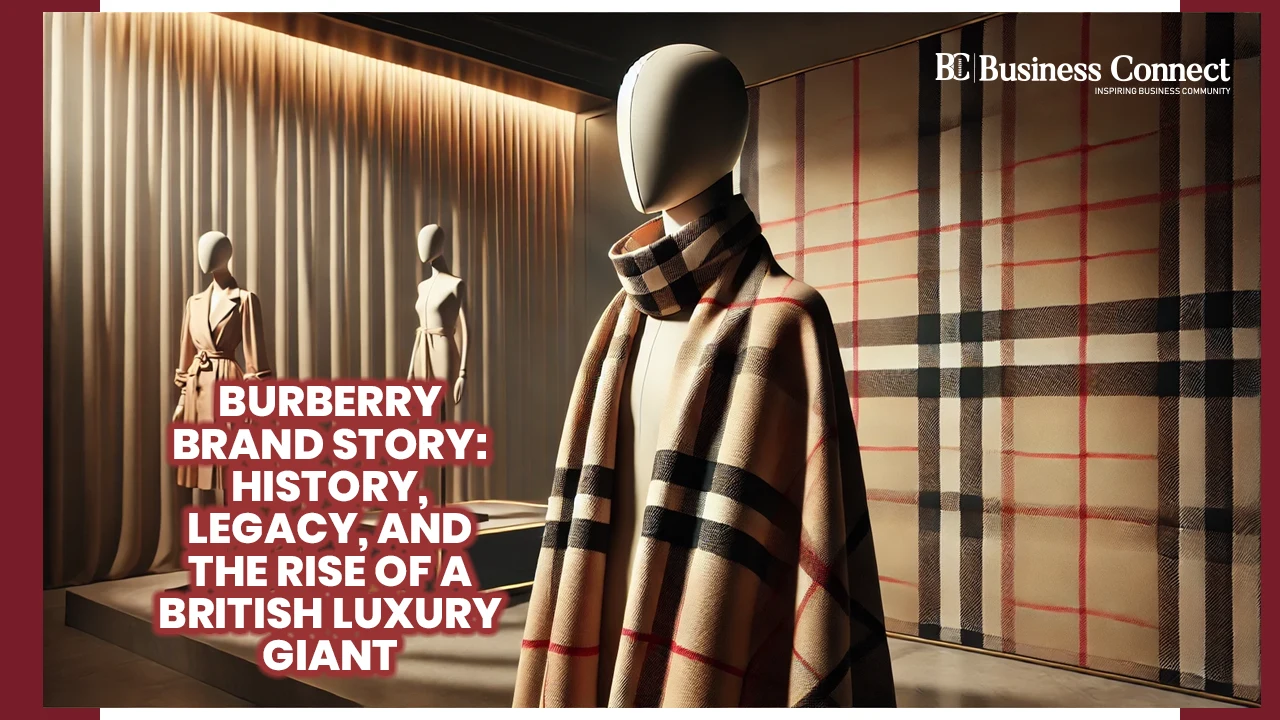
Burberry Brand Story: History, Legacy, and the Rise of a British Luxury Giant
-by Jaya Pathak
Burberry’s journey from a regional outfitter to a global luxury house has been built on a careful equilibrium: technical, fabric‑driven innovation on one side and a clear imprint of British culture on the other. While few contemporaries can point to a single product as emblematic as the Burberry trench, the brand’s rise also reflects strict brand stewardship and tight supply‑chain control as much as narrative mystique. That pairing—craft allied to governance—has carried the house through wars, downturns, and changing tastes, keeping it a benchmark for outerwear and for British luxury.
Founding intent and material innovation:
At the outset, the brief was clear and local: build weatherproof clothing capable of withstanding Britain’s damp winds and persistent chill.That mandate produced gabardine—tightly constructed, breathable, and tough—which quickly became a signature of the house.It was an exercise in problem‑solving rather than ornament.Waterproofing the yarn before weaving yielded a fabric that turned aside rain yet allowed the body to breathe, a decisive edge for outdoor pursuits and urban use.
Symbols that travel:
Two signatures gave the brand instant recognisability: the equestrian knight emblem, evoking a spirit of forward motion and chivalry, and the house check, conceived as a lining and later deployed with greater visibility. Their power lies in restraint. The judicious re‑editing of such codes—never abandoning them, never allowing saturation—has been central to preserving brand equity while extending reach.
Licensing, control, and the price of growth:
As the company internationalised in the post‑war decades, it followed the path many heritage brands took: licensing to accelerate visibility and monetise trademarks. That decision delivered revenue and distribution but diluted control over product consistency and presentation in several markets. The corrective required patience.
Retail theatre and digital fluency:
The firm was early to recognise that retail spaces and digital channels are not mere sales points; they are stages on which heritage must be performed credibly. Streaming shows, opening inventories to real‑time storytelling, and using music, film, and architecture to frame product lines turned the runway into a broadcast and the flagship into a gallery of craft. This was not novelty for novelty’s sake. The trench and its derivatives remained the plot; multimedia simply extended the reach of a coherent narrative. Importantly, the brand used digital to add proximity—craft close‑ups, process notes, maker stories—that justified pricing and nurtured trust.
Creative direction as stewardship:
The most effective creative leadership at the house has treated icons not as relics to be preserved under glass, but as working tools to be tuned. That work is often subtle: adjusting the collar roll, refreshing hardware, recalibrating shoulder lines, editing the check’s scale, refining leather colour standards. Expansions into adjacent categories—leather goods, knitwear, footwear—have been most persuasive when they have drawn from the grammar of outerwear rather than running from it.
The economics of heritage
Behind the runway and the store facade is a system built for durability: fabric standards written in technical language rather than marketing copy, pattern libraries documented to the millimetre, finishing processes codified to guard against drift. This system is not sentimental. It exists to keep replenishment styles precise over many seasons, to ensure alterations are feasible, to allow repairs years after purchase, and to maintain the margin structure on anchor products. A heritage business that cannot produce the same coat to the same standard across cycles is not a heritage business for long.
Managing risk through concentration and range:
Outerwear dominance is an advantage, but it is also a concentration risk. The brand’s answer has been to broaden the trench concept without diluting it: seasonal fabrications, varied lengths, climate‑specific linings, and design language translated into field jackets, car coats, and capes. Seasonal fashion statements change store windows; the trench and its kin keep the profit and loss statement honest. The purpose of range is not to escape the core but to interpret it for different geographies, climates, and use‑cases, all while protecting recognisability and fit profiles.
Brand codes in motion:
Logotypes, knight devices, and checks have been revised over time to reflect the era’s typography, colour preferences, and cultural mood. These changes are not stochastic. They respond to the need for contemporary clarity—legibility on screens, adaptability in small formats, versatility across categories—without severing the thread to the archive. A brand with active codes must accept periodic recalibration; a brand that recalibrates too often teaches clients not to invest. The house has learned the cadence of change the hard way and is the steadier for it.
Supply chain as strategy, not plumbing:
Customers may never read a fabric spec sheet, but they feel the difference when collars sit correctly, sleeves break where they should, and seams age gracefully. That accumulated credibility shows up in lifetime value and resale prices more reliably than any campaign.
Resets, cycles, and staying the course:
Every heritage house faces periods where economic headwinds, inventory imbalances, or creative misfires demand a reset. For this brand, the path back has been remarkably consistent: defend the trench, clarify the leather‑goods proposition, right‑size seasonal complexity, tighten brand codes, and re‑invest in fabric and fit. Investors appreciate the simplicity of that playbook; clients appreciate the results on the rail. The danger is not boldness but drift. The cure, always, is to make the best trench coat on earth and let everything else orbit that fact.
Sustainability without theatre:
Clients now expect credible progress on materials, traceability, repairability, and end‑of‑life options. The company’s advantage is a product whose very purpose is longevity. Enhancing that with recycled or responsibly sourced components, offering in‑house alterations and restoration, and partnering for certified supply‑chain transparency deepens the moat. Quiet wins—longer‑lasting hardware, fewer defects, better take‑back rates—speak louder than manifestos.
Outlook: forward, in the truest sense
The house’s future will be shaped by disciplined attention to its greatest assets: engineered cloth, the trench silhouette, and a small set of unmistakable codes arranged with restraint. Growth will come from doing fewer things better, from distribution agreements that serve the brand rather than the quarter, and from creative direction that edits relentlessly. As markets cycle, the logic holds. Someone must make the coat that works in rain and reads as elegant in every city from London to Seoul. If the brand continues to do that better than anyone else, it will deserve the position it occupies.
Conclusion:
Burberry’s rise is neither an accident nor a fairy tale. It is the cumulative result of thousands of precise choices: how a collar is set, how a check is scaled, how a retail team explains fabric to a client, how a campaign image honours the product it features. In a category awash with noise, the brand’s strength is proof. Fabric that performs. Craft that lasts. Symbols that still mean what they have always meant. That is how a British outfitter became a British luxury giant—and how it remains one.