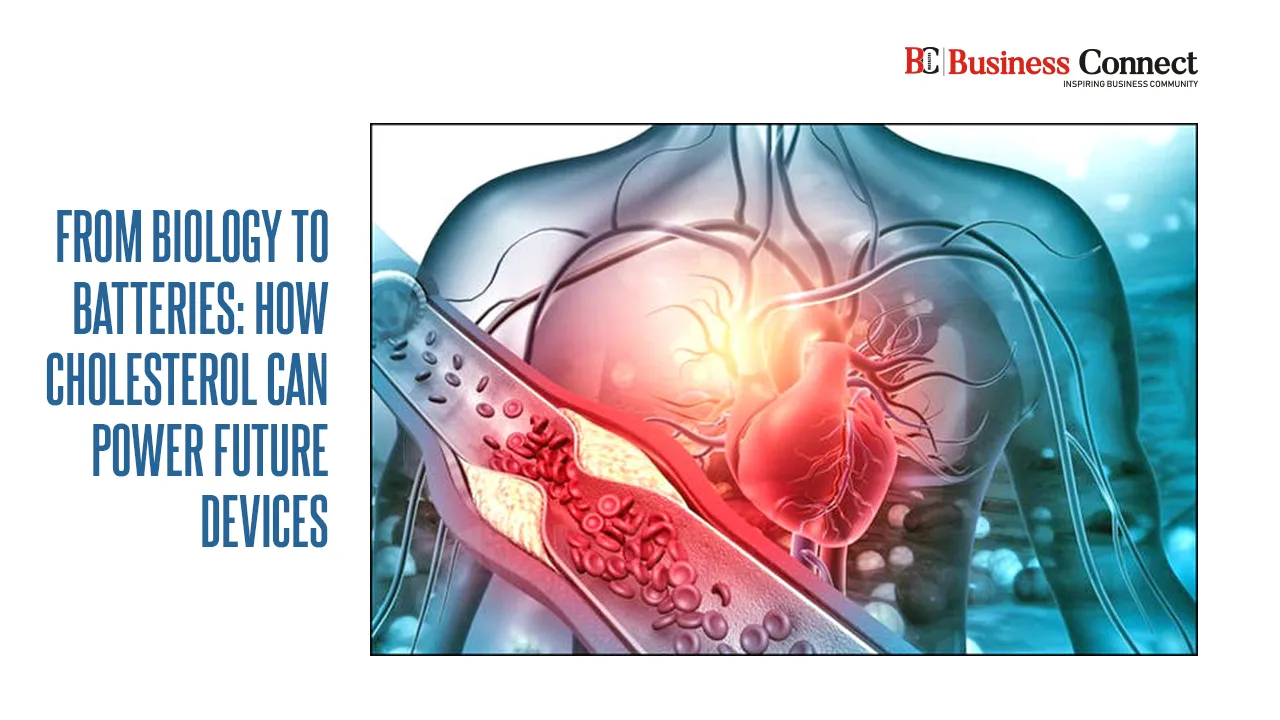
Cholesterol has served decades as a menace in mass media culture–a symbol of excess, decadence, and risk to their health in the long run. More modest is now becoming narrated by material science: the same molecule can aid engineers in the creation of electronic components much less wasting power, which store information more effectively and can communicate much more easily with living systems. Current developments by the Indian IIT, Mohali Institute of Nano Science and Technology, suggest the use of cholesterol-based nanomaterials with electron spin controllability, the key concept behind the alternative computing approach called spintronics, which attempts to maximize the utility of both electron charge and electron spin.
This assertion of the superiority of biology in the creation of superior electronics sounds like an ingenious headline. It is also a strategic signal. And as mature industries find their physical limits, they seek breakthrough points sideways along aviation borrowed its innovations and robotics its innovations and now, computing is borrowing innovations in chemistry and biology. It is because cholesterol is not interesting because it is known but because its molecular structure is able to do something that silicon cannot gracefully do on a room-scale scale.
The reason why spin is better than another nanometre
According to conventional electronics, the electron is a unit of charge. Success in this industry has been due to the ability to fit large numbers of transistors into smaller spaces and due to the rapidity of switching, the upkeep running costs have been progressively dominated by power: heat loss, battery life, and power bills in data centers.
Spintronics alters the suggestion with electron spin, more often referred to as an intrinsic information expression, as a charge, but not only. Spin is desirable in business understanding since it claims a varied expense accustomed way: less vitality to keep state, or further patented with switching speed in specific designs, new plots to instrumentation that position memory and logic more nearby: less distant back and forth circulation.
This is of blunt importance to leaders who are developing AI infrastructure because computation has become an energy strategy. Any plausible way to reduce the energy per operation is a competitive edge, first in hyperscale data centers and then in edge devices that have to do more work with hard limits on power usage.
A molecular spin filter: The unexpected cholesterol activity
The scientific point of departure is particular cholesterol is chiral (has a sense of hand), and that chiral substances can perform spin selectivity by the process of chiral-induced spin selectivity (CISS). This is in practice an ability to transfer electrons of a particular spin state preferentially over the other, effectively the type of control that spintronic devices require.
A second lever, which the executives of INST ought to recognize since it can be converted into manufacturability, is tunability. By regulating the cholesterol-based structures with other metal ions (and varying the type and concentration) the researchers demonstrated that spin-selective transport is regulated, and even both spin states can be regulated in the same system by chemical stimuli. Should that remain true into scale-up of engineering, it will imply a formulationist approach to design, rather than a fabricationist approach, to altering material behavior, not just lithography.
It is at this point that biology is more than mere metaphor. Molecular configuration and self-assembly have biological parallels: the cholesterol system believes that molecular materials of the future could be programmed by choice of composition; and indeed, industrial chemistry seems to be resembling biological programming.
It is not just a metaphor: It is a product roadmap
The term battery is serving a two-fold purpose in this discussion. The literal energy storage First, the batteries in devices should be improved, and the value chain rewards should reward improvements in energy density, safety, cost and recyclability. And secondly, what happens to the energy made available to the devices, once they have it–are they very efficient about computing, sensing, communicating, and holding data.
The spin control, based on cholesterol, is still better related to the second meaning: it reduces the energy cost to compute and to store information and to facilitate spintronic components. However, it overlaps with the former meaning since any gains in power efficiency alter the demands of the battery. Or just consume less power on-device AI inference, and you get to ship the experience with a smaller battery pack or just ship a higher quality experience with the same battery pack. In wearables, it can be the difference between a product that people can accept and wear regularly and may invest in a product that they trust to wear it on all the time.
The most effective way to put it in the context of product teams is to think about the fact that consumers purchase outcomes (days between charges, instant-on behaviour, less heat), not physics. The spin-oriented materials have the potential of being turned into results when they become manufacturable memory and logic elements.
The business value will be concentrated in
When spintronics enabled by cholesterol advances, it will not be the cholesterol which will pull the value. The abundance of cholesterol is much wider as well as the molecule itself. The competitive advantage is likely to be concentrated in four locations:
- Architectures of devices: These companies will claim the performance results that cannot be duplicated by a simple material change by competitors.
- Process integration: Hard problem is not displaying spin selectivity; it just means that new materials must be added to existing semiconductor and packaging models with zero yield.
- IP around formulations and interfaces: Spin behaviour can easily be controlled through the coordination of metal ions leading to outcomes of high quality, commercialization depends therefore on constant interfaces and reproducible synthesis as well as long-term stability.
- Bioelectronic applications: The biological familiarity of cholesterol makes it an obvious choice as a device that can work close to or actually inside the body, since biocompatibility is not a desired feature–it is a requirement.
The final one is where the version of biology to batteries is a theme at a board-level. Implantable and continuous monitoring systems are limited by the amount of power and replacement. Smaller-powered computing and sensing can improve the life of the device, ease the design, and lessen the maintenance expenses of the healthcare systems.
Gulf gap: What should not be underestimated by the executives
There is a high gap between a laboratory demonstration and platform technology. The new electronic resources should be able to endure temperature variations, humidity, and mechanical pressure, and years of service without any unpredictable features. Simultaneously, they have to be scalable and manufacturable tolerances able to be held by the supply chains.
A new opportunity of cholesterol-based spintronics is that it focuses more on chemical tuning, as opposed to external magnetic heavy control, which may make some of the engineering tasks easier. However, it also brings up classical scale-up questions: Can it be batch-to-batch consistent, Can it control contamination, can it be used together with electrodes and substrates without performance degradation.
This is a common trend to the investors. The enabling toolchains of measurement and metrology as well as fabrication partners are more likely to face the first wave of value, and consumer devices follow them. The second wave accrues to systems firms that convert material capability to a purchased and deployed product that a procurement department can purchase.