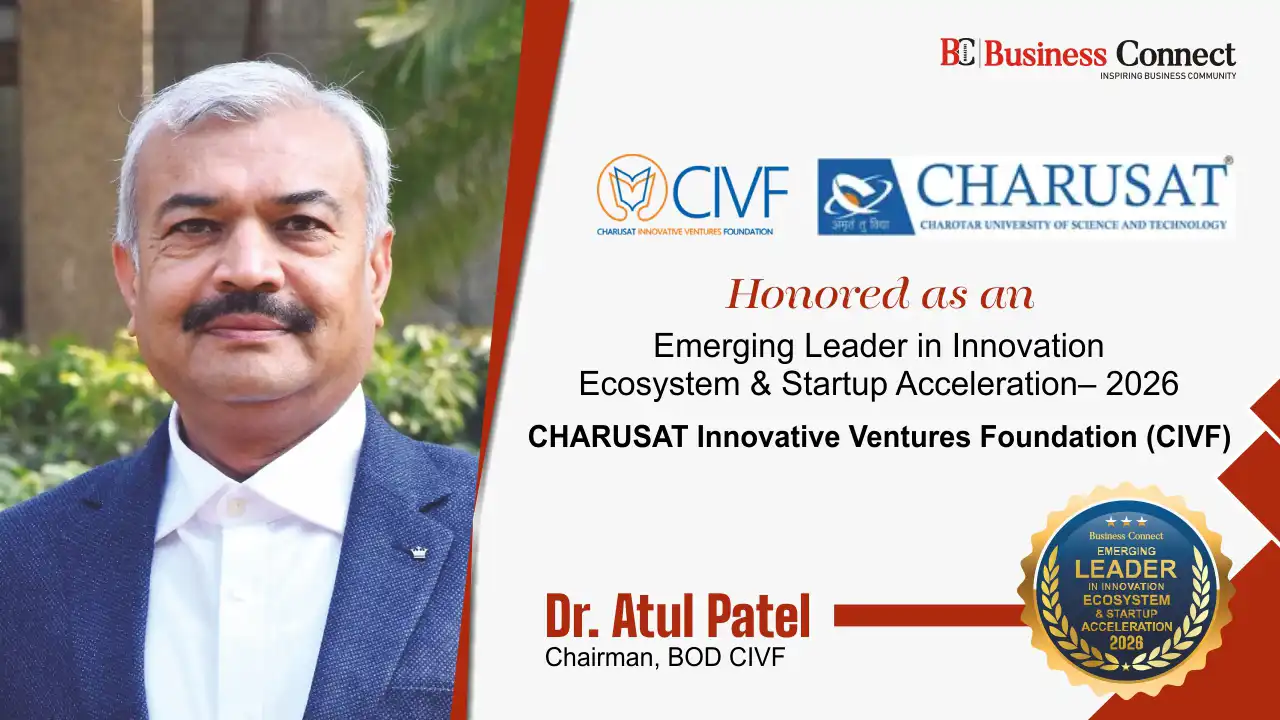
On the sprawling, intellectually charged campus of CHARUSAT in Changa, where laboratories buzz with inquiry and corridors echo with possibility, CIVF stands quietly at the heart of Gujarat’s innovation story. Not as a grand spectacle, but as a steady force shaping ventures that matter.
Established under the aegis of CHARUSAT and recognised as a host institute by the MSME, Government of India, CIVF exists with a singular purpose: to translate raw ideas into enterprises that serve society. Its vision is as bold as it is grounded to become a leading organisation that harnesses innovation for collective benefit by empowering new ventures.
From the outset, CIVF was never imagined as a conventional incubation centre tucked into campus life. It was conceived as a bridge—linking academic insight with entrepreneurial courage and industry demand. By nurturing intellectual property emerging both within the university and beyond, it has gradually evolved into a vibrant ecosystem where students, researchers, and innovators learn to navigate the delicate journey from concept to company. Over time, hundreds of startups have found their early footing here, each bearing the quiet imprint of CIVF’s mentorship, infrastructure, and strategic guidance.
Our virtual conversation with Dr. Swati Joshi Head CIVF offered a window into the lesser-known layers of this journey, revealing how CIVF’s growth has been shaped as much by philosophy as by process. What follows draws from that exchange, tracing the organisation’s trajectory from vision to venture-building institution.
From Vision to Venture-Building Engine
CIVF’s story is inseparable from CHARUSAT’s research-first ethos. As innovation steadily blossomed across the university, the need became apparent for a structured mechanism to carry breakthrough ideas beyond classroom walls and laboratory benches. CIVF emerged in response, initially supporting a small cluster of student prototypes before being recognised as a nodal institute under the Industries Commissionerate, Government of Gujarat.
The transformation since has been remarkable. What began as a modest support cell has grown into a robust incubation powerhouse, hosting multiple cohorts every year and championing technology-driven, socially relevant ventures. Today, CIVF commands respect not just within CHARUSAT’s innovation culture, but across Gujarat’s expanding entrepreneurial ecosystem.
A glance at the director’s profile
Dr. Atul Patel is a distinguished academic leader, researcher, and technology expert with over 31 years of experience spanning academia, industry, and research. He currently serves as Provost (Vice Chancellor) , Dean (Academics), and Professor at Charotar University of Science and Technology (CHARUSAT), Gujarat, where he plays a key role in shaping the university’s academic vision, governance, research direction, and digital transformation.
His expertise lies at the intersection of Artificial Intelligence, Machine Learning, Deep Learning, Cloud Computing, Big Data Analytics, IoT, and advanced networking technologies, making him a driving force in next-generation computing and intelligent systems.
Dr. Patel has consistently worked on integrating emerging technologies into education, research, and institutional systems through e-governance initiatives, ICT infrastructure, and innovative learning models. An accomplished scholar, he holds a Ph.D. in Wireless Communications and has built a remarkable research portfolio that includes 138+ international journal publications, 30+ conference papers, 21 books and book chapters, and multiple patents in technology innovation.
His research contributions span AI in healthcare, smart agriculture, optical and wireless communication systems, computer vision, and intelligent data systems. He has supervised numerous doctoral scholars, with eight Ph.D. completions and several ongoing.
Dr. Patel has also led and executed high-value research and consultancy projects, including integrated ERP systems, AI-based diagnostic tools, blockchain frameworks for food traceability, and IoT-driven solutions. His projects have been funded by prominent bodies such as AICTE and GUJCOST, reflecting national recognition of his research impact.
Beyond research, he is a seasoned academic administrator who has served as Registrar, Controller of Examinations, IQAC Steering Committee Chairperson, and a member of multiple statutory and academic bodies. He is actively involved in faculty development, curriculum innovation, quality assurance, and institutional policy-making.
A recipient of several prestigious honors, including the Man of Excellence Award, Best Researcher in AI & ML, and Education Leadership Award, Dr. Patel is also a Senior Member of ACM, and a member of IEEE and CSI. He serves on editorial boards and as a reviewer for reputed international journals, contributing to the global research ecosystem. Through his leadership, research excellence, and commitment to technology-driven education, Dr. Atul Patel continues to shape the future of higher education and applied artificial intelligence in India and beyond.
The People Powering the Platform
Behind every thriving incubator is a committed collective, and CIVF draws its strength from its multidisciplinary team. Led by its Director and CEO and supported by program managers, domain specialists, finance experts, IPR professionals, and outreach teams, the organisation has built an operational backbone capable of guiding startups from idea validation to market launch.
Seamlessly embedded within CHARUSAT’s academic community, this professional team works closely with faculty mentors, research centres, and intellectual property cells. The result is a rare synergy where intellectual depth meets practical execution, a collaborative model that forms the true heartbeat of CIVF’s success.
Leadership as Facilitation
One of CIVF’s most defining leadership lessons has been learning how to lead without controlling. What began as a more centralised management style gradually transformed into one rooted in facilitation, built on trust, empowerment, and shared accountability. Teams are encouraged to take ownership, processes are shaped by data, and setbacks are viewed less as failures and more as stepping stones within the innovation cycle. This leadership evolution has cultivated a culture where collaboration is currency and experimentation is not only tolerated but encouraged, creating an environment flexible enough to grow with its startups.
Staying Ahead of the Curve
Amid sweeping shifts driven by AI, automation, and emerging deeptech arenas, CIVF has remained notably agile. It continuously realigns programming to accommodate new technological frontiers,launching specialised cohorts, opening access to advanced laboratories, hosting expert workshops, and blending digital incubation tools with on-site mentorship. Startups operating in AI/ML, blockchain, IoT, biotech, cleantech, and allied sectors find here a launchpad designed for relevancy, one that stays tuned not only to today’s opportunities but tomorrow’s disruptions as wel
Building Trust with Entrepreneurs
CIVF’s incubatees represent a wide spectrum: curious students testing bold ideas, faculty members translating research into enterprise, and early-stage founders seeking their first serious platform. Trust, however, is not built on aspiration alone, it is earned through process. Transparent selection systems, milestone-linked funding support reaching up to ₹30 lakh, structured mentorship from academia and industry leaders, personalised advisory frameworks, and long-term partnership beyond graduation from the incubator, all ensure that trust remains tangible rather than symbolic. This consistency has established CIVF as a credible and dependable name within Gujarat’s startup community.
Research at the Core
What most distinctly sets CIVF apart is its proximity to, and integration with, academic research. CHARUSAT’s steady flow of patents, prototypes, pilot studies, and technical discoveries feeds directly into the incubation pipeline. CIVF converts these scholarly outputs into entrepreneurial ventures by validating proofs of concept, running in-house pilots, conducting technology assessments, publishing insights, and systematically converting academic innovation into market-ready enterprises. It is this continuous feedback loop between research and commercialisation that gives CIVF’s startup portfolio both intellectual integrity and market alignment.
Visibility Through Community, Not Noise
Unlike commercial brands that chase reach, CIVF’s visibility grows organically through credibility and community. Its digital platforms highlight success stories, cohort milestones, and partnerships. Alliances with government institutions, fellow incubators, corporates, and industry associations extend its ecosystem reach across the region. Yet perhaps its most powerful marketing channel remains its alumni network with the founders who become ambassadors of a system that stood by them when the journey was most uncertain.
What Truly Sets CIVF Apart
CIVF’s advantage extends far beyond physical infrastructure. Its real strength lies in a rare convergence of assets: universitybacked research resources, MSME and Government of Gujarat recognition, mature operating systems, deep industry linkages, and the support of a global mentor-investor network that includes over 800 NRIs from the Charotar belt. Strategically situated in Anand, home to legacy institutions such as AMUL, NDDB, and ELECON, CIVF benefits from unparalleled corporate proximity and industrial connectivity.
What makes its model nearly impossible to replicate is not a single differentiator but the tightly interwoven ecosystem itself: academic alliances cultivated over decades, governmentcertified frameworks developed through experience, trust built cohort by cohort, and seamless integration with R&D infrastructure. CIVF is not merely an incubator, it is a living system of knowledge, credibility, and collective ambition.
The milestones attained so far
CIVF’s growth trajectory is marked by measurable impact and institutional recognition. Every achievements underscore CIVF’s position as a trusted incubator transforming ideas into scalable:
- Conducted 9,987+ entrepreneurship and innovation awareness programs.
- Delivered 436+ expert sessions across diverse domains.
- Supported 481 projects and developed 136+ Proofs-ofConcept (PoCs).
- Incubated 50+ startups across sectors including healthtech, agritech, IoT, and AI.
- Disbursed ₹1.90 Cr+ in seed grants to early-stage startups.
- Facilitated 36+ investor calls for fund raising
- Enabled startups to secure ₹30.94 Cr.+ in follow-on funding.
- Nurtured 12+ social innovations with community impact.
- Facilitated the filing of 30+ patents.
- Built a strong network of 40+ industry mentors, 24 investors, and 45+ corporate partners.
- Earned the support of 800+ donors from the Charotar region.
- Recognized as an MSME (GoI) Nodal Institute with authorization to provide seed funding up to ₹ 15 lakhs- 1 Cr.
- Recognized as an Industries Commissionerate (GoG) Nodal Institute with authorization to provide seed funding up to ₹ 30-40 Lakhs.
- CIVF has been recognized and awarded by several leading corporates and reputed media houses for its exemplary performance and contributions to the startup and innovation ecosystem, including Adani Group, Elecon Engineering Company, The Indian Express, IIC-MoE etc.
FAQs: CIVF – CHARUSAT Innovative Ventures Foundation
1. What is CIVF and what does it do?
CIVF (CHARUSAT Innovative Ventures Foundation) is an incubation and venture-building platform under CHARUSAT, Gujarat. It helps transform innovative ideas from students, researchers, and entrepreneurs into scalable enterprises, providing mentorship, infrastructure, and funding support.
2. Where is CIVF located?
CIVF is located on the sprawling campus of CHARUSAT in Changa, Gujarat, strategically close to major industrial hubs like AMUL, NDDB, and ELECON.
3. Who can benefit from CIVF programs?
CIVF supports a wide spectrum of innovators including students, faculty, early-stage entrepreneurs, and startups working in sectors like AI/ML, IoT, healthtech, agritech, cleantech, and social innovation.
4. What kind of support does CIVF provide to startups?
Startups at CIVF receive mentorship from industry and academic experts, access to advanced laboratories, seed funding up to ₹30 lakh, technology validation, business advisory, and help with investor connections.
5. Who leads CIVF and what is their expertise?
CIVF is guided by leaders like Dr. Atul Patel, Provost and Dean at CHARUSAT, who has over 31 years of experience in AI, ML, IoT, cloud computing, and advanced networking. He integrates research and technology into entrepreneurship programs.
6. How does CIVF integrate academic research into entrepreneurship?
CIVF converts research outputs such as patents, prototypes, and PoCs into commercial ventures. Startups receive technology assessment, pilot studies, and validation to ensure market readiness.
7. What makes CIVF different from other incubation centers?
CIVF stands out due to its tightly interwoven ecosystem: university-backed research, government recognition (MSME & Industries Commissionerate), mature operating systems, deep industry linkages, global mentor networks, and a strong alumni community.
8. What milestones has CIVF achieved so far?
- Conducted 9,987+ entrepreneurship programs and 436+ expert sessions
- Supported 481 projects and developed 136+ PoCs
- Incubated 50+ startups across multiple sectors
- Disbursed ₹1.90 Cr+ in seed grants and facilitated ₹30.94 Cr+ in follow-on funding
- Filed 30+ patents and nurtured 12+ social innovation projects
9. How does CIVF support social impact initiatives?
CIVF encourages startups that address societal challenges. It nurtures social innovations, provides mentorship, and helps scale solutions that create positive community impact.
10. How is CIVF recognized and supported?
CIVF is recognized as a nodal institute by MSME (Government of India) and Industries Commissionerate (Government of Gujarat), enabling seed funding up to ₹30–40 lakh. It has also received accolades from corporates like Adani Group, Elecon Engineering, The Indian Express, and IIC-MoE for its contributions to the innovation ecosystem.