Introduction
For product development teams in Indian manufacturing, one of the biggest issues in this competitive environment is that prototype budgets seem to continuously go out of control. This is a costly issue not only in terms of monetary value but also in terms of time, where businesses are unable to capitalize on timely opportunities. One of the major issues is that prototype material selection is done based on cost or previous experiences, which is not an effective solution since it ignores other complexities that may cause costly production issues in the future.
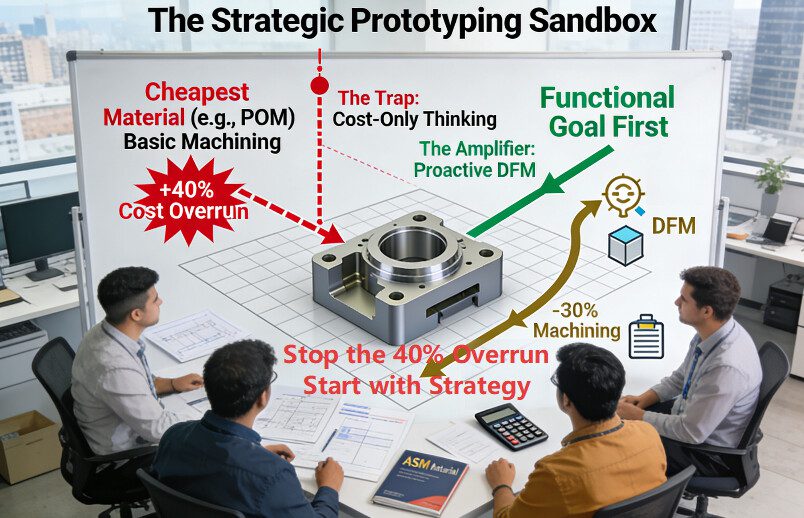
The major issue is that prototype cost is not looked at in isolation, but its actual cost is far beyond just paying for the material. To make prototyping a cost-effective investment instead of a cost center, a strategic framework is required, which is not provided by simply considering cost lists but also considering cost control through material selection based on functional testing goals, proactive optimization, etc., that reduces overall risk.
Beyond Material Price: What Constitutes the True Total Cost of a CNC Prototype?
The biggest mistake made in the cost estimation of a prototype is the misconception that the cost of the material is the only cost involved. The true cost of ownership (TCO) for a CNC prototype extends beyond the cost of the materials used, as it encompasses a complex cost structure consisting of the cost of the materials, the programming cost, the cost of machining time, which depends on the properties of the materials, and the cost of post-processing, which is often neglected. Strategic thinking can lead to unconventional, highly efficient solutions.
For example, a block of aluminum 6061 may have a higher intrinsic cost than a block of POM (Acetal), but its better machinability can result in a much faster cutting speed. As explained in the authoritative sources for the properties of materials, such as the ASM Handbook, the aluminum alloys can accommodate a faster cutting speed than many plastic materials. This can compensate for the cost difference, so the cost of the metal prototype can be equal to, or even less than, the cost of the plastic prototype. This cost analysis approach is the first step to making a financially intelligent decision.
How to Select Between Metal and Plastic Based on Functional Testing Objectives, Not Just Cost?
To begin with, the foundation for a good prototype selection is the establishment of the “job to be done.” The selection between metal and plastic, for instance, should not be limited to cost factors only. Rather, a strategic approach to prototype selection, focusing on the objectives of the prototype, ensures that every single rupee invested results in the highest possible validation value.
For instance, for structural integrity tests, aluminum or steel may be a pre-requisite. Likewise, for heat control experiments, high-conductivity metals are the only option. If a prototype is going to represent the final physical form of an injection-molded part, the production-grade ABS or nylon is a must-read, despite the fact that it might be more costly to machine.
Such a targeted strategy avoids costly mismatches. A cheap material like plastic that is easy to machine for a part that will be made from metal does not help provide any meaningful data on stiffness, weight, or thermal performance. On the other hand, a complex metal housing for a part that needs to be tested for snap fit assembly with a plastic part is a waste if the intention is to test the snap fit assembly.
The underlying question is: What particular performance feature does this prototype have to serve as a validation for? Choosing the right material depends solely on that choice so that the prototype is a reliable instrument in minimizing risks between design and production.
Which Design Optimizations Can Slash 30% or More Off Your Prototyping Time and Cost?
The most significant cost reduction opportunity is Strategic Design for Manufacturability (DFM). A few minor design changes can greatly simplify the CNC machining process. This reduces some of the most costly elements of the process: programming complexity and machine time. By incorporating only a few key design optimizations, cost savings of 30% or more are possible. The key is to design for the process, not against it.
1. Standardizing Features to Eliminate Custom Tooling
One of the simplest design optimizations is standardizing the radii of internal corners. For instance, if a standard radius of 3mm is set, a machinist can easily pick a common end mill that fits all parts. On the contrary, if radii are not standardized, each different radius may require a special tool, which increases tooling costs, necessitates tool changes by the machinist, and adds to programming complexity. Likewise, standarizing hole sizes to commonly available drill bits helps avoid milling with end mills, which is slow and time-consuming.
2. Designing for Machinability and Stability
The depth-to-width ratio of pockets or cavities plays a major role in machining. Deep narrow ones require longer and more slender tools that are more susceptible to deflection or vibration, so the cutters have to operate at slower speeds with lighter cuts and possibly result in poorer surface finish or tool breakage. On the other hand, using a reasonable depth-to-width ratio lets designers use shorter tools that can cut workpieces in an aggressive way. Furthermore, having clear and consistent datum features helps in machining complex parts in fewer setups and this way, the risks of alignment problems and the expenses of handling workpieces are also eliminated.
3. Simplifying Geometry for Efficient Toolpaths
Prioritizing through-holes over blind holes is a design rule that is easy to follow. Through-holes allow for the easy departure of chips from the material. This makes the drilling process easier. The departure of chips also allows for a faster drilling cycle. The design should avoid the creation of thin walls. This is because it may cause the tool to break. A design that considers the physical limits of a rotating tool will always be cheaper to make than a design that does not. Reaching out to a supplier for DFM feedback is the fastest way to take advantage of these important design optimizations, a key benefit of an experienced CNC machining rapid prototyping service.
How Can a CNC Prototype De-Risk Your High-Volume Injection Molding or Die Casting Investment?
The highest-value use of a strategic CNC prototype is as a “mine sweeper” for high-tooling-cost production processes. The biggest return on investment for a CNC prototype is the opportunity to identify and solve problems with your designs before investing in expensive injection molds or difficult-to-change die casting tools. By using the CNC prototype to physically validate the production-critical aspects of your designs, you can convert the cost of the prototype into a form of insurance against costly production delays.
This calls for the design of the CNC prototype not only in terms of its shape but also in terms of a manufacturing simulation. While CNC machining does not require draft angles in a design, incorporating them in the prototype allows for a verification process for the ease of part ejection from a mold.
An in-depth wall thickness audit of the physical prototype can be a predictive and preventative measure for sink marks and warpage in the end product. You can even design parting lines and ejector pins for the prototype and verify their impact in terms of aesthetics. Such a verification process makes the transition from prototype to production seamless and makes the use of custom rapid prototyping services a critical risk management process in the development schedule.
What Should You Look for in a Supplier to Ensure True Cost Control and Technical Partnership?
It is a risky approach to rely only on the cost of a supplier when searching for a prototyping partner. The true cost-saving partner is not necessarily the one with the lowest machine cost, as they are identified by the quality of the partnership, not the cost. The evaluation must go beyond the quoting process to determine the supplier’s proactive engineering mindset, as well as the level of transparency with their processes, which are the true indicators of a quality partnership.

1. Depth of Proactive Design for Manufacturability (DFM) Feedback
The first and most important question to ask is the quality of the DFM feedback provided during the initial quote. Does the supplier provide you with specific feedback on how to save time or money? For example, do they explain how a change to a radius will save 15 minutes of machine time, or how a change to a wall thickness will save the cost of a very expensive tool? If they are providing you this level of feedback during the initial quote, they are working hard to save you money even before you make the order.
2. Strategic Process Planning and Transparent Value Engineering
A sophisticated partner will be able to walk you through their “why” in terms of their manufacturing strategy. Why did they select 3+2 axis positioning instead of full 5-axis simultaneous machining for your part? How will their fixturing strategy reduce setup operations? This level of transparent value engineering demonstrates their expertise and instills confidence in their ability to optimize their entire process, not just press a few buttons on a computer screen.
3.Integrated Quality Systems and Supply Chain Stability
Finally, the quality systems are evaluated to ensure predictable outcomes. Does the supplier provide material certifications and lot tracing capabilities? Is the inspection process solid? If the supplier’s quality systems are integrated with internationally recognized quality management systems such as those defined by the ISO 9000 family of quality management standards, you have a foundation for predictable outcomes. This is what drives the cost control. This is what keeps your project on track on time and on budget.
Case in Point: Solving a Medical Device Enclosure Challenge
The power of strategic prototyping to deliver compounded value can be highlighted by a real-world example. A medical device developer was challenged by a critical problem. They needed to deliver a “perfect” fit between a precision machined aluminum internal chassis and an over-molded plastic exterior shell. The initial solution approach involved machining the two parts separately and assembling them. However, the results were disappointing. There were high failure rates due to minute alignment issues.
The answer came in the form of a strategic manufacturing partner who thought outside the box in their approach to the entire prototyping process. An innovative “single setup, nested machining” concept was proposed and implemented. The aluminum chassis was machined first, and then, without ever removing it from the CNC machine, it was used as a precision fixture in its own right.
The plastic blank was placed around it, and then the exterior shell was machined in perfect, concentric relationship with the machined chassis core. This brilliant concept resulted in a seamlessly integrated prototype, which perfectly validated the assembly concept. The end result was a 35% cost savings in prototype manufacturing, along with a schedule that was accelerated by weeks, de-risking the entire route to production injection molding. This case example illustrates that true cost-effective CNC prototyping occurs when technical ingenuity is applied to solve a specific functional challenge.
Conclusion
To control the cost of CNC prototypes, it is not a matter of locating the cheapest supplier, but rather a sophisticated business discipline that ensures every decision, from the science of materials to the geometry of the design, to the supplier, is aligned with the end goal of validation.
By making decisions on materials with the goals of functional testing, engaging in a proactive DFM strategy to drastically cut the cost of machining, using the prototype as a surrogate for production, and working with a supplier that can offer the depth of engineering resources, the cost of prototypes can be shifted from a cost center to a profitable investment. This approach can literally compress the cost of product development.
FAQs
Q1: For a prototype that needs to be both robust and light, is aluminum always the best option?
A: It depends. While, for example, 6061-T6 is a widely recognized aluminum alloy for its strength-to-weight ratio and great machinability, the choice of material is governed primarily by the type of testing that the prototype will be subjected to.
Q2: When can I expect the first CNC prototype after ordering?
A: From a reliable rapid prototyping service, the lead time can range from as fast as 3-5 business days after the design is finalized, especially for simple geometries and materials.
Q3: Can I get the same level of precision on a plastic part as on a metal part?
A: Yes. Modern computer-controlled machines can achieve extremely high levels of precision on both plastics and metal parts. The limitation on plastics is the material’s different material behavior. A skilled machinist will be able to work around this by using special tooling techniques. For a part that requires a critical, stable size, metal parts like aluminum are more reliable. The level of precision that is required must be based on the intended function of the part.
Q4: What information do I need to give to start a CNC prototyping project?
A: You need at least a 3D CAD file in a neutral format like STEP or IGES. It’s also greatly helpful if you can provide a 2D drawing with main dimensions, tolerances (using GD&T if applicable), and surface finish requirements. This serves to make the design intentions crystal clear. With this information, we will be able to generate a price quotation for your part very fast and with great precision.
Q5: If my design changes after the first prototype, will the cost for the next iteration be very high?
A: The cost impact will vary depending on the nature of the change, but if initial DFM recommendations are implemented, then many design changes can be contained within a module, allowing for a significant degree of re-use of the original program. In a collaborative partnership, we will strive to “design for iteration” in a way that keeps the cost of validation loops low.
Author Bio
Innovative ideas in this article are provided by the manufacturing engineering team at LS Manufacturing, a partner passionate about helping innovators and engineers overcome complex prototyping and manufacturing challenges. Specializing in advanced CNC machining, injection molding, and additive manufacturing, with a quality system grounded in strict international standards, their team is dedicated to helping you turn intricate designs into high-performance, manufacturable products. For a strategic partnership on your next project, check out their custom rapid prototyping services to receive a comprehensive DFM analysis and quote.