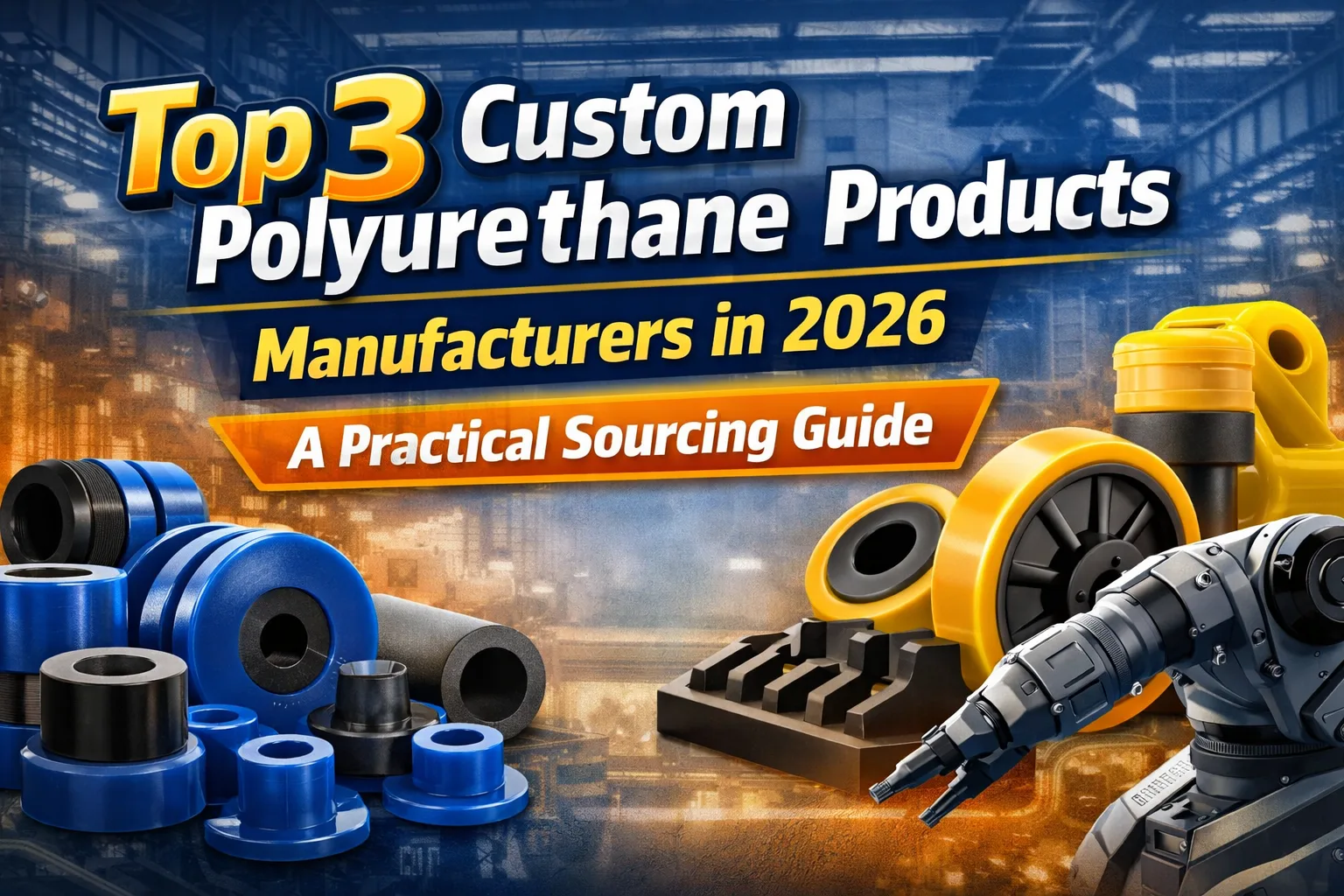
Polyurethane (PU) has become one of the most widely used engineering polymers in modern industry. Its excellent abrasion resistance, load-bearing capacity, impact strength, and design flexibility make it suitable for mining, material handling, construction equipment, screening systems, and industrial automation. Compared with traditional rubber or metal components, custom polyurethane products often deliver longer service life and lower total cost of ownership in harsh working environments.
As industrial applications become more specialized, standard off-the-shelf PU parts are no longer sufficient. Many buyers now require custom polyurethane components designed around specific dimensions, hardness levels, load conditions, and wear patterns. Selecting the right custom polyurethane products manufacturer is therefore a strategic decision that directly affects equipment reliability and long-term operating costs.
This guide introduces three leading custom polyurethane products manufacturers in the global market and explains how buyers can evaluate suppliers for long-term cooperation.
Why Custom Polyurethane Products Are in High Demand
Polyurethane stands out because it combines properties that are rarely found in a single material. It offers rubber-like elasticity together with plastic-like strength. In mining and bulk material handling, PU screen panels and liners outperform rubber in abrasion resistance. In conveying systems, PU rollers and wheels provide higher load capacity and lower rolling resistance. In sealing and protective applications, polyurethane resists oil, grease, and many industrial chemicals better than conventional elastomers.
Custom polyurethane products are typically required when:
- Standard parts fail prematurely due to extreme abrasion or impact
- Equipment geometry demands non-standard dimensions
- Specific hardness or elasticity is needed to balance wear resistance and vibration damping
- Harsh environments require improved chemical or weather resistance
- OEMs seek to optimize performance while reducing maintenance costs
In these scenarios, the manufacturer’s ability to tailor material formulations and processing methods becomes critical.
Key Capabilities to Look for in a Custom Polyurethane Manufacturer
Before reviewing individual manufacturers, buyers should understand what differentiates a capable PU supplier from a general rubber or plastic factory.
- Material formulation expertise
Different PU formulations offer varying levels of hardness, elasticity, and wear resistance. A competent manufacturer can recommend suitable formulations for high-abrasion, high-load, or impact-prone applications. - Process diversity
Custom polyurethane parts may be produced through casting, injection molding, or machining of PU stock. Each process affects dimensional accuracy, mechanical properties, and production efficiency. - Tooling and mold design
In-house mold design and tooling support allow faster development cycles and better control over part quality, especially for complex geometries. - Quality control systems
Consistent material mixing, curing control, and dimensional inspection ensure stable performance across production batches. - Engineering support
Manufacturers that provide application analysis and wear-life optimization add significant value for OEM and industrial customers.
Top 3 Custom Polyurethane Products Manufacturers
Suconvey Industrial (China)
Suconvey is an industrial materials manufacturer specializing in custom polyurethane products for mining, screening, conveying, and industrial equipment applications. Its PU product portfolio includes custom polyurethane sheets, wear liners, screen panels, rollers, and molded components.
The company focuses on application-driven design. Instead of supplying generic PU parts, Suconvey works with customers to adapt hardness, thickness, reinforcement methods, and mounting structures to match specific operating conditions. This approach is particularly valuable in industries such as mining and bulk material handling, where wear patterns and impact loads vary significantly from one site to another.
Suconvey’s strengths include its ability to handle both small-batch prototyping and scalable production. For equipment manufacturers and project-based buyers, this flexibility reduces the risk of over-committing before field testing. In addition, its export-oriented supply model makes it accessible to overseas customers seeking cost-effective custom polyurethane solutions with reasonable lead times.
Argonics (USA)
Argonics is a US-based manufacturer known for engineered polyurethane wear solutions for mining, aggregate, and bulk material handling industries. The company focuses on high-performance polyurethane liners, conveyor skirting systems, and impact-resistant components designed to extend equipment service life in abrasive environments.
Argonics emphasizes application engineering and field-proven performance. Its polyurethane products are often designed as part of complete wear protection systems rather than standalone components. This system-level approach can help end users achieve more predictable maintenance cycles and improved operational uptime.
For buyers operating in North America or in industries where on-site technical support and performance validation are critical, Argonics represents a reliable partner. Its experience in extreme wear environments makes it particularly suitable for high-abrasion applications where conventional materials fail quickly.
BASF (Global)
BASF is a global chemical company with extensive polyurethane material development capabilities. While BASF is primarily known as a material supplier rather than a component manufacturer, many custom polyurethane product manufacturers rely on BASF’s PU systems and technical support to develop high-performance parts.
In some regions, BASF works closely with manufacturing partners and solution providers to deliver tailored polyurethane components for industrial applications. Its strength lies in material science, formulation development, and long-term performance optimization under demanding conditions.
For large industrial programs or advanced engineering projects, BASF’s PU systems offer a high level of consistency and reliability. Companies seeking long-term stability in material supply and technical documentation often prefer polyurethane solutions developed with BASF material platforms.
How to Evaluate a Custom PU Manufacturer for Long-Term Cooperation
Choosing a custom polyurethane products manufacturer should go beyond initial pricing considerations. Buyers should evaluate potential partners based on long-term value creation.
- Application understanding
Suppliers that take time to understand your operating conditions, wear mechanisms, and failure modes are more likely to propose effective solutions. - Prototype and testing support
Field testing of prototypes under real working conditions provides valuable feedback before large-scale deployment. - Process transparency
Clear communication about material formulation, curing processes, and quality control helps build trust and reduces the risk of unexpected performance issues. - Scalability
As equipment usage increases, suppliers must be able to scale production while maintaining consistent quality. - After-sales support
Long-term cooperation often involves product optimization based on field performance data. Manufacturers willing to refine designs over time offer greater strategic value.
Typical Applications of Custom Polyurethane Products
Custom PU components are widely applied in:
- Mining and quarrying equipment
- Vibrating screen panels and wear liners
- Conveyor systems and impact zones
- Industrial rollers and wheels
- Protective linings for chutes and hoppers
- Construction machinery components
Each application places different demands on abrasion resistance, impact strength, and environmental durability. The best manufacturers tailor polyurethane formulations and part designs to address these specific challenges.
Final Thoughts
The demand for custom polyurethane products continues to grow as industries seek more durable, cost-effective alternatives to traditional rubber and metal components. While global material suppliers provide advanced PU systems, the role of specialized manufacturers remains critical in transforming these materials into high-performance industrial parts.
For buyers looking to improve equipment reliability and reduce downtime, partnering with an experienced custom polyurethane manufacturer can deliver substantial long-term benefits. Manufacturers with strong application knowledge, flexible production capability, and stable quality control systems are better positioned to support evolving industrial requirements.
In an increasingly competitive industrial landscape, the right custom polyurethane partner is not just a supplier, but a technical collaborator that contributes to operational efficiency and product innovation.