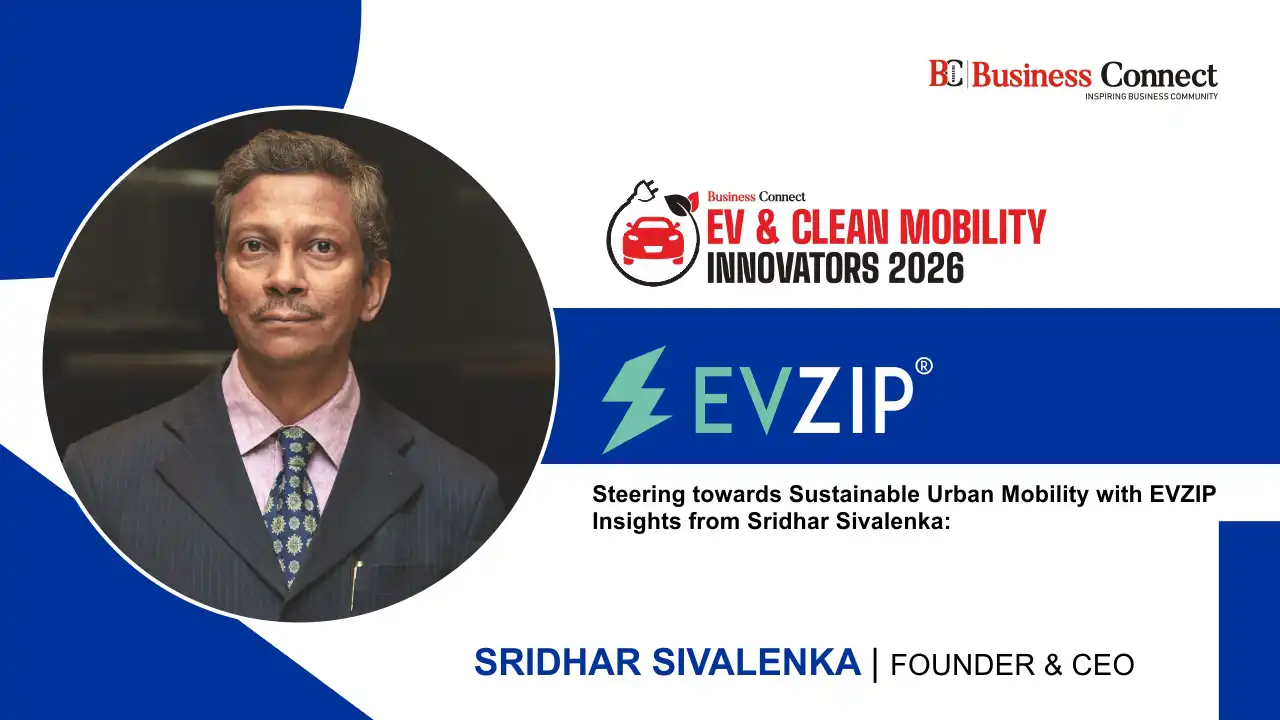
As urban India rethinks mobility, EVZIP Mobility has positioned itself at the intersection of sustainability and structure. Founded with a clear focus on first and lastmile connectivity, the company operates a 100% electric fleet designed to make daily.
In just two years, EVZIP has clocked over 1,80,000 rides with a fleet of 120 electric vehicles, building a reputation for fixed pricing, operational discipline, and commuterfirst services. At the helm is Mr. Sridhar Sivalenka, Founder and CEO, a seasoned business leader with over three decades of experience in driving operational efficiency and building scalable enterprises. Under his leadership, EVZIP has evolved from a focused metro connectivity solution into a structured electric mobility platform. In this conversation with Business Connect Magazine, Mr. Sridhar shares his perspective on the evolution of the EV industry, the entrepreneurial journey behind EVZIP, and the road ahead for sustainable urban transport.
BCM: Mr Sridhar Sivalenka, thank you for being here with us today. Please provide an overview of the company and the offerings.
Mr Sridhar: EVZIP was founded in 2023 with a clear objective, to solve the first and last-mile connectivity challenge around public transportation hubs. Many commuters rely on metro and bus networks but struggle to complete the final stretch of their journey affordably and reliably. EVZIP was created to address that gap through a 100% electric fleet built around structured, sustainable mobility.
Our services today extend beyond basic last-mile rides and are structured across multiple mobility needs:
- Ride Hailing – Point-to-point electric cab services through our dedicated APP with fixed pricing and no surge, ensuring predictable and affordable daily travel.
- Hourly Rentals – Flexible EV rentals for customers who need a vehicle for multiple stops or planned engagements.
- Airport Transfers – Reliable, on-time electric pickup and drop services designed for comfort and punctuality.
- Outstation Trips – Clean and economical electric travel options for intercity journeys.
- Employee Transportation Services (ETS) – Dedicated electric fleet solutions for corporates, built around safety, punctuality, and operational discipline.
- Shuttle Services – Fixed-route electric shuttles connecting metro stations with corporate hubs.
- Subscription Plans – Structured commute packages for frequent riders seeking cost-effective, long-term travel solutions. Across all the services, our focus remains consistent, dependable mobility with sustainability at the core.
BCM: Can you walk us through the company’s journey so far?
Mr Sridhar: Our journey has been progressive and purpose-driven, built on clear milestones rather than aggressive expansion. EVZIP started operations in 2024 with its first fleet of electric vehicles in North Hyderabad and within few months we launched our Employee Transportation Services (ETS) for corporates. This marked an important phase in our evolution, as we began partnering with organizations to provide safe, disciplined, and reliable electric transport solutions for their workforce.
The strong response from corporates validated our operating model and strengthened our fleet utilization. The same year, we officially launched our EVZIP mobile app, expanding into ride-hailing services and enabling individual commuters to access our electric mobility platform directly. This step allowed us to serve both B2B and B2C segments under a unified technology-driven ecosystem.
In 2025, we achieved a major milestone by becoming the official first and last-mile connectivity partner for L&T Hyderabad Metro Rail. This partnership reinforced our sustainability vision and established EVZIP as a structured mobility partner within the urban transit network. During this phase, we also introduced E-EESHA, our women-driven mobility initiative aimed at empowering women drivers while offering safer commuting options for women passengers.
As demand grew, we expanded our offerings further by launching dedicated shuttle services connecting metro stations with major IT parks, strengthening daily commuter infrastructure in key corridors. In 2026, we entered our next growth phase by expanding operations into Andhra Pradesh, beginning with Vijayawada. This marked our transition from a city-focused operator to a multi-city electric mobility platform.
BCM: What were the challenges you faced in the initial stage of the company?
Mr Sridhar: Our initial plan was to deploy electric three-wheelers for low-cost commuting. However, regulatory constraints around corporate vehicle deployment in our operating region made that model difficult to scale in a structured way. We also faced a shift challenge within the driver ecosystem. Many drivers were used to working across multiple apps with flexible timings. Moving to a disciplined, shift-based fleet model required training, alignment, and trust-building.
BCM: How did you overcome these hurdles, and what opportunities did it lead to?
Mr Sridhar: We pivoted to electric four-wheelers, which provided clearer regulatory alignment and better service consistency. This allowed us to strengthen safety, comfort, and operational discipline. At the same time, we invested in driver training and standardized shift systems to build a reliable fleet.
Our partnership with Hyderabad Metro Rail became a key milestone, enhancing credibility and accelerating adoption. The pivot ultimately broadened our scope beyond low-cost commuting into a comprehensive electric mobility platform covering corporate transportation, ridehailing, shuttle services, and subscription-based travel.
BCM: Please define the vision and mission of the company.
Mr Sridhar: Our vision is “: to revolutionize last-mile connectivity with affordable electric vehicle solutions, supporting the green revolution and minimizing carbon footprint through advanced technology” Our mission is “To lead India’s electric urban mobility shift with sustainable, reliable, and efficient services.”
BCM: Did you witness any transformation regarding your respective industry over the years?
Mr Sridhar: The mobility industry has undergone three major shifts over the past few years. First was digitization. App-based platforms changed customer expectations, making convenience and real-time access standard. Second came pricing volatility. Surge models and frequent cancellations created unpredictability, which impacted commuter trust. Third, and most significant, has been the shift toward sustainability.
A few years ago, convincing customers to choose electric vehicles was challenging. Range anxiety and limited charging infrastructure slowed adoption. Today, with improved infrastructure, better battery technology, and strong government policy support for EV adoption, acceptance has grown significantly. We’ve observed that while ride-hailing became convenient, it also became inconsistent. The next phase of mobility, in our view, will be structured, electric-first, and systemdriven, combining convenience with predictability and sustainability.
BCM: What are the key differentiating factors that make EVZIP stand out?
Mr Sridhar: What differentiates EVZIP is our operating model and accountability. Unlike aggregator platforms that onboard third-party vehicles and drivers, we own our fleet and directly hire and train our drivers. This allows us to maintain operational control, ensure service discipline, and take complete responsibility for every ride. We operate a 100% commercially registered electric fleet with a clear focus on reducing urban carbon emissions.
Our pricing is transparent, with no surge fluctuations, which builds long-term commuter trust. Safety is another core differentiator. All rides are supported by real-time GPS monitoring, centralized tracking, and in-cab safety features such as SOS alerts. Our fleet is structured, shift-based, and system-driven, which reduces unpredictability.
Additionally, our EVZIP–EESHA initiative, a womendriven mobility service for women commuters, reflects our commitment to both safety and empowerment. At its core, EVZIP stands for structured, sustainable, and accountable mobility, not just convenience.
BCM: Do you believe R&D is essential for the growth of the company?
Mr Sridhar: R&D is central to our growth strategy. We continuously invest in in-house innovation to optimize fleet operations and build smarter, increasingly automated systems. Our command center relies on real-time data dashboards that help us monitor performance, improve efficiency, and reduce operational gaps. We regularly collect customer feedback, identify pain points, and refine our platform to enhance user experience. AI-driven analytics further enable us to understand commuter behavior and anticipate evolving expectations.
BCM: Please shine some light on the work culture and your leadership approach.
Mr Sridhar: Our work culture is built on accountability, respect, and shared purpose. We maintain an open and collaborative environment where feedback is encouraged and operational discipline is non-negotiable. Our drivers are an integral part of our ecosystem, and we invest in training, engagement, and long-term relationships to ensure consistency and trust. My leadership approach is centered on clarity and empowerment. I believe in setting direction, enabling teams to take ownership, and fostering a culture where performance and positivity go hand in hand. I must also acknowledge the pivotal role of my Co-Founder & COO, Mr. Sitaram Cherukupalli, whose operational expertise has been instrumental in shaping our systems and growth trajectory.
BCM: What milestones and achievements does the company boast of?
Mr Sridhar: Within a short span since our inception, we have achieved several meaningful milestones. We are the first APP based, 100% electric cab fleet in South India to offer ride-hailing, ETS and Subscription services, reinforcing our commitment to sustainable mobility. We also introduced a women-driven, women-focused two wheeler taxi initiative, setting a new benchmark for safety and inclusion in the region.
A key institutional milestone was our partnership with L&T Metro Rail as the official first and last-mile connectivity partner for Hyderabad Metro. On the governance and quality front, we earned ISO 9001:2015 certification for our quality management systems. We are also recognized under the Startup India program, reflecting our alignment with innovation-led growth. In addition, we are LEI recognized and DUNS registered, reinforcing our commitment to global compliance standards, transparency, and institutional credibility.
BCM: Please share a token of advice that can serve as guidance to the budding entrepreneurs.
Mr Sridhar: Success, in my view, is rooted in discipline. Build systems before you build scale. Growth without structure is fragile. Don’t chase valuation headlines or external hype. Focus on strengthening your fundamentals and maintaining strict cash flow discipline. A solid foundation will always outlast shortterm excitement.