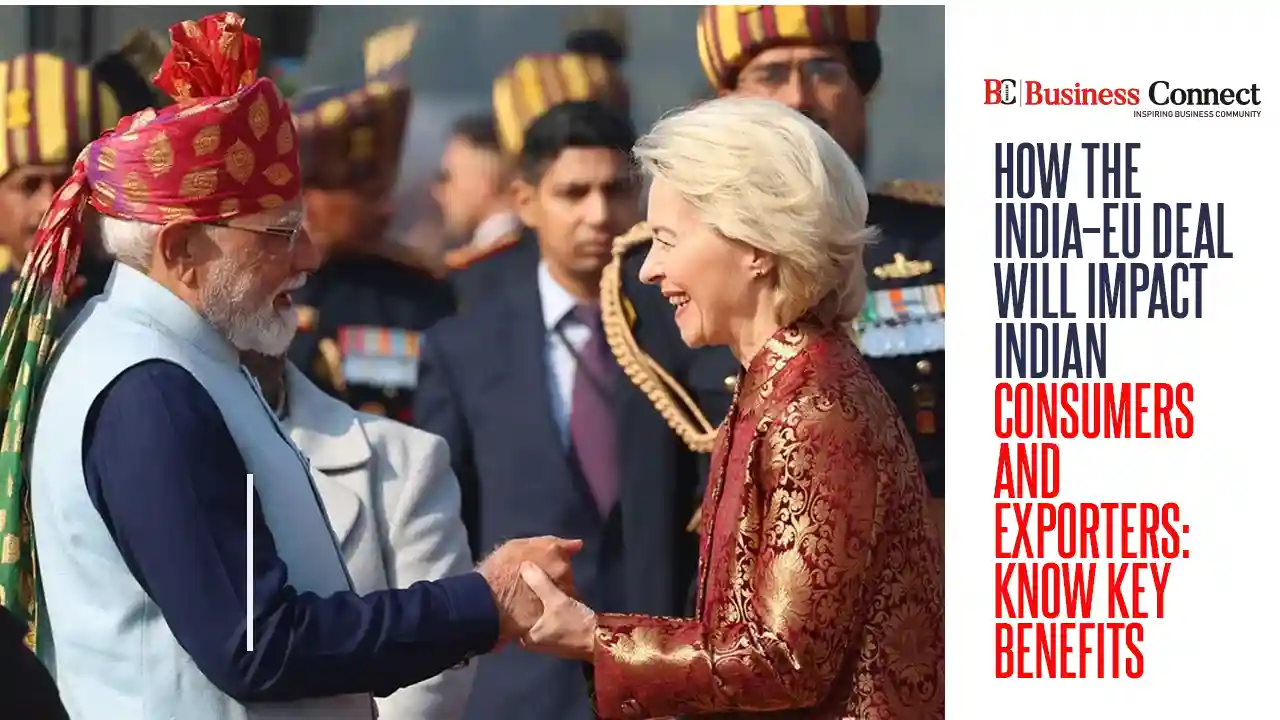
In a historic move, India and the EU finalized the “mother of all” trade agreements on Tuesday. Ursula Von Der Leyen, President of the European Commission, responded to the deal by stating on social media site X (previously Twitter) that “Europe and India are making history today.”
Today, Europe and India are creating history. The mother of all deals is now complete. We have established a two-billion-person free trade zone that will be advantageous to all parties. This is just the start. We’re going to strengthen our strategic partnership,” Ursula Von Der Leyen stated on X.
Additionally, Prime Minister Narendra Modi announced on Tuesday that India and the European Union have reached a free trade agreement, emphasizing that the two countries combined account for almost one-third of global trade and 25% of the world’s GDP. Speaking virtually at Indian Energy Week, he referred to the agreement as the “mother of all deals” and said that it gives millions of Europeans and 140 crore Indians important chances.
How Indians will gain from the India-EU agreement
Known as the “mother of all deals,” the India-EU Free Trade Agreement (FTA) seeks to offer both nations significant economic advantages. European vehicles, alcohol, and a number of food goods will probably become more affordable for Indians after the agreement.
According to the European Union, tariffs on 96.6% of its products exports to India will either be removed or lowered, saving European exporters up to €4 billion annually. Important developments under the trade deal were also revealed at the India-EU Summit, along with the formation of an EU-India Security and Defense Partnership.
Under the agreement, levies on olive oil, margarine, and other vegetable oils would be lowered or eliminated, while tariffs on EU exports including fruit juices and processed goods will be eliminated. There will be a 40% reduction in spirits tariffs.
In keeping with the pact’s emphasis on both the economy and environment, the EU also intends to give India 500 million euros in support over the next two years to help reduce greenhouse gas emissions. Meanwhile, the EU will grant full market access to a variety of Indian exports, including manufacturing, chemicals, textiles, and electronics, while India has agreed to significantly reduce import levies on a number of European goods.
Additionally, 90% of taxes on European surgical, medical, and optical equipment will be eliminated. The European Union further stated that duties on the majority of EU aircraft and spacecraft exports to India will be eliminated. Additionally, the agreement will eliminate tariffs of up to 44% on machinery, 22% on chemicals, and 11% on medicines. The EU anticipates that this will improve market access and treble EU exports to India by 2032.
An estimated $136 billion worth of goods are traded in both directions between India and the EU. India is anticipated to receive duty-free access under the agreement for important exports including textiles, leather goods, and marine products, as well as tariff reductions in industries like cars, wines, and spirits.