-By Jaya Pathak
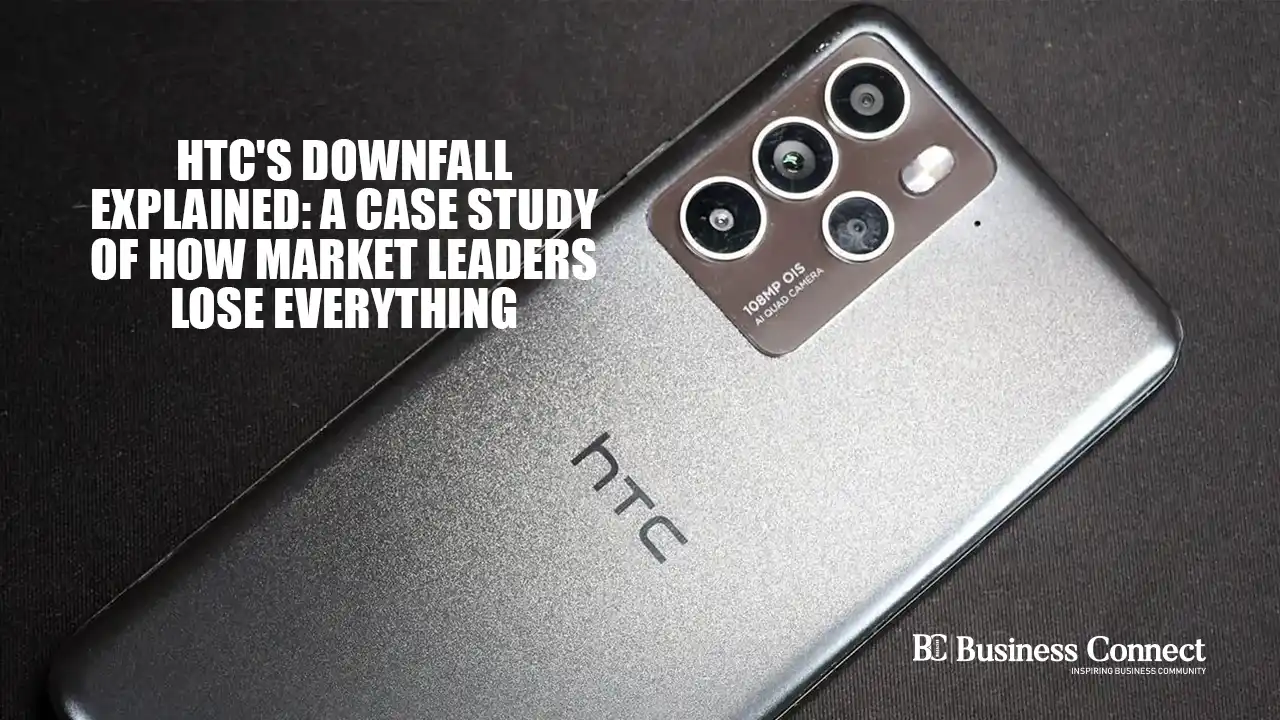
In 2011, HTC appeared as a company that had the right time, partners, and products to establish the smartphone era. By the turn of the decade, it had turned out to be a lesson case, evidenced of the fact that leading in a fast market is not a job; it is a discipline.
When HTC was on top
HTC was not just there as the waves of smartphones began; it was swept to the top of the market in the U.S. According to data released by Canalys which was quoted by Bloomberg, it put HTC in a leading position with 24 percent share in Q3 2011 in the U.S. compared to Samsung and Apple at the time.
The highest market share of HTC smartphones in the world reached 10.7 percent in 2011 and this number was still repeated in various reports. That peak is important since it shows the actual strength of HTC during the Android boom years: the devices were stocked by carriers, reviewed by magazine, and accepted by consumers.
Then the curve bent- hard. By 2014, the global share of HTC was already reported by analysts as lower than 2 which was an incredible degradation after hitting 2011. As of 2019, according to the BBC, by the whole world for the smartphone, the share of HTC had faded to 0.05 percent of the total after hitting an all-time high of 10.7 percent in 2011.
The unravelling: The transformation of the momentum into a trap
The demise of HTC can be simplified as a reason to lose competition to Apple and Samsung, but it is too simplistic to be used. The less enjoyable fact is that HTC lost the capacity to transform brilliant hardware into long lasting business model.
Take into account the asymmetry in strategy. By creating a closed circle of hardware, software, services, and retail, Apple created a reinforcing loop, which stayed profitable due to switching costs rather than the industry average. To a large extent, HTC was a hardware brand, on a platform (Android), which consumers could switch manufacturers with minimum friction, therefore a product-cycle fall was not a blow, it was a customer-quitting incident.
This issue has an inner form to be reported by Wired: former and current employees narrowed the causes of HTC down to unwise business choices and a corporate culture that does not welcome criticism. In China, Wired as well explains a vicious cycle of poor sales meant lower orders of components meant more expensive units which made devices less competitive thus resulting in poor sales once more.
This is the scale penalty which market leaders play underrated. Losing bargaining power, marketing oxygen, and channel confidence, in making less equals losing as product teams ship fixes, which is in fact, compounding at a faster rate than you can.
There are three strategic errors that reoccur within the history of HTC
1) Brand positioning drift: The consumers in the high-end markets will require to be given a consistent rationale to pay above the median in the category. The identify of HTC swung–design-oriented, specifications focused, hero of carriers, etc, where the Apple narrative remained consistent, and the Samsung volume + innovation machine remained noisy. Citing the increase in competition by Samsung and Apple, Forbes reported the fall of HTC as a company that was expanding massively.
2) Distribution fragility: The weakening of volumes made the carriers selective in offering prime shelf space and marketing assistance to the devices that had the highest chances of selling fast. According to Wired, in addition to decreased sales, carrier support has been limited, with the HTC U11 only being sold by Sprint in 2017, and this further limited coverage.
3) The lack of a defendable control point: In platform business, the winner has the relationship with the customer; OS, services, app store, identity, payments or enterprise management. Excellent devices were sold by HTC, yet it lacked the rails that can guarantee continuing customer value.
Once Android hardware turned into a commodity, the strength of the company was simple to imitate and difficult to capitalize on.
When HTC had already turned into systems company problem, it treated smartphones as a product company problem.
Google deal: A way out of the middle of the battle
In 2017, HTC took a financially sound but strategically belching step by signing a cooperation agreement with Google in which some employees of HTC, most of whom are Pixel phone workers, would be absorbed by Google. The announcement given by HTC said it will get US 1.1 billion cash and Google will be entitled to a non-exclusive license of the HTC intellectual property.
Independent coverage was similar to such terms. CNBC commented that the 1.1 billion deal would see Google buying approximately 2,000 HTC employees, with a non-exclusive IP license. The TechCrunch later announced that Google had closed the 1.1 billion acquisition, which it acquired with more than 2,000 engineers and that HTC would still produce smartphones without selling the Vive VR business unit.
It was not merely a deal but it was an omen. HTC had developed some of the finest smartphone engineering capabilities in the world, but it could no longer reliably use those capabilities to create market strength under its flag. By moving further out of owning the flagship story, the company successfully commercialized one of its core competencies, which is hardware engineering.
The subsequent shift to VR and other trades of HTC can continue to create value, but the weapon is already inscribed in smartphone: the moment the company cannot protect the engine that converts products into recurring consumers, it will fade away.
What leaders should learn:
The message of HTC is not not to make mistakes. It is not keep making the sort of mistakes that go right around the wrong end of you. Protect the control point. Unless you own platform, services, or distribution, you should expect your product lead to be short-lived and come up with a strategy.
Treat scale as a strategic resource, rather than a result. The case of HTC in China as described by Wired shows the reason why a declining volume can easily increase expenditures and hasten a downward spiral.
Ensure feedback is a government mandate. The force of bad news making an organization resistant begins to occur, whereby the organization begins looking for internal comfort rather than for market truth. Create a brand promise that is ten years worthy. There is always competitive pressure, and identity together with execution discipline is the only way it can survive.
- High Tech Computer Corporation: This is the original full name of the Taiwanese company known today simply as HTC Corporation. Founded in 1997, it is famous for developing early smartphones, the HTC Vive virtual reality system, and the first-ever Android phone, the HTC Dream. Vedantu +3
- HTC Global Services: An American IT solutions and business process outsourcing provider headquartered in Troy, Michigan.
HTC continues to produce 5G mobile phones, with notable recent models including the
Latest HTC 5G Smartphones
- Display: 6.8-inch OLED screen with a 120Hz refresh rate.
- Performance: Equipped with the Qualcomm Snapdragon 7 Gen 3 processor for high performance and AI optimization.
- Camera: Features a versatile triple-camera setup on the rear (50MP main, 50MP telephoto, and 8MP ultra-wide) and a 50MP front camera.
- Battery: A 4,600 mAh battery supporting 60W fast charging, 15W wireless charging, and 5W reverse wireless charging.
- Durability: IP67 rated for dust and water resistance, with Gorilla Glass protection.
- Display: 6.7-inch OLED display with a 120Hz refresh rate.
- Performance: Powered by the Qualcomm Snapdragon 7 Gen 1 chipset with 12GB of RAM.
- Camera: A quad-camera system on the back, including a 108MP main sensor, an 8MP ultra-wide lens, a 5MP macro lens, and a 2MP depth sensor. It has a 32MP front camera.
- Battery: 4,600 mAh battery with 30W fast charging, wireless, and reverse wireless charging support.
- Durability: IP67 certified for water and dust resistance.
- Display: 6.6-inch IPS LCD display with a 120Hz refresh rate.
- Performance: Runs on the Qualcomm Snapdragon 695 5G mobile platform.
- Camera: A 64MP main camera, 8MP ultra-wide, and 2MP depth sensor on the rear, with a 32MP front camera.
- Battery: 4,520 mAh battery with wireless charging capabilities.
- Unique Feature: Designed to run 2D and 3D content on extended reality (XR) devices like the HTC Vive Flow headset.
HTC vs BlackBerry: Which Smartphone Giant Ruled the Market?
| Feature | HTC | BlackBerry |
|---|---|---|
| Founded | 1997, Taiwan | 1984, Canada |
| Original Focus | Smartphones & PDAs | Smartphones, enterprise security |
| Operating System | Android | BlackBerry OS / Android (later) |
| Flagship Devices | HTC One series, HTC Desire | BlackBerry Bold, BlackBerry Key series |
| Market Focus | Consumer & business | Enterprise / corporate users |
| Peak Popularity | 2008-2012 | 2005-2013 |
| Current Status | Mostly exited smartphone market | Exited manufacturing; software/security focus |
HTC vs Google (Pixel Devices)
| Feature | HTC | Google (Pixel Series) |
|---|---|---|
| Founded | 1997, Taiwan | 1998, USA |
| Original Focus | Smartphones & PDAs | Search engine; later smartphones |
| Operating System | Android | Android (pure stock) |
| Flagship Devices | HTC One, HTC U series | Pixel, Pixel XL, Pixel Pro series |
| Market Focus | Consumer & business | Consumer & tech enthusiasts |
| Hardware Design | Sleek, premium materials | Google-designed, emphasizes software |
| Innovation | Early Android pioneers | AI/Camera software integration |
| Current Status | Limited smartphone presence | Active, ongoing Pixel releases |
FAQs
1) Has HTC has ever been a market leader?
Yes–Bloomberg, has quoted Canalys statistics that HTC has been dominating the U.S. smartphone market with a 24 percent share in third quarter of 2011.
2) What is the extent of the market share lost by HTC?
The BBC media described how HTC had lost an annual record of 10.7% share of global smartphones down to 0.05 in 2019.
3) Have the ills of HTC only begun at the point at which Apple and Samsung were more powerful?
The competitive force played a factor; Forbes exclusively cites the expansion of Samsung and Apple at the expense of HTC, but there were also internal strategic implementation matters.
4) What actually has happened to Google in 2017?
An official deal that would see some of the HTC staff move to Google was announced; HTC would get US1.1 basis and Google would get the chance of no exclusive right to HTC IP. CNBC and TechCrunch announced the transfer of about 2,000 workers and then stated that the deal was completed.
5) Does HTC control itself in business now of smartphones?
Following the Google acquisition, TechCrunch stated that HTC would proceed to produce own smartphones but it would keep its Vive VR department.