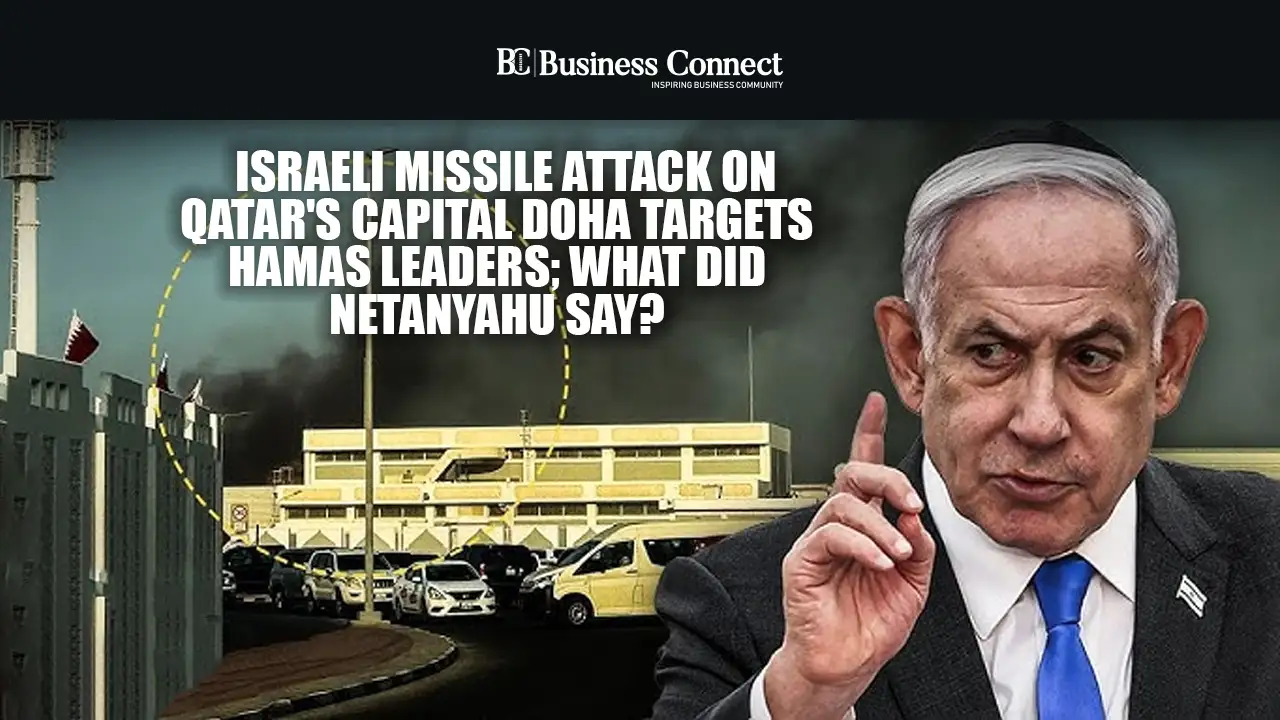
Burning cars and plumes of smoke rising into the sky — these were the scenes from Qatar’s capital, Doha, on September 9, when Israel launched a missile strike. Israeli officials confirmed the attack, stating that the operation specifically targeted senior Hamas leaders.
Doha Under Fire: Israeli Missile Attack Aims at Hamas Leaders, Netanyahu Issues Statement
According to the Israeli military, the strike was aimed at Hamas chief Khalil al-Hayya, a longtime key figure within the group. Al-Hayya, who began his political journey in the 1980s, was originally associated with the Muslim Brotherhood, which later laid the foundation for Hamas. Over the years, he worked closely with leaders like Ismail Haniyeh and Yahya Sinwar.
Media reports suggest that while al-Hayya survived the strike, five others were killed — including his own son. Reports also indicate that the leaders were attacked during a meeting, allegedly after receiving approval from former U.S. President Donald Trump. At the time, they were discussing America’s latest ceasefire proposal.
Israeli Prime Minister Benjamin Netanyahu described the operation as an entirely independent Israeli action. In a post on the social media platform X, he wrote that the strike against Hamas’s senior terror leaders was “a fully sovereign Israeli operation — initiated, executed, and owned by Israel.”
The Israeli Defense Forces and security agencies emphasized that this was a precision strike against Hamas leaders who had long been directing the group’s operations. According to Israel, these leaders were directly responsible for years of terrorist activities, the October 7 massacre, and for orchestrating and continuing the ongoing war against Israel.
Before the strike, Israel emphasized that measures were taken to avoid civilian casualties. Special precision-guided weapons and reliable intelligence were used to ensure that only the intended targets were hit. The IDF (Israel Defense Forces) and ISA (Israel Security Agency/Shin Bet) declared they would continue such operations with full force and determination until Hamas is defeated, as the group remains responsible for the October 7 massacre.
This attack came shortly after IDF Chief of Staff Eyal Zamir had warned that Hamas leaders abroad would also be targeted. On August 31, Zamir stated that much of Hamas’s leadership resides overseas, adding, “We will reach them all.” Qatar, which has long hosted Hamas’s exiled leaders, has also played a central role as a mediator between Israel and Palestine. The strike threatens to further complicate delicate negotiations over a ceasefire in Gaza and the release of hostages taken on October 7.
Qatar strongly condemned the attack. Foreign Ministry spokesperson Majed Al-Ansari described it as a “cowardly strike on Hamas’s political headquarters,” saying it violated all international laws and norms. In contrast, Israeli Finance Minister Bezalel Smotrich praised the operation, writing on X that “terrorists will find no safe haven anywhere in the world from Israel’s long reach.” He lauded the IDF and Shin Bet for their precise execution.
Reactions also poured in from India and Pakistan. India’s Ministry of External Affairs expressed concern and urged all parties to show restraint and pursue diplomacy to prevent further escalation. Pakistan’s Prime Minister Shehbaz Sharif condemned the strike as “entirely wrong and a dangerously provocative act.” He said he had spoken with Qatar’s Emir, Sheikh Tamim bin Hamad Al Thani, to convey Pakistan’s condolences and solidarity.
From Washington, U.S. Vice President JD Vance voiced frustration over the incident. In a television interview, he said even former President Donald Trump did not believe the strike served U.S. or Israeli interests. White House Press Secretary Karoline Leavitt also confirmed that Trump was unhappy with Israel’s decision, though the U.S. would still pursue peace efforts.
As for the reason behind the strike, the backdrop lies in the ongoing war that began in October 2023 between Israel and Hamas. Qatar had taken on the role of mediator, attempting to broker a ceasefire. Recently, Hamas signaled partial acceptance of U.S.-backed ceasefire proposals and expressed willingness to discuss them. Israel’s Foreign Minister Gideon Sa’ar also hinted that his country might accept the U.S. plan. In the meantime, Trump had issued Hamas a final ultimatum: accept the ceasefire deal or face consequences. It was during these sensitive talks that Israel launched its strike on Doha.
FAQ: Israeli Missile Strike on Qatar’s Capital Doha
1. What happened in Doha on September 9?
On September 9, Israel launched a missile strike on Qatar’s capital, Doha. The attack caused fires and smoke across parts of the city and specifically targeted senior Hamas leaders.
2. Who was the main target of the strike?
The strike was aimed at Khalil al-Hayya, a senior Hamas leader who has been active in the group since the 1980s. He survived the attack, but five others — including his son — were killed.
3. Why did Israel carry out this attack?
According to Israel, the strike was a precision operation against Hamas leaders responsible for:
Orchestrating terrorist activities for decades.
Directing the October 7 massacre in Israel.
Leading ongoing war efforts against Israel.
4. Did the U.S. have a role in this strike?
Reports suggest the meeting was attacked after alleged approval from former U.S. President Donald Trump, though U.S. officials later expressed dissatisfaction. Vice President JD Vance and Trump himself both signaled the strike was not in America’s best interest.
5. What was Prime Minister Benjamin Netanyahu’s response?
Netanyahu stated that the operation was a fully sovereign Israeli action — initiated, executed, and owned by Israel. He stressed that Israel alone was responsible.
6. How did Israel ensure civilians were not harmed?
The Israeli Defense Forces (IDF) claimed they used precision-guided weapons and credible intelligence to avoid civilian casualties, targeting only Hamas leaders.
7. How has Qatar responded?
Qatar strongly condemned the strike. Foreign Ministry spokesperson Majed Al-Ansari called it a “cowardly attack” on Hamas’s political headquarters and said it violated international laws.
8. How did other countries react?
India: Expressed concern and urged restraint and diplomacy.
Pakistan: Condemned the attack as provocative; PM Shehbaz Sharif expressed solidarity with Qatar.
U.S.: Vice President JD Vance criticized the strike, saying it was not in Israel’s or America’s interest.
Israel (domestic reaction): Finance Minister Bezalel Smotrich praised the operation, saying terrorists have no safe haven.
9. Why is Qatar significant in this conflict?
Qatar has long hosted Hamas’s exiled leaders and acted as a mediator in ceasefire talks between Israel and Hamas. The strike threatens to derail ongoing negotiations over a Gaza ceasefire and the release of hostages.
10. What is the broader context of this attack?
The strike occurred amid the war that began in October 2023 between Israel and Hamas. At the time, Hamas had shown some willingness to consider U.S.-backed ceasefire proposals, and Israel had hinted at acceptance too. The strike, however, has further complicated peace efforts.
Add Business Connect magazine to your Google News feed
Must Read:-
- England vs South Africa 3rd ODI Highlights: Harry Brook Leads Team to Record 342-Run Victory
- Conjuring 4 Outshines Baaghi 4 & Bengal Files, Targets ₹15 Crore Opening
- Madharaasi Box Office Day 1 Advance Booking: Sivakarthikeyan’s Latest Film Opens 46% Lower Than His Previous Release in Tamil
- Sivakarthikeyan: Profile of a Rising Star in Tamil Cinema
- Madharasi Movie Explained: Sivakarthikeyan & AR Murugadoss’ Power-Packed Collaboration
- Madharasi: Everything to Know About Sivakarthikeyan & AR Murugadoss’ Upcoming
- Madrasi Movie Review – What Works, What Doesn’t in Sivakarthikeyan’s New Film