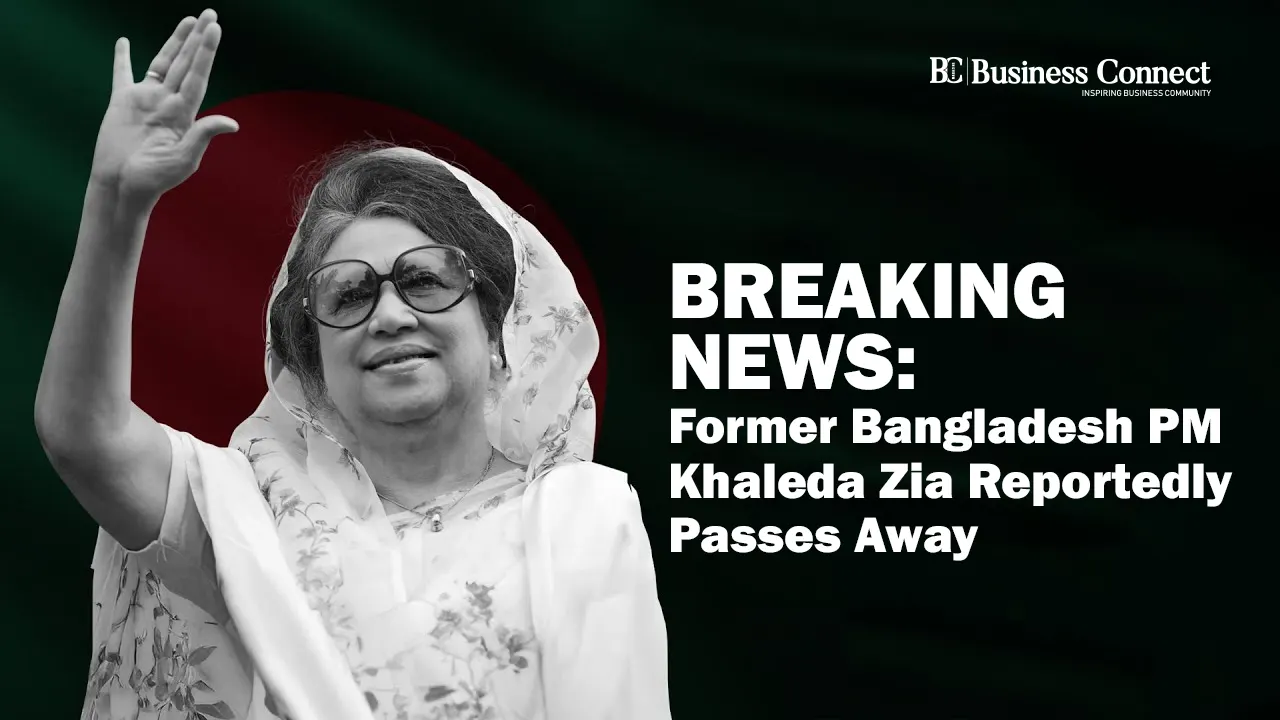
Zia was found not guilty in the graft cases on November 27, 2024. Zia passed away at a hospital on December 30, 2025, following years of protracted illness.
Bangladesh’s First Female Prime Minister Khaleda Zia Dies at 80
Khaleda Zia, Bangladesh’s first female prime minister and a longtime political rival of ousted leader Sheikh Hasina, has died after a prolonged illness. She was 80.
Zia had been planning to contest a third term as prime minister in February, when Bangladesh is set to hold its first national election since a popular uprising in late 2024 forced Sheikh Hasina from power.
Her health had deteriorated sharply in recent days. Doctors said on Monday that her condition was “extremely critical” and that she had been placed on life support. Given her age and overall poor health, physicians said it was not possible to administer multiple treatments simultaneously.
“Our favourite leader is no longer with us. She left us at 6am this morning,” her party, the Bangladesh Nationalist Party (BNP), announced in a Facebook post on Tuesday.
Following news of her death, large crowds gathered outside Evercare Hospital in Dhaka, where she had been undergoing treatment.
Rise to Power
Khaleda Zia was thrust into national politics after the assassination of her husband, President Ziaur Rahman, in a military coup in 1981. Until then, she had largely remained out of the public eye.
She went on to lead the BNP and emerged as a major political force, becoming Bangladesh’s first female prime minister in 1991 following the country’s first democratic elections in two decades.
Known for her uncompromising stance, Zia refused to participate in elections held under military ruler General Hussain Muhammad Ershad in the 1980s, helping establish her reputation as a strong opposition leader in a male-dominated political landscape.
Political Career and Rivalry
Zia’s first term in office was widely praised for initiatives aimed at improving women’s education and social development. Her government also restored parliamentary democracy by amending the constitution with bipartisan support.
Her second term in 1996, however, lasted only a few weeks and was marred by controversy. The election was criticised as one-sided after opposition parties demanded a neutral caretaker government to oversee the polls—a system that was later approved before parliament was dissolved.
Zia returned to power in 2001, serving until October 2006. That administration faced sharp criticism over allegations of corruption.
Her political career was defined by a bitter and enduring rivalry with Sheikh Hasina, leader of the Awami League. Over the past 16 years, during Hasina’s rule, Zia became the most prominent symbol of opposition to what critics described as an increasingly authoritarian government.
She boycotted the 2014 general election after Hasina scrapped the caretaker government system, which had been designed to ensure neutrality during elections. Zia was later convicted on corruption charges and jailed—allegations she consistently denied, saying the cases were politically motivated.
She was acquitted and allowed to travel to London for medical treatment only after Hasina lost power.
With her death, Bangladesh has lost one of its most influential and polarising political figures—an architect of the country’s democratic transitions and a dominant presence in its modern political history.
Khaleda Zia, Bangladesh’s first female prime minister and a towering figure in the country’s modern political history, died on Tuesday after a prolonged illness. She was 80.
Zia had been hospitalised for the past month, receiving treatment for multiple serious conditions, including kidney damage, heart disease, and pneumonia. Doctors had described her condition as “extremely critical,” and she was placed on life support in her final days.
Her death was confirmed by the Bangladesh Nationalist Party (BNP), which said in a statement that she passed away at 6am, surrounded by close family members, including her son Tarique Rahman, his wife, and their daughter.
Political Developments Before Her Death
Zia was released from custody in January 2025, shortly after mass anti-government protests in Bangladesh toppled then-prime minister Sheikh Hasina, forcing her into exile in India. Hasina has since been convicted and sentenced to death for crimes against humanity linked to her government’s violent crackdown on the protests.
Despite Zia’s fragile health, the BNP said in November that she planned to campaign in the upcoming general elections, as the party sought a return to power after years in opposition. If successful, the BNP is expected to elevate Zia’s son, Tarique Rahman, as the country’s next leader.
Rahman, 60, returned to Bangladesh only last week after spending 17 years in self-imposed exile in London.
Although Zia remained largely out of public view due to her medical condition, she continued to serve as a symbolic figurehead for opposition forces and the broader democratic movement.
Tributes and Condolences
During Zia’s final days, interim leader Muhammad Yunus urged the nation to pray for her recovery, calling her a “source of utmost inspiration for the nation.” Following her death, Yunus paid tribute to Zia as a “symbol of the democratic movement.”
“The nation has lost a great guardian,” Yunus said in a statement. “Her role in the struggle to establish democracy, a multi-party political culture, and the rights of the people in Bangladesh will be remembered forever.”
The Awami League, now banned in Bangladesh, also issued a condolence message from Sheikh Hasina, who remains in India. In her statement, Hasina said Zia’s “contributions to the nation were significant and will be remembered,” calling her death a “profound loss for Bangladesh’s political life.”
International leaders also expressed condolences. Indian Prime Minister Narendra Modi said he was “deeply saddened” by Zia’s passing and praised her contributions to Bangladesh’s development and bilateral ties with India.
“We hope that her vision and legacy will continue to guide our partnership,” Modi wrote on X.
Pakistan’s Prime Minister Shehbaz Sharif described Zia as “a committed friend of Pakistan,” saying her service to Bangladesh would leave a lasting legacy.
Enduring Legacy
Zia’s political career was marked by both influence and controversy, as well as a decades-long rivalry with Sheikh Hasina that shaped Bangladesh’s political landscape. Over the past 16 years, she emerged as the most prominent symbol of opposition to Hasina’s rule, which critics increasingly characterised as authoritarian.
With her death, Bangladesh has lost one of its most consequential political leaders—an architect of democratic transitions, a resilient opposition figure, and a central force in the nation’s turbulent political history.
FAQs on the Death of Khaleda Zia
Q1. Who was Khaleda Zia?
Khaleda Zia was Bangladesh’s first female prime minister and a founding leader of the Bangladesh Nationalist Party (BNP). She served multiple terms as prime minister and was one of the most influential figures in the country’s modern political history.
Q2. When did Khaleda Zia pass away?
Khaleda Zia passed away on December 30, 2025, at a hospital in Dhaka, following years of prolonged illness.
Q3. How old was Khaleda Zia at the time of her death?
She was 80 years old.
Q4. What was the cause of Khaleda Zia’s death?
She died after battling multiple health complications, including kidney damage, heart disease, and pneumonia. Doctors had described her condition as “extremely critical,” and she was on life support in her final days.
Q5. Where did Khaleda Zia die?
She passed away at Evercare Hospital in Dhaka, where she had been undergoing treatment for the past month.
Q6. Who confirmed Khaleda Zia’s death?
Her death was confirmed by the Bangladesh Nationalist Party (BNP) through an official statement.
Q7. Was Khaleda Zia planning to return to active politics?
Yes. Despite her poor health, the BNP said in November that Zia planned to campaign in the upcoming general elections scheduled for February.
Q8. What role did Khaleda Zia play in Bangladesh’s democracy?
Zia played a key role in restoring parliamentary democracy in Bangladesh in the early 1990s and was a major advocate of multi-party politics.
Q9. How did Khaleda Zia enter politics?
She entered politics after the assassination of her husband, President Ziaur Rahman, in a military coup in 1981.
Q10. When did Khaleda Zia become prime minister for the first time?
She became Bangladesh’s first female prime minister in 1991, following the country’s first democratic elections in two decades.
Q11. What were Khaleda Zia’s major achievements in office?
Her first term was praised for advancing women’s education, social development, and restoring parliamentary democracy through constitutional amendments.
Q12. What controversies surrounded her political career?
Her career included allegations of corruption, imprisonment, house arrest, and criticism over disputed elections, particularly during her second term in 1996.
Q13. What was Khaleda Zia’s relationship with Sheikh Hasina?
Zia had a decades-long political rivalry with Sheikh Hasina, which defined Bangladesh’s political landscape for more than 30 years.
Q14. Was Khaleda Zia ever convicted of corruption?
She was previously convicted and jailed on corruption charges, which she denied as politically motivated. She was later acquitted on November 27, 2024.
Q15. When was Khaleda Zia released from custody?
She was released in January 2025, following mass protests that led to the ousting of Sheikh Hasina’s government.
Q16. Who is expected to lead the BNP after Khaleda Zia?
If the BNP returns to power, her son Tarique Rahman is expected to emerge as the country’s next leader.
Q17. Where was Tarique Rahman before returning to Bangladesh?
Tarique Rahman had been living in self-imposed exile in London for 17 years before returning to Bangladesh last week.
Q18. How did international leaders react to Khaleda Zia’s death?
Leaders from India and Pakistan, including Prime Minister Narendra Modi and Prime Minister Shehbaz Sharif, expressed condolences and praised her contributions.
Q19. What did interim leader Muhammad Yunus say about Khaleda Zia?
Muhammad Yunus described her as a “symbol of the democratic movement” and said the nation had lost a “great guardian.”
Q20. What is Khaleda Zia’s legacy?
Khaleda Zia is remembered as a central figure in Bangladesh’s democratic transitions, a resilient opposition leader, and one of the most influential and polarising leaders in the country’s political history.