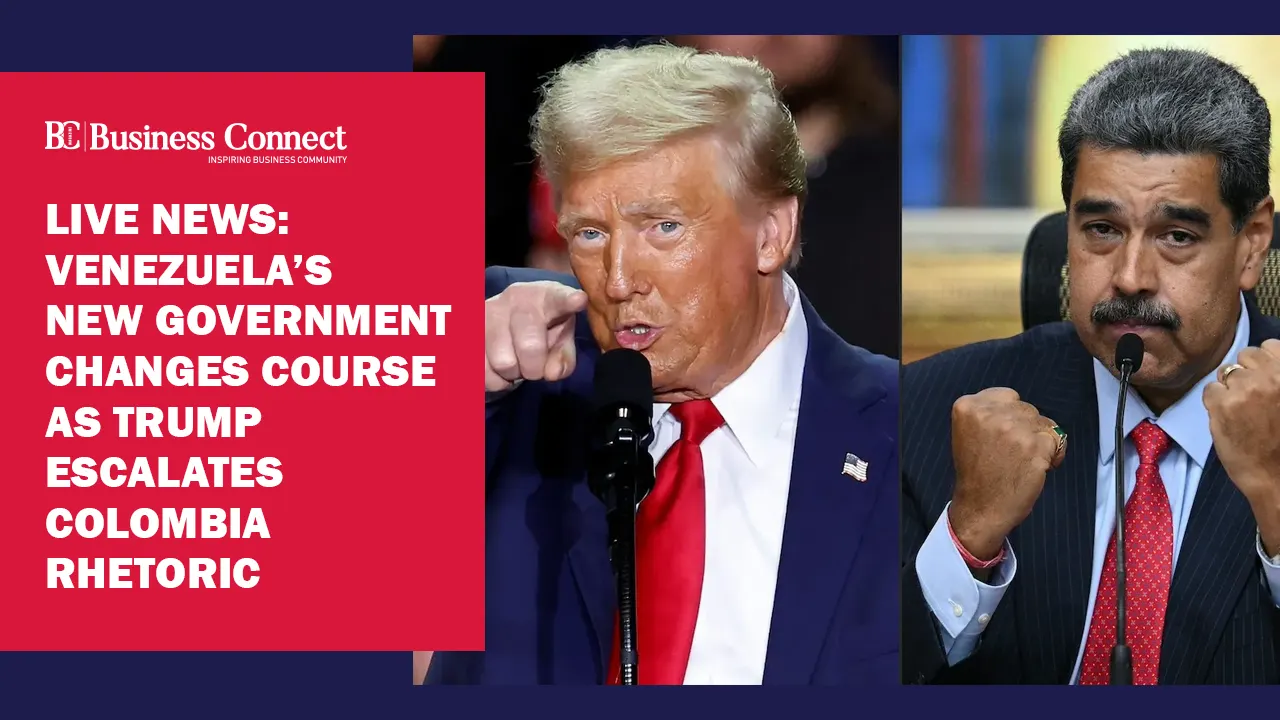
Trump Signals Possible U.S. Action Against Multiple Countries
Following the U.S. raid in Caracas that captured Venezuelan President Nicolás Maduro, President Donald Trump suggested on Sunday that the United States could take action against other countries in the region and beyond. He specifically threatened Colombia, described Cuba as “ready to fall,” and reiterated his interest in acquiring Greenland for national security purposes.
Speaking to reporters on Air Force One, Trump criticized Colombia’s president, Gustavo Petro, saying the country was “run by a sick man who likes making cocaine and selling it to the United States.” He added, “He’s not going to be doing it for very long,” referring to alleged cocaine operations. When asked about the possibility of a U.S. operation targeting Colombia, Trump replied, “It sounds good to me.”
Trump also highlighted other countries as potential points of concern. Regarding Mexico, he said drugs were “pouring” through the country and warned that the cartels there were “very strong,” signaling potential U.S. action. On Iran, amid ongoing protests, he stated that if the government were to commit violent crackdowns, the U.S. “would hit very hard.”
On Cuba, a long-time Venezuelan ally, Trump suggested no immediate military intervention was needed, stating, “It looks like it’s going down” and noting that the country had lost income from Venezuelan oil.
Earlier Sunday, Secretary of State Marco Rubio had also suggested Cuba could face U.S. military pressure, accusing the Cuban government of supporting Maduro’s security apparatus and propping up his regime. Rubio, the son of Cuban immigrants, has long advocated for the removal of Cuba’s leadership.
Finally, Trump reiterated his longstanding interest in Greenland, describing the territory as strategically important and “covered with Russian and Chinese ships all over the place,” framing it as a matter of U.S. national security.
Acting President Delcy Rodríguez signaled openness to dialogue following earlier defiant statements from Venezuelan officials, even as President Donald Trump warned that the United States could take action against other countries, including Colombia.
Cuba said on Sunday that 32 of its citizens were killed in U.S. attacks in Venezuela, including military and intelligence personnel, marking a rare public acknowledgment of Havana’s direct involvement in supporting the Maduro government.
According to Cuban state media, President Miguel Díaz-Canel said the victims were members of Cuba’s armed forces or interior ministry who had been deployed to Venezuela at the request of its government. He described their deaths as occurring during combat or as a result of aerial bombings.
“Our compatriots carried out their mission with dignity and heroism and fell after fierce resistance against the attackers,” Díaz-Canel said. The Cuban government announced two days of national mourning in response to the losses.
The disclosure marked a rare public acknowledgment by Cuba, whose leftist government has maintained deep and long-standing ties with Venezuela, that its personnel are operating inside the country.
For years, Havana has deployed thousands of Cuban citizens to Venezuela in exchange for oil. While many serve as doctors and teachers, the deployments have also included intelligence officers and security personnel.
In December, The New York Times reported that amid growing U.S. military pressure, Venezuelan President Nicolás Maduro expanded the role of Cuban bodyguards in his personal security and increased the presence of Cuban counterintelligence agents within Venezuela’s armed forces, moves aimed at reducing the risk of a coup.
It now appears that some of those Cuban personnel may have been among the casualties after U.S. forces launched operations on Saturday. Venezuelan authorities said on Sunday that preliminary estimates put the death toll at 80.
Asian markets, the first to open after the U.S. strikes on Venezuela, showed little sign of concern on Monday as gains in technology stocks outweighed worries about potential energy supply disruptions. Major regional indices posted strong early advances, with Japan’s Nikkei 225, South Korea’s Kospi, and Taiwan’s Taiex each rising more than 2%. Hong Kong’s Hang Seng Index also recorded modest gains.
Meanwhile, Venezuela’s newly appointed acting president, Delcy Rodríguez, struck a noticeably more conciliatory tone toward the United States, calling for dialogue and peaceful coexistence.
In a statement released late Sunday on Instagram and other social media platforms, Rodríguez said Venezuela “aspires to live without external threats” and emphasized the country’s right to sovereignty. At the same time, she extended what she described as “an invitation to the U.S. government to work together on a cooperative agenda,” focused on shared development, respect for international law, and long-term coexistence.
The remarks marked a sharp shift from her rhetoric just a day earlier. On Saturday, following the capture of former President Nicolás Maduro, Rodríguez delivered a fiery speech accusing the Trump administration of illegally abducting Venezuela’s leader and calling for his return.
Rodríguez, 56, a former foreign minister and Maduro’s vice president, initially refused to acknowledge her new role after Maduro was taken into U.S. custody, repeatedly referring to him as Venezuela’s “only” president.
U.S. President Donald Trump said on Saturday that Rodríguez had spoken with Secretary of State Marco Rubio and had agreed to cooperate with a transition government. However, tensions quickly resurfaced, and Trump later warned that Rodríguez would face severe consequences if she failed to comply.
Notably, Rodríguez’s statement on Sunday did not demand Maduro’s release. Maduro and his wife are currently being held in a federal jail in New York on drug-related charges.
Addressing Trump directly, Rodríguez said Venezuela and the broader region deserved “peace and dialogue, not war,” adding that unity and stability remained her vision for the country’s future.
On Sunday, Venezuela’s Supreme Court formally declared Rodríguez the country’s acting president, solidifying her position amid ongoing political and diplomatic uncertainty.
U.S. President Donald Trump sent mixed signals about who controls Venezuela following U.S. military action and the capture of President Nicolás Maduro, saying aboard Air Force One that the United States was “dealing with the people that just got sworn in.”
Asked directly who was in charge, Trump said, “Don’t ask me who’s in charge, because I’ll give you an answer, and it’ll be very controversial.” Pressed further, he added bluntly: “We’re in charge.”
The remarks came as Trump administration officials sought to clarify that Washington’s goal was to coerce Venezuela, not govern it, softening language Trump had used a day earlier suggesting U.S. control.
Meanwhile, Cuba confirmed that 32 of its citizens were killed during the U.S. strikes in Venezuela. Cuban state media said the dead included members of the armed forces and interior ministry who were deployed at Venezuela’s request. President Miguel Díaz-Canel praised them for their “dignity and heroism” and declared two days of national mourning, marking a rare public admission that Cuban military personnel were operating in Venezuela.
Venezuela’s acting president, Delcy Rodríguez, adopted a more conciliatory tone on Sunday night, calling for peace and dialogue with the United States after previously issuing defiant statements. “Our people and our region deserve peace and dialogue, not war,” she said. Trump, however, warned that she would face severe consequences if she failed to comply with U.S. demands.
Speaking further to reporters, Trump said “Cuba looks like it is ready to fall,” claiming the country had lost its primary source of income from Venezuelan oil. He also said many Cubans had been killed while attempting to protect Maduro, though he provided no figures. Trump added that the U.S. was considering reopening its embassy in Caracas.
Trump also escalated rhetoric toward Colombia, accusing President Gustavo Petro of overseeing cocaine production and suggesting that U.S. action against Colombia was under consideration, saying, “It sounds good to me.”
Beyond the immediate regional fallout, the U.S. intervention has dealt a significant blow to Iran, one of Venezuela’s closest international allies. Over the past two decades, Iran and Venezuela built deep political and economic ties rooted in shared opposition to the United States and cooperation in evading sanctions.
Between 2021 and 2023, Iran shipped 25 million barrels of oil and refined products to Venezuela, worth about $2.5 billion, according to data from Kpler. Iran also invested billions in Venezuela’s energy, housing, and industrial sectors and deployed engineers to repair major refineries. Iranian media report that Venezuela owes Tehran roughly $2 billion, a debt now widely seen as unlikely to be repaid.
U.S. Secretary of State Marco Rubio said Maduro’s removal was driven not only by alleged drug trafficking ties but also by his decision to invite U.S. adversaries, including Iran, to expand their influence in Latin America.
Iran condemned the U.S. action as a violation of international law, with Foreign Minister Abbas Araghchi reaffirming Tehran’s support for Venezuela and confirming that Iranian diplomats remain active in Caracas.
Analysts say Iran’s influence in Venezuela has been severely damaged but not eliminated. “Iran will try to deepen relations with other leftist governments in Latin America and maintain ties with Venezuela’s next leadership,” said Sina Azodi, an Iran expert at George Washington University.
Iran and Venezuela also maintained limited military cooperation, including the assembly of Iranian Mohajer-2 drones in Venezuela and the public display of armed Iranian drones by Maduro in 2022.
Maduro’s Capture Signals Trump’s Push to Reassert U.S. Dominance in the Americas
The lights went out. Air defenses were neutralized. Explosions echoed across the capital. Under the cover of darkness, U.S. helicopters swept into Caracas and seized Venezuela’s president, Nicolás Maduro.
Hours later, as President Donald Trump publicly celebrated the operation, he repeatedly referenced one thing: Venezuela’s oil, mentioning it more than 20 times.
The dramatic intervention has shaken Latin America more profoundly than perhaps any single event this century, but its meaning sharply divides the region.
For much of the Latin American left, the episode reinforced long-standing fears that the United States remains an imperial power willing to use military force to dominate its neighbors and exploit their natural resources. For the Latin American right, Trump’s move represented the removal of a corrupt dictatorship and the beginning of Venezuela’s economic revival.
Left-leaning governments in Brazil, Mexico, Colombia, Chile, Spain and Uruguay jointly condemned the U.S. bombing campaign and Maduro’s capture, calling it “an extremely dangerous precedent” and warning against any foreign control or appropriation of Venezuela’s strategic resources.
In contrast, Argentine President Javier Milei, the region’s most prominent right-wing leader, openly applauded the U.S. action. “There’s no middle ground,” he said. “You are either on the side of GOOD, or you are on the side of EVIL.”
What is broadly acknowledged, however, is that the intervention marked a forceful return of the United States as the central power broker in Latin America.
Trump made that intention explicit. Reviving — and renaming — the Monroe Doctrine, he declared on Saturday: “They now call it the Donroe Doctrine. Under our new national security strategy, American dominance in the Western Hemisphere will never be questioned again.”
This represents a sharp break from the past three decades of U.S. policy in the region, which largely emphasized democracy promotion and free trade. Under Trump, policy has shifted toward transactional, power-driven engagement, often aligned with his personal political interests.
In recent years, Trump imposed tariffs on Brazil to support former President Jair Bolsonaro, sanctioned Colombia’s president for criticizing U.S. policy, endorsed a right-wing candidate in Honduras, and provided Argentina with a $20 billion financial lifeline ahead of key elections.
To many in the region, the moves revived memories of Washington’s long history of intervention — from invasions of Mexico, Panama and Haiti to backing military coups during the Cold War.
“Thinking as a region, this is frightening in a way I haven’t seen for a long time,” said Celso Amorim, foreign policy adviser to Brazilian President Luiz Inácio Lula da Silva. “This return to interventionism isn’t even disguised. The objective is clearly economic.”
Mr. Lula held emergency meetings with his cabinet following the attack and issued one of the strongest rebukes, saying the U.S. had “crossed an unacceptable line” and urging the United Nations to respond forcefully.
On Sunday, the Community of Latin American and Caribbean States convened an emergency meeting. Venezuela’s foreign minister warned that the strike should alarm the entire region. “Today it may be Venezuela; tomorrow it could be any other country that decides to exercise its sovereignty,” he said.
Others disagreed. Leaders in countries critical of Maduro argued that Venezuela’s authoritarianism provoked U.S. action. Ecuador’s president, Daniel Noboa, declared: “To all the narco-Chavista criminals, your time is coming.”
Still, most analysts expect little beyond diplomatic condemnation. The United States remains the region’s most important economic partner, and Trump has shown a willingness to deploy economic pressure, political interference and now military force.
“We are at a low point in inter-American diplomacy,” said Arturo Sarukhán, former Mexican ambassador to the U.S., adding that fragmented politics make a coordinated regional response unlikely.
Brazil’s relative economic independence — with China now its largest trading partner — has allowed it to take a tougher stance. Amorim warned that Trump’s approach could accelerate Latin America’s shift toward Beijing as countries seek counterweights to U.S. pressure.
Absent a full-scale U.S. occupation of Venezuela, observers say the region is unlikely to act in unison — a reality that may embolden Trump further.
Within hours of the Venezuela operation, Trump suggested Cuba could be next. By Sunday, he openly floated action against Colombia, accusing President Gustavo Petro of drug trafficking and responding affirmatively when asked if the U.S. might intervene.
“He’s not going to be doing it for very long,” Trump said. “It sounds good to me.”