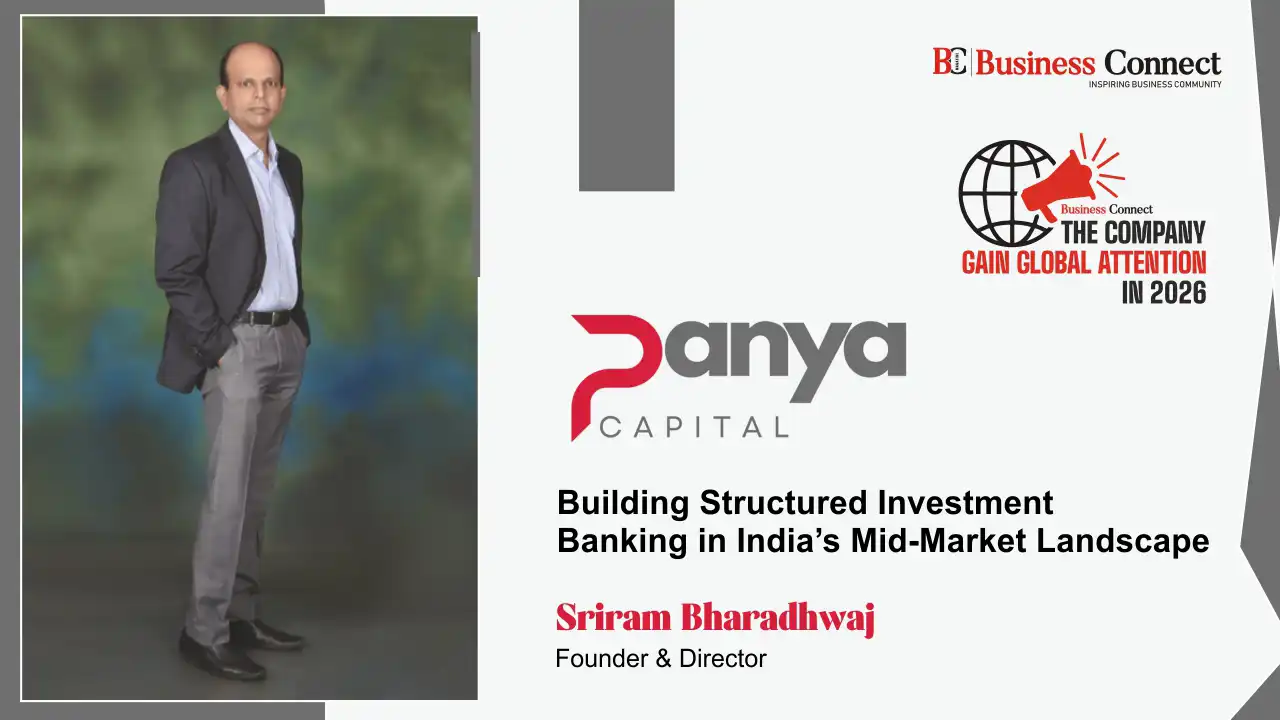
In India’s rapidly evolving financial ecosystem, there is a silent but powerful shift happening in the mid-market investment space. While headlines often celebrate billion-dollar unicorns and mega private equity deals, a large segment of India’s growth economy operates between $5 million and $50 million, ambitious companies ready to scale, restructure, or transition ownership. This is where Panya Capital positions itself with clarity and intent.
In conversation with Mr. Sriram Bharadhwaj, the founder of Panya Capital becomes clear: this is not just another advisory firm chasing transactions. It is a decade-old investment banking team; built around structured execution, sector understanding, and long-term value creation.
A Decade of Building Institutional Discipline
The team with over decade of experience, Panya Capital has evolved into a focused mid-market investment banking firm. Unlike boutique advisors who operate opportunistically, the firm emphasizes process-driven mandates and structured dealmaking.
Its transaction range typically spans from a few million dollars to approximately $50 million. This positioning is deliberate. It allows Panya Capital to work closely with promoter-driven businesses that are large enough to scale but still require strategic financial structuring.
Over the past decade, the firm has increasingly focused on mergers and acquisitions (M&A) and equity raising as its primary growth levers. Rather than treating M&A as a one-off advisory service or equity raise as a transactional capital activity, Panya Capital views both as long-term transformation tools, enabling businesses to unlock strategic capital, accelerate expansion, strengthen governance, and enter new phases of maturity with confidence.
As Mr. Bharadhwaj highlights in discussions, scaling is not about doing more deals, but about doing the right deals with deep sector alignment.
A Technology-First Vision
One of the most distinctive aspects of Panya Capital’s evolution is its technologyfocused vision.
Unlike traditional investment bankers who operate purely from financial modeling perspectives, the leadership at Panya Capital brings operational exposure, particularly in technology-driven businesses. Mr. Bharadhwaj himself comes from a strong technology background, having scaled and executed multiple technology-led initiatives. This matters. Because when you understand how a technology company scales, its product lifecycle, recurring revenue mechanics, SaaS margins, customer acquisition challenges, your advisory role becomperspectives, the leadership at Panya Capital brings operational exposure, particularly in technology-driven businesses.
Mr. Bharadhwaj himself comes from a strong technology background, having scaled and executed multiple technology-led initiatives. This matters. Because when you understand how a technology company scales, its product lifecycle, recurring revenue mechanics, SaaS margins, customer acquisition challenges, your advisory role becomes more strategic than transactional.es more strategic than transactional.
Panya Capital aims to deepen its presence in technology-oriented sectors, building expertise that differentiates it in a relatively unorganized mid-market advisory environment. And that leads to one of its most important value propositions. Organized Investment Banking in an Unorganized Segment. India’s mid-market investment banking space remains fragmented. Many deals in the $5–30 million range are handled by informal brokers or loosely structured advisory firms.
Panya Capital positions itself differently. It emphasizes institutional processes, structured documentation, financial diligence preparation, and curated investor outreach. The firm does not just “connect buyer and seller.” It represents mandates, especially on the seller side, with strategic positioning.
A defining characteristic of Panya Capital’s deal portfolio is its strong technology orientation. More than 60% of the firm’s transactions are technology-focused. This concentration is not incidental but reflects the firm’s belief that technology is no longer a sector in itself, but the backbone of modern enterprise growth.
By anchoring the majority of its mandates in technologydriven businesses, Panya Capital positions itself at the center of innovation-led value creation. These are companies where scalability, intellectual property, data ecosystems, and platform economics shape valuation dynamics. Navigating such deals requires a deep understanding of product architecture, recurring revenue models, regulatory landscapes, and investor appetite for high-growth, asset-light businesses.
At the same time, the remaining 40% of its transactions span nontechnology sectors, ranging from manufacturing and consumer businesses to traditional services and infrastructure-linked enterprises. In these engagements, the firm often identifies digital transformation opportunities, operational optimization strategies, and capital structuring frameworks that help legacy businesses compete in increasingly tech-influenced markets.
Equity Fundraising & Private Equity Alignment
Panya Capital’s core expertise spans:
- Equity fundraising
- Mergers and acquisitions
- Structured financial solutions
- Strategic capital advisory
The firm works closely with select private equity funds and growth capital investors. Rather than operating as a broadbased fundraising platform, Panya Capital builds relationships with curated investor networks aligned to specific sectors.
When representing a seller mandate, the firm prepares companies for institutional scrutiny, financial restructuring, governance alignment, and valuation positioning.
Private equity, especially in India, is no longer just about capital infusion. It is about operational discipline, growth acceleration, and exit pathways. Panya Capital understands this dynamic.
Instead of branding itself as a “startup ecosystem player,” the firm prefers to operate within what it describes as an ecosystemfocused model, one where businesses are not just funded but repositioned for long-term value.
This perspective reflects maturity. Private equity investments typically operate within 5–7 year horizons. Aligning promoter expectations with fund lifecycle realities requires clarity, not just optimism.
Merger and acquisition as a Strategic Growth Lever
In the past few years, Panya Capital has placed increasing emphasis on mergers and acquisitions. Why? Because India’s growth cycle has matured. Many companies that began 15–20 years ago are now entering generational transition. Others are consolidating to build scale before global competition intensifies. M&A is no longer optional, it is strategic.
Panya Capital’s role in M&A goes beyond transaction execution. It evaluates:
- Strategic fit
- Cultural alignment
- Synergy mapping
- Integration feasibility
The mid-market often struggles with integration planning posttransaction. Having advisory oversight that understands both operational and financial implications significantly reduces post-deal friction.
Navigating India’s Economic Transitions
India’s business landscape has seen significant shifts in recent years, regulatory tightening, funding corrections, valuation rationalization, and increased investor scrutiny. While some entrepreneurs interpret this as slowdown, seasoned advisors see it differently.
It is a normalization phase. For firms like Panya Capital, this environment creates opportunity. As speculative capital reduces, disciplined capital becomes more valuable. Businesses require structured advisory support more than ever, particularly those navigating sectoral corrections.
Mr. Bharadhwaj’s outlook reflects realism rather than hype. Having observed multiple sectors and industry cycles, he recognizes that sustainable investment banking is not built during booms alone but built during recalibrations.
Differentiation Through Sector Understanding
One honest observation from leadership conversations stands out: there may not be a dramatic “marketing differentiator” in terms of services offered. Equity fundraising and M&A are common services across investment banks. So where is the differentiation?
- In sector depth.
- In hands-on experience.
- In understanding the psychology of Indian promoters
- In bridging traditional businesses with institutional capital.
Many mid-sized companies struggle not because they lack revenue, but because they lack structured financial storytelling. Panya Capital helps bridge that narrative gap.
And in the $10–35 million range, that storytelling can significantly impact valuation outcomes.
Scaling with Discipline in future
Looking ahead, Panya Capital’s vision is centered around scaling intelligently, not aggressively.
The focus remains:
- Deepening technology sector mandates
- Expanding curated private equity relationships
- Strengthening cross-border advisory capabilities
- Building repeat institutional partnerships
Rather than expanding into unrelated verticals, the strategy appears to be depth over breadth.
This approach aligns well with India’s mid-market evolution. As more family-owned businesses consider structured exits or partial monetization, organized advisory platforms will become essential.
A Strategic Conversation in Progress
As discussions continue with Mr. Sriram Bharadhwaj, one thing becomes evident, Panya Capital is positioning itself for the next decade, not just the next deal.
In a market where many advisors chase volume, Panya Capital is building institutional credibility in a segment that remains under-structured yet full of opportunity. India’s economic story is not written only in billion-dollar headlines. It is written in the steady growth of mid-sized companies transitioning into structured, capital-backed enterprises. And in that journey, advisory platforms like Panya Capital play a quietly significant role.