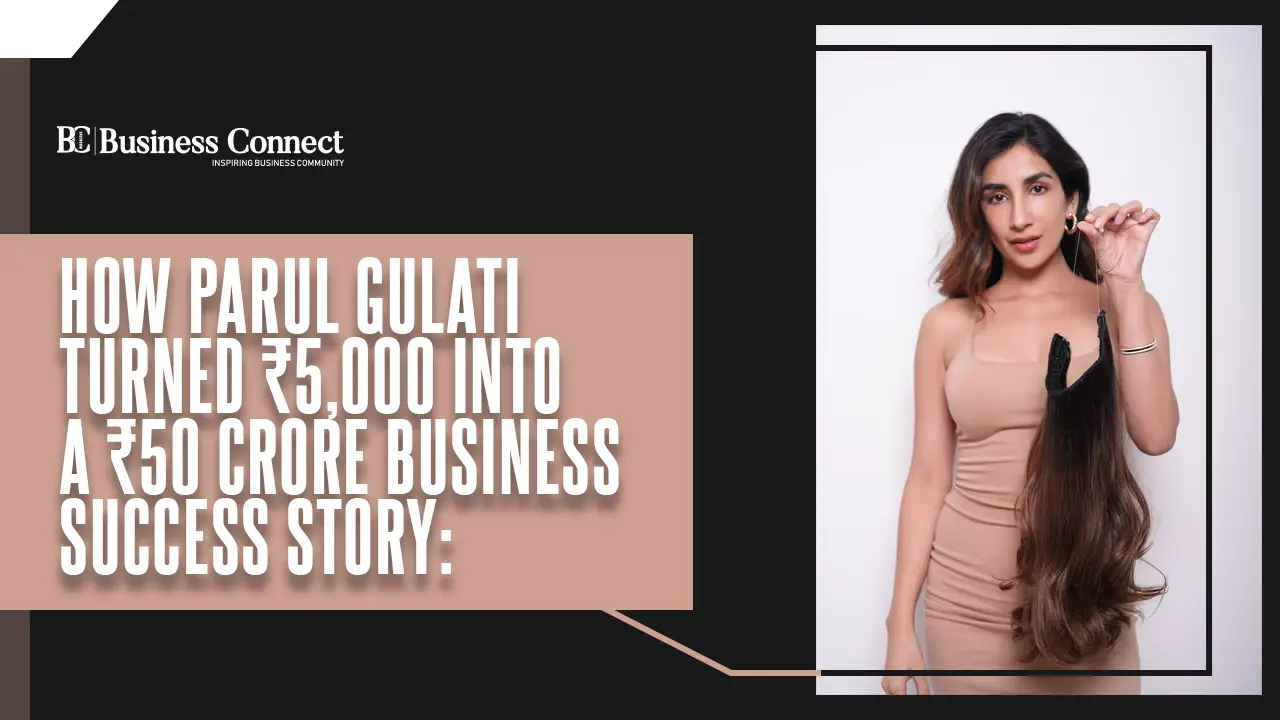
By Jaya Pathak
The Indian market still underestimates a kind of an entrepreneur who appears like brand, talks like creator, and acts like it is cold business with a manufacturer. Parul Gulati has occupied that awkward position, she is famous enough not to be accepted as a celebrity dabbler yet stubborn enough to establish a business that does not act like a vanity project.
The 5,000 package image of origin has struck new media vernacular: easily, screen, into-the-head. Other sources quote various figures of early capital, such as ₹30,000, to which no-one should be surprised as to how the myth of startups is pushed down to the media.
Of greater importance than the specific denomination per se is the rationale behind it: Nish Hair is a low-capital high-conviction venture in an industry that is built on trust and dies on embarrassment the loss of hair, hair thinning, hair make-up, self-esteem.
Another business lesson that Gulati too is not able to resist revealing in her story is unspoken. She did not get started trying to develop a platform; she started by trying to offer a product to a customer, who had reservations about admitting that she was in need of it.
This explains her positioning rather oddly, hair as identity, extensions as a tool of pragmatically covering thinning, language which is emotionally smart and businesses shrewd in equal measure. Whenever categories are intimate, the customer does not just buy utility, she buys discretion, reassurance and a sense that she will not feel ridiculed to seek solution.
Nish Hair:
Nish Hair is a company that offers 100% human hair extensions and other related items like wigs, toppers, extensions, accessories in a variety to accommodate various price sensitivities such as single strands and fuller coverage. It has been characterized by Gulati as the kind of unromantic patience that is so often lost in the influencer economy: she began her business right at her living room, sewing bits with her mother, and it took her months to sell a handful of items, go on calls with hairstylists, and, in some cases, go to homes of her customers to have a trial.
This is important as it shows what is driving the business: it is not the virality, but the readiness to work in the lowest status in the company until the company would afford to install a system.
The discipline would then manifest itself in marketing model the brand grew to be identified with. Nish Hair only maintained a marketing budget comparatively late with sales being primarily caused by hours of Instagram reels of the founder of the company, and that the company relaxes its spend decisions as it grew. It is the founder-led mechanism of distribution, only done with more patience than the market usually permits: gain reputation in society, resolve the questions head-on, and turn the interest into action.
It does not appear hard on the surface but it is in fact, a business of labour– unending content production, unending customer dialogue, unending manipulation of an object that the customer desires to know about, before they make a purchase.
Then was it the time that is apt to reduce years of labor into a single program on the TV. Gulati appeared at Shark Tank and obtained 1 crore in the form of 2% equity at the hand of Amit Jain. She requested 1 crore 2 per cent. Equity, was offered, and with the help of Amit Jain, and she told subsequently the sales of the brand were also tripled in the aftermath of the show.
Shark Tank is commonly perceived as marketing in the market; in reality, it is a credibility event, especially where the customers are in fear of being swindled, and institutional investors are concerned with repeatability.
To have the inclination to appreciate the arc of arc of; do one wish to know; Rs 5,000 to 50 crore without being sentimentally minded, then the jarring exercise is to separate the talk of valuation and the reality of operation. Gulati as saying that Nish Hair is valued at over 50 crore, and also mentions how lean the initial couple of years were- she says she earned ₹40,000 in the first year selling about four hair extensions.
It is not a motivational poster, it is a working program, that contraposition, of small initial sales, of bigger and bigger afterward. It implies a founder who, over time, remained in the category and made taboo become normal, and for salon and customers to believe that this is not one of those fly-by-wire salespeople.
The other choice of her model, which needs further attention in serious business circles, is labour design. We quote the words of Gulati that Nish Hair consists of an all-women team and provides the number of employees. It as an all-women team and it measures 35 team members.
This is not just a social declaration in a consumer brand, it may be a customer-trust bargain, a sympathic selling edge, and (done effectively) an inner culture that remains less alienated than the emotional truth behind the product.
It is also indicative of the brand that extends to offline. Nish Hair started online but has branched into offline in the last one year, which now had a studio in Mumbai where you can have a trial and consultations, another store is planned, and it has salons in other states.
Where the product is purchased based on a factor of fit and feel, offline is not a thing of the past, it is an avenue of risk aversion, particularly among the more geriatric customers who seek to lay their eyes on the product and feel it first, before purchasing. What is more interesting as the implication is strategic: Gulati seems to be developing a hybrid trust architecture–awareness content, D2C scale, offline reassurance and conversion.
The most insignificant, ironical, part of the story is the celebrity angle. The mention of Moneyacting career and training of Gulati such as the move to Mumbai and studying at RADA in London.
That background is significant, not because it puts glamour into it, but because is it is what made her comfortable with the camera and story-telling-things- talents that in a social economy based on commerce can act as a compounding resource. But the business lives as long as business operations do: consistency of the vendor, consistency of the product, customer service, returns, inventory, and maintain the quality consistent as the demands vary.
When individuals repeat 5,000 line, then it is well worth them taking them with a grain of salt. What is more practically learned is not that it is possible to begin with a small number–which is possible–but that it is possible to create trust in a sensitive category by use of founder-led selling and then to professionalise the distribution without losing the initial chastisement which made the customer believe.
And there might be the true success tale. Not arithmetic between ₹5,000 and ₹50 crore, but the gumption to continue the construction process when the first year brings ₹40,000 and the market continues to believe that your product category is awkward. The fact that most businesses fail is not because they were bad ideas. They perish since the founder lacks patience before trust gathers time to multiply.
FAQs
- What can investors and boards do to assess these kinds of narratives of ₹X to ₹Y crore founders without having been cynical?
View the figure of origin as an act of industriousness, not as checked fact, and put hard work on repeatability: conversion drivers, retention, return rates, gross margins, and reliance on a single personality by the distribution business.
- What is the strategic asset on which founder-led marketing in sensitive consumer categories, as seen in hair loss solutions, relies?
It has a crunching effect on the trust cycle–customers get to watch demonstrations, see counterarguments being countered, and get reassurance–where embarrassment or fear of fraud are barriers to purchase.
- What is the rationale of having an offline studio to a D2C-first personal-care brand?
Since physical tests and consultations lower the perceived risk and increase the market to be addressed by customers who are not risk-averse to purchase online, the conversion could be enhanced but not because of the presence only.
- Why is Nish Hair model difficult to copy as it seems?
Combination of credibility of the content, readiness to do high-touch selling early (including home trying) and a product mix that fits different sensitivities to price- these things can only be acquired with time, not just money.
- What is the actual leadership issue after an event such as Shark Tank has already been seen?
Stopping demand spikes without causing a decline in the quality and the service, and creating the frameworks that can maintain the 3X-levels of scale without making the brand a media fad.