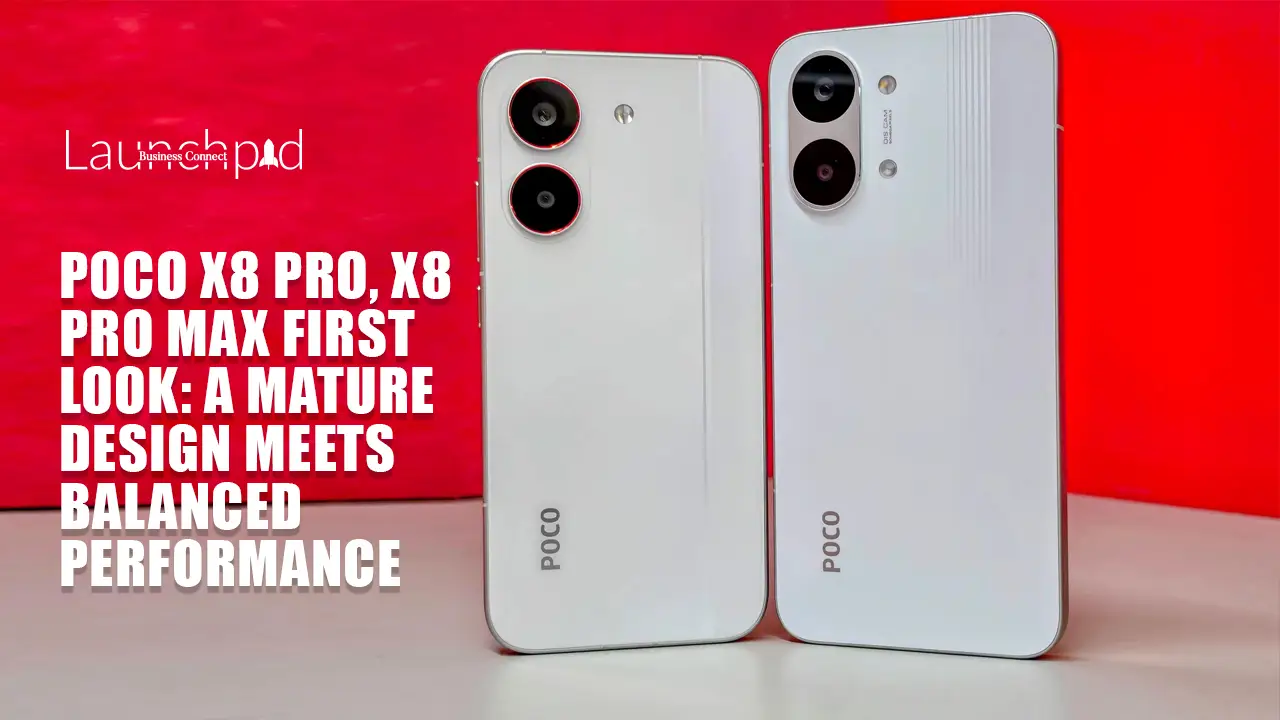
First impressions of the Poco X8 Pro and Poco X8 Pro Max: Every smartphone company faces an identity problem at some time in its development. Do you continue to double down on what made you popular, or do you evolve with your buyers, even if that means toning things down? For a very long time, Poco didn’t actually face that problem. It was fully aware of its values.
Unrefined performance, aggressive pricing, and designs that failed to find a way to fit in. With bright visuals, stark contrasts, and RGB features that unabashedly leaned into gaming culture, Poco devices—whether the X series or the F lineup—were designed to stand out.
The problem with customers, though, is that they mature. And when they do, businesses run the danger of falling behind or growing alongside them.
Poco seems to have taken a deliberate decision with the Poco X8 Pro and Poco X8 Pro Max, almost like the brand is now maturing like one of those characters from your favorite anime series (looking at you, Naruto). This is neither a total break from its origins nor a radical reinvention. Rather, it seems like an intentional, measured change. One that shows a company paying great attention to its community and reacting maturely.
In an exclusive interview with ABP Live, Ken Sekhar, the marketing head of Poco India, stated, “We’ve seen a sort of ‘growing up’ of this audience over the last year.” They are expressing their want for more and a greater premium. We want increased battery life and better performance. In many respects, the X8 Pro series is an answer to that need.
Not Loud Anymore, Just… Considered
Seldom have Poco phones been accused of being subtle. That was the point, to be fair. Performance was intended to be indicated by the design language even before the device was turned on.
But this time, there’s a clear sense of restraint in the approach.
The X8 Pro series maintains Poco’s performance-first characteristics while embracing a cleaner, more streamlined look. Although they have been greatly reduced, the recognizable cues—racing stripes across the rear and red accents surrounding the power button and camera modules—remain. They now enhance the design rather than overpower it.
Perhaps the best illustration of this change is the circular RGB lights built within the camera module. RGB components would be prominently shown on earlier Poco smartphones, practically demanding attention. The lighting is much more nice, regulated, and restrained here.
It gives the design personality without being overpowering.
This is in line with what Sekhar said about Poco’s changing design ethos: “It’s a lot more premium.” It’s much more completed now. It doesn’t show up. However, it looks amazing when you move your phone and the light hits it perfectly.
I understand exactly what he says, having spent some time with the White variety. It is undoubtedly one of the most elegant-looking Poco gadgets in recent memory; it is polished, subtle, and self-assured without being noisy.
Premium Build, Familiar Practicality
There is a noticeable improvement in build quality to go along with the change in style.
Both gadgets feel sturdy and well-made, with a metal frame and glass back. This has a feeling of balance as well as a comforting heft. You know, the kind that enables these phones to coexist peacefully with rivals in the mid-premium market.
Nevertheless, this is still glass. Glass also has its own set of hazards, as usual. A case is recommended if you have a tendency to handle your devices carelessly.
Thankfully, Poco still includes the necessities in the box: a 100W charger, a USB-C cable, and a protective case. Even if it’s a minor feature, it matters in a market where in-box accessories are becoming less and less common.
Performance: Staying True To Its DNA
The performance guarantees that Poco hasn’t lost its identity if the design indicates maturity.
Making its debut in India on a 3nm architecture, the MediaTek Dimensity 9500s on the Pro Max offers everything you would anticipate from a Poco gadget. Quick boot times, snappy multitasking, and reliable performance throughout daily use.
The Dimensity 8500-Ultra-powered ordinary X8 Pro likewise performs admirably, but the Pro Max unmistakably sets itself apart.
Regarding Poco’s intentions, Sekhar was rather straightforward: “Why does the X have to be pigeonholed? Why can’t the X confront the F? This lineup appears to be the solution.
He added that the X8 series was superior in terms of basic performance measures. These internal lines have already started to blur, especially with the Pro Max, which has essentially forced Poco’s own F series to advance.
Battery: Still Playing To Its Strengths
Battery life is one area where Poco has continuously performed well. And that heritage is carried on by the X8 Pro series.
By any standards, the Pro Max’s 9,000mAh silicon-carbon battery is impressive. This type of capacity causes the discussion to go from “will it last the day?” to “when do I actually need to charge this?” The gadget strikes a mix between convenience and endurance when paired with 100W quick charging. Later on, ABP Live’s comprehensive assessment will provide more insight into the optimization of everything.
Poco X8 Pro’s 6,500mAh battery may be smaller on paper, but it remains more than sufficient for most users.
Cameras: Admirable Foot Forward
Historically, Poco’s main selling point has not been cameras. However, there is a discernible improvement this time.
The X8 Pro Max produces crisp, detailed daylight photos with well-balanced colors in preliminary tests.
Compared to what we have usually seen from Poco devices, the results feel more regulated and refined. It’s no longer lagging behind, even if it isn’t trying to win the camera race.
The Bigger Picture: Poco’s Strategic Shift
Beyond the hardware, Poco’s attempt at a more comprehensive strategy change is noteworthy. Consumer interactions are evolving, according to Sekhar: “No one has come and told me I want a phone at 20K or 30K.” They are discussing the type of technology they hope to see. It’s a big change from price-first to experience-first.
It clarifies why Poco is currently pushing the X series past its conventional limits. “X8 Pro matches a F series, and X8 Pro Max goes beyond the F series,” according to Sekhar. Therefore, the only thing the F series can do is improve. This goes beyond simply upgrading the product. It’s a repositioning.
Poco X8 Pro Series First Impressions: Early Verdict
After working with the X8 Pro lineup for a while, Poco becomes clearer and more self-assured.
Strong performance, huge batteries, and reasonable pricing are still the essentials. On top of that, however, is a renewed focus on overall user experience, design, and finish. With this, Poco is transitioning from its “spec-first” phase to a more balanced one. more thoughtful. more mature.
Furthermore, the X series might no longer be a supporting player in Poco’s own portfolio or the market as a whole if this trend keeps up.