Introduction
India is enthusiastically developing its domestic semiconductor manufacturing industry. However, the reliable supply of essential precision parts with consistent quality, which heavily depends on the supply of high-end equipment for semiconductor manufacturing, is a major hurdle in the development of the industry. This is because the standard for CNC machining services is generally inadequate to satisfy the extreme requirements for precision parts that must be supplied for the manufacturing of semiconductor equipment. This results in a short lifespan of the parts, leading to machine downtime.
This article will attempt to explain the fundamental difference between the standard for Semiconductor CNC Machining services, decipher the essential technical challenges involved with it, and how the best of global manufacturing standards can help resolve the problem of precision parts required for the development of Semiconductor Equipment Manufacturing in India. To understand the significance of the solution to the problem, it is essential to address the following core questions.
What is True Semiconductor-Grade CNC Machining, and How is it Worlds Apart from Conventional Machining?
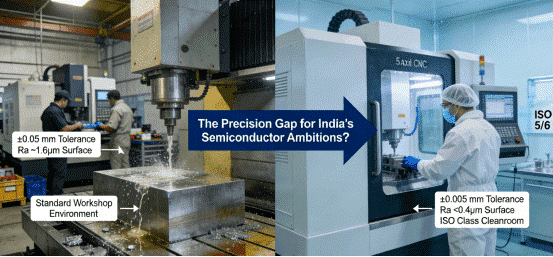
Semiconductor Grade CNC Machining is an ultra-precision manufacturing discipline performed in a cleanroom environment, focused on delivering parts for semiconductor manufacturing equipment. Its purpose is not just “metal cutting” but creating “vessels” that need to contain vacuum, plasma, and ultra-pure chemistry reliably. The distinction is not just incremental but foundational.
Studies done by industry analysis platforms such as Semiconductor Engineering highlight the explosive increase in complexity and precision demands of semiconductor manufacturing equipment. The contrast is highlighted when numbers are used:
| Parameter | Semiconductor-Grade CNC Machining | Conventional CNC Machining |
| Dimensional Tolerance | As tight as ±0.005 mm (5µm) or better | Typically ±0.05 mm (50µm) |
| Surface Finish (Ra) | < 0.4 µm (often Ra 0.2 µm or better) | ~1.6 µm |
| Cleanliness | Mandatory ISO Class 5-7 Cleanroom processing | Not a controlled factor |
| Material Traceability | Full lot traceability with certified documentation | Often limited or batch-based |
For an Indian semiconductor industry that needs to deliver a robust, self-sufficient supply chain, access to this level of CNC machining services is not a luxury but a necessity, laying the foundation for improving equipment availability, process stability, and cost of ownership in the long term.
Why Must Semiconductor Manufacturing Rely on Ultra-High-Precision Machining Technology?
The never-ending quest for miniaturization and yield improvement in semiconductor production requires that the accuracy of each component be absolute.
The Dual Challenge – Precision for Yield & Endurance in Harsh Environments
The economic necessity for High Precision Semiconductor Machining is twofold: ensuring yield security and surviving brutal environmental conditions. First, as the yield guardian, a defect in a CNC machined component that measures only a few microns can be disastrous. A defect in a seal that measures less than a micron can allow a leak; a particle on a rough surface contaminates a wafer; a defect in the flatness of a chuck causes film thickness problems. Second, the component must survive a hostile environment that requires special solutions.
- Vacuum & Plasma Integrity
Components must withstand high vacuums & corrosive plasmas. Approaches like choosing materials that have low outgassing characteristics & utilizing special post-processing techniques like electrolytic polishing are used to ensure that the surface has the least gas retention & corrosion resistance.
- Dimensional Stability
Thermal Cycled Environments – In semiconductor machining, extreme thermal cycling is common. Machining must ensure that the component has high dimensional stability in extreme temperature environments.
The Unmatched Role of Precision Subtractive Manufacturing
Additive manufacturing technology, also known as 3D printing, while advancing rapidly in capability and potential for use in many applications, still cannot replace subtractive manufacturing in many critical components. The reasons for this are many and have to do with the inability of 3D printing technology to meet the ultra-high requirements for semiconductor manufacturing. The roughness of the surface finish of 3D printing components makes a vacuum environment impossible. There is also a problem in attaining the purity and isotropy that is a necessity for semiconductor components. For a technical comparison, please refer to this guide for ‘semiconductor CNC machining’.
What Invisible Machining Challenges Must Be Overcome for Reliable Semiconductor Equipment?
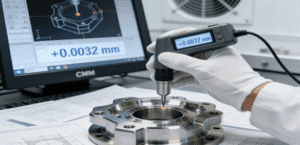
But the achievement of specifications on the drawing is just half the battle. The making of semiconductor equipment involves the conquering of hidden challenges that are not apparent until the machine is operational.
Controlling Micro-Deformation
Residual stress can cause parts to subtly change shape during the machining process. High-precision machining of semiconductor parts uses FEA to optimize tool paths. Multi-stage stress-relieving heat treatments are used to guarantee stability of the parts in their final state.
Achieving “Mirror”-Grade Surface Finishes
A surface roughness of less than 0.4 µm is often a mandatory requirement. This “mirror-grade” finish prevents the formation of micro-pits where particles can get lodged or gases can collect. This requires not just precision cutting but finishing operations such as mechanical polishing, vibratory finishing, or electrolytic polishing.
Implementing Holistic Contamination Control
Contamination control is the absolute bedrock. It is a full-process ecosystem that includes:
- Material and Tooling Purity
Using certified materials of high purity and tooling that is free from contaminants.
- Process and Environmental Control
Machining in a clean environment with HEPA filtration, clean coolants, and adhering to tight protocols for people and parts handling. This is in accordance with the very stringent standards set by organizations like International Semiconductor Industry Association (SEMI) that define industry-wide cleanliness and material standards.
How to Identify a Precision Manufacturing Partner Meeting International Standards?
For semiconductor equipment manufacturing firms, the selection of appropriate CNC machining services partner is a strategic business decision. The checklist must be extended beyond the machines themselves.Certification is the First Filter. A real semiconductor-grade CNC machining services provider will be not only ISO 9001 certified but also have the possession of industry-specific certifications such as IATF 16949 (Automotive Industry) or AS9100D (Aerospace).
These are recognized standards in the industry that require aspects like process control, full traceability, and continuous improvement – exactly the fields critical for semiconductor components. A manufacturer who has got a series of such certifications is basically a minimum qualification for a quality system.
Technical Capability and Documentation are Non-Negotiable. The partner should even be able to provide the delivery of very simple things like 5-axis machining or in-process metrology. However, what is equally important is their potential to provide complete documentation packages such as Material Certificates of Conformity (COC), First Article Inspection Reports (FAIR), and full dimensional inspection reports for each lot. Help from Prototype to Volume is Vital. The right partner will be able to assist in progress from design for manufacturability (DFM) feedback to rapid prototyping to full-scale production. This is the critical path for innovation.
What Do Success Stories Reveal About Pathways to Enhanced Equipment Performance?
Consider the case of an etch equipment manufacturer plagued by inconsistent yield from its reactor chamber lids—a critical, large-format CNC machined part. Minor distortions and surface variations led to plasma instability and particle generation, causing significant annual losses from wafer scrap and service interventions.
The solution involved a partnership with a specialist in semiconductor CNC precision machining. The collaborative process included DFM analysis to optimize the lid’s geometry for stability, followed by a high-precision semiconductor machining protocol. This involved symmetric machining strategies on a 5-axis center to balance internal stresses, multi-stage thermal cycling for stress relief, and final machining in a temperature-controlled environment with in-process CMM verification.
The result was not just a part meeting print specifications, but one exhibiting exceptional in-service stability. The lid’s on-tool yield stabilized above 99.5%, eliminating a major source of variation and saving the client substantial costs associated with downtime and yield loss.
The revelation is clear: collaborating with precision manufacturing experts possessing deep technical mastery and controlled processes is a strategic lever for equipment manufacturers. It is a direct path to achieving higher machine performance, greater reliability, and a lower Total Cost of Ownership (TCO).
Conclusion
The growth of the semiconductor industry in India is inevitably tied to the strength of the underlying high-end equipment industry, whose performance is ultimately contingent upon the underlying strength of the underlying ultra-precision components’ manufacturing prowess.
The chasm between conventional ultra-precision machining and semiconductor ultra-precision machining is vast, requiring an intimate understanding of the unique technical drivers, ultra-challenging environment, and international benchmarks. By engaging with international benchmarked manufacturing prowess, Indian industries can now effectively leverage the supply chain foundation to drive the growth of the semiconductor industry.
Are you looking for reliable component solutions for semiconductor equipment with high accuracy, requiring top-tier international standards for manufacturing and quality services? Then look no further than professional high precision CNC machining services.
Author Bio
Manufacturing Insights Expert The expert shares advanced practices and comprehensive industry insights India. The article has been composed from research and technical analysis of internationally leading manufacturing service providers, among them.
FAQs
Q: What precision can Semiconductor CNC Machining achieve?
A: The precision is normally within the range of ±0.005mm. The precision can be even better for some parts, up to ±0.002mm. This is to ensure perfect integration and functioning of the equipment.
Q: Why is cleanliness control so critically important?
A: Particulate contamination entering the vacuum chamber of a tool can be catastrophic for plasma-based processes. The contamination can even lead to the loss of an entire wafer. Hence, contamination-free machining is a mandatory requirement.
Q: What are some common materials for parts of semiconductor equipment?
A: Aluminum alloys are commonly used for their lightweight properties and ability to dissipate heat. Similarly, stainless steel is also commonly used for parts of semiconductor equipment for their strength. However, some parts can be made of titanium or ceramics depending on their application.
Q: How do machining services aid in the transition from prototype to production?
A: It is a quality service provider who provides smooth transition from Design for Manufacturability (DFM) review and rapid prototyping into production. This ensures early design feasibility verification and, more importantly, consistency in quality and performance from prototype to production.
Q: How can a supplier’s material and quality traceability be verified?
A: Suppliers must be able to furnish original Mill Certificate (CoC) for raw materials, and they must have a strong traceability system in place, which enables every part produced to be traced back to its raw material, machining parameters, and inspection history, which is a fundamental requirement for a high-quality system.