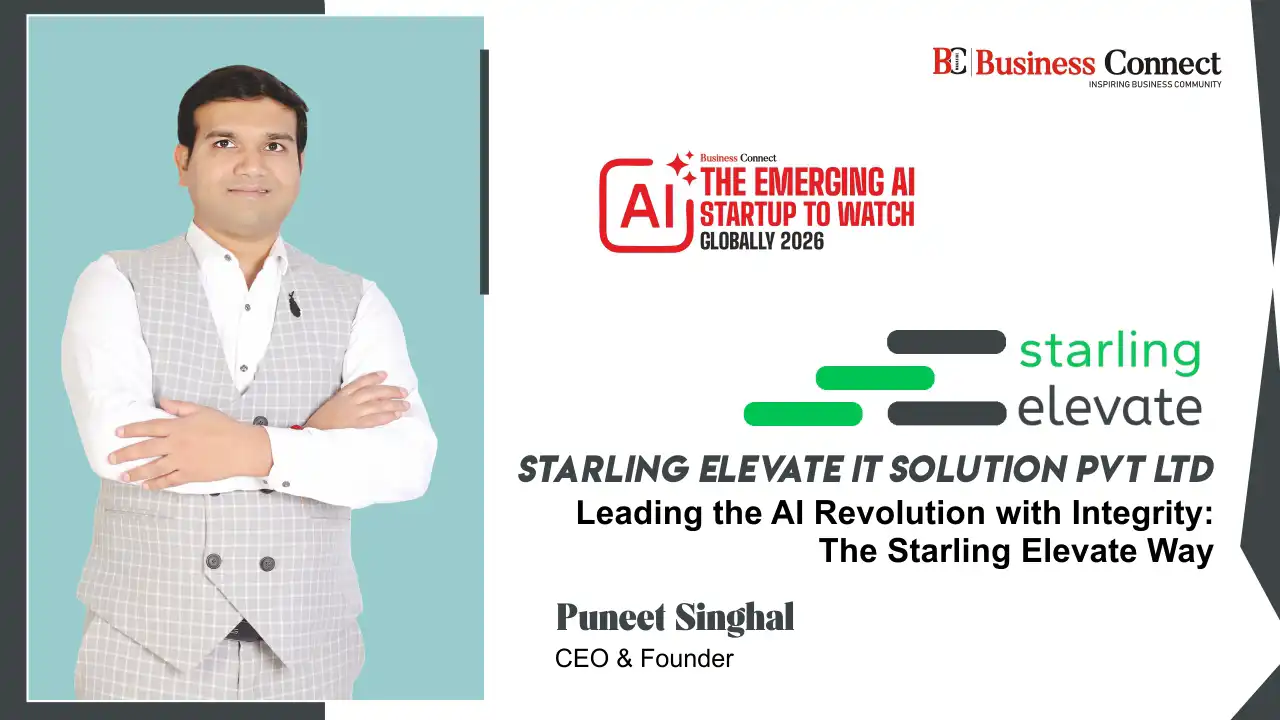
Headquartered in Jaipur, Starling Elevate IT Solution is an AI-driven software development company that specialises in engineering AI-first architectures to address complex business challenges. With a focus on Responsible AI by design, they architect AI-native enterprise systems built for adaptive reasoning, structured autonomy, and governance-by-design deployment.
Under the competent leadership of Puneet Singhal , Founder & CEO, Starling Elevate leverages expertise in agentic AI systems, multi-agent orchestration frameworks, Large Language Model pipelines, and more to build interoperable AI stacks aligned with cloud-native environments.
The company collaborates with startups and growth-stage enterprises across the globe, including the United States, the United Kingdom, Australia, Singapore, and more, to build adaptive, human-aligned AI ecosystems that reduce operational complexity while maintaining ethical clarity and long-term trust.
Starling Elevate’s Vision and Mission
Starling Elevate’s vision is to become a globally trusted AI-native enterprise partner shaping the next generation of intelligent systems that drive adaptive decision-making, autonomous workflows, and data-centric strategy. The company’s long-term ambition is to architect scalable, resilient, and governance-aligned AI ecosystems that enable organisations to operate with clarity, agility, and sustainable advantage.
The company’s mission is to engineer AI-first architectures that address business complexity while embedding Responsible AI by design. As AI systems advance toward greater autonomy, priorities such as model transparency, bias mitigation, compliance alignment, secure deployment, and human-in-the-loop oversight become essential.
Every solution we build integrates explainability, observability, and accountability frameworks at the system level. Through strategic collaboration, they deliver measurable impact while ensuring long-term trust, control, and ethical alignment.
Industry Evolution Over the Years
According to Puneet, “The transformation in startups has been both technical and philosophical.” Startups have shifted from prioritising speed and rapid deployment to building AInative systems from inception. Intelligence is now embedded into core infrastructure, focusing on contextual reasoning, adaptation, and structured autonomy.
There is a strong shift towards responsible AI, with governance, transparency, and compliance becoming essential. Founders understand credibility and scalability, depending on ethical deployment. Investor expectations have matured, valuing architectural integrity, AI maturity, and sustainability.
The startup ecosystem has moved from experimentationdriven innovation to engineering-driven maturity. Competitive advantage now lies in building intelligent systems that are adaptive, scalable, and responsibly designed.
Starling Elevate’s Journey
Starling Elevate’s entrepreneurial journey began with a conviction to engineer AI with depth, structure, and responsibility. The early days were marked by intense research, late nights, and refining models. The team prioritised building a solid technical foundation over rapid expansion.
As opportunities grew, they moved to a co-working space, collaborated, and expanded their team. During this phase, they focused on building scalable, enterprise-ready systems grounded in Responsible AI principles. With increasing client trust, they establish their own office, reflecting stability, credibility, and long-term commitment.
“For us, entrepreneurship has been about steady progress, balancing innovation with responsibility and ambition with architectural integrity,” asserts Puneet.
R&D: The Backbone of Growth
R&D is the backbone of sustainable growth in the AI industry. The company’s focus is on understanding AI systems’ reasoning, scaling, and responsible operation. Through structured experimentation, they refine architectures, embed transparency, and ensure scalable, secure, and alignment with Responsible AI alignment.
For Starling Elevate, R&D is a strategic investment in longterm credibility, adaptability, and meaningful impact, rather than an expense.
Credibility-Driven Marketing
Starling Elevate’s marketing strategy focuses on credibility, prioritising transparency, architectural clarity, and Responsible AI commitment. The company competes through thought leadership, explaining AI-native systems and governance safeguards. Messaging targets founders and enterprise leaders who value disciplined AI deployment and accountability.
Rather than mass visibility, Starling Elevate emphasises precision engagement and relationship-driven growth.
“We build with depth, communicate with clarity, and deploy responsibly because in AI, credibility is the strongest differentiator,” states Puneet.
Puneet’s Distinctive Leadership Approach
According to Puneet, “leadership is not about authority; it is about responsibility, clarity, and long-term direction. He emphasises intellectual depth, ethical awareness, and futurefocused thinking in a rapidly evolving AI landscape. A leader’s role is to provide architectural clarity, prioritising Responsible AI, disciplined engineering, and structured experimentation.
Puneet believes leadership is about enabling others, fostering curiosity, accountability, and governance-driven decisionmaking. Leadership means guiding innovation with intention, ensuring progress remains intelligent, secure, and aligned with human values. For him, leadership is service: setting direction, supporting teams, and building responsibly together.
Fostering an Innovative Work Culture
The work culture at Starling Elevate mirrors the systems it builds – structured, adaptive, and responsibly designed. The company fosters an environment driven by intellectual curiosity and accountability, prioritising thoughtful engineering over impulsive experimentation.
The team emphasises depth over speed, evaluating every solution for architectural integrity, scalability, and governance alignment. Responsible AI is embedded in daily practice through transparency, data integrity, compliance awareness, and oversight. Collaboration, structured debate, and continuous learning are central to operations, balancing creativity with disciplined execution.
Ultimately, Starling Elevate’s culture is one of “disciplined curiosity” – exploring boldly and building responsibly.
Road Ahead: Building a Responsible AI Future
Starling Elevate’s expansion strategy focuses on intelligent growth, prioritising architectural maturity and Responsible AI alignment. The company is strengthening its AI-native systems to support agentic architectures and contextual reasoning with governance and accountability at the core.
The future of Starling Elevate is about advancing adaptive intelligence and designing systems with structured reasoning, transparency and control. Puneet emphasises deepening domain specialisation, global collaboration, and investing in research and infrastructure resilience.
According to Puneet, “Growth means deeper expertise, stronger partnerships, and sustained accountability – not just expansion.”
Leadership Insights
Puneet advises budding entrepreneurs to “build with conviction, not comparison”. He emphasises focusing on clarity, discipline, and responsible execution to achieve sustainable success. Define your foundation early: what problem you are solving, why it matters, and what values guide your decisions.
As technology advances, integrity becomes even more important. Trust, transparency, and accountability are longterm assets. “Innovation must always be balanced with responsibility,” he adds.
Closing Message: Building with Purpose
Puneet emphasises the importance of balancing innovation with responsibility in today’s AI-driven business landscape. He urges leaders to prioritise long-term resilience, trust, and ethical standards over rapid adoption of new technologies.
To entrepreneurs, the leading man believes in focusing on substance over visibility, building with integrity, executing with discipline, and letting performance define their reputations. For established leaders, adaptability and encouraging Responsible AI practices are key.
“Finally, build thoughtfully, lead responsibly, and innovate with purpose. The future will not belong to those who move fastest, but to those who move with wisdom and integrity,” Puneet concludes.