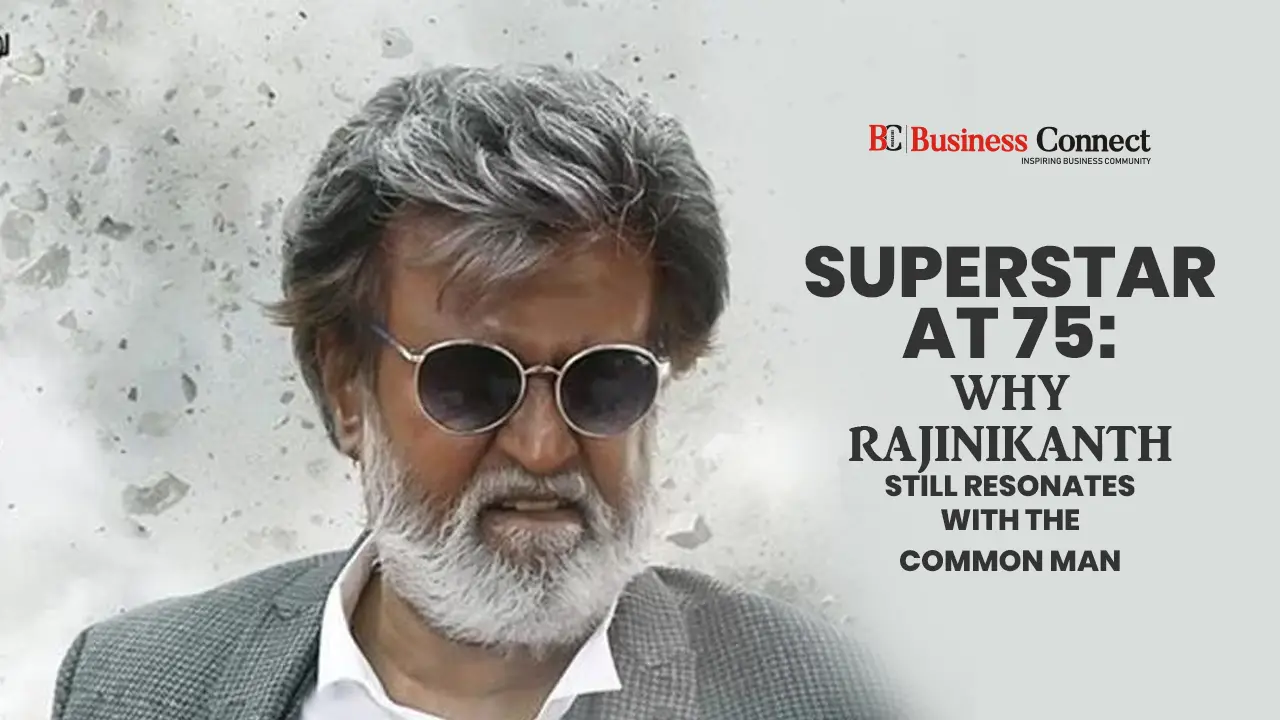
The subject of Rajinikanth’s size is no longer relevant as he turns 75 on December 12. The question is: How has he been able to feel like one of us despite being so large for so long?
The word “thalaivar” does not exist. It’s an emotion. People don’t merely applaud a celebrity when Rajinikanth appears on film. They witness struggle, fashion, joy, and hope. They see someone that resembles them in appearance and speech, fails, gets back up, falls again, and maintains their composure. A lot of actors receive whistles. Ownership only goes to Rajini.
Fifty years after the debut of Apoorva Raagangal (1975), 75-year-old Rajinikanth continues to lead festival releases, transform theaters into stadiums, and force youths to dress like him for Coolie performances. “How big is Rajinikanth?” is no longer the question. The question is: How has he been able to feel like one of us despite being so large for so long?
Tracing his development into the characters he became on screen—the villain, the style icon, the people’s hero, the experimenter, and the comeback machine—might be the greatest way to respond to that. His dialogues became his biography at some point, rather than just phrases.
Rajinikanth: the villain
The film journey of Rajinikanth doesn’t start with a valiant entrance. Sharp eyes, rough lines, and effortless menace are the first signs of it. He was the disruptor in Apoorva Raagangal, Moondru Mudichu, and 16 Vayathinile; all it took was a smirk or a slouch to take control of a scene. “Idhu eppdi irukku?” was the first line that seemed more like a question to the audience than a dialogue. How are things going?
It wasn’t arrogance. It was mindset. A newcomer told the gathering, “I won’t fit into your mold.” I’ll transform into something you’ve never seen before. Playing villains during those years accomplished something important. They offered him emotional depth in addition to establishing him as an actor. Anger, insecurity, conceit, and vulnerability were present—sometimes simultaneously. Even if you didn’t appreciate the character’s actions, you couldn’t help but admire Rajini’s performance.
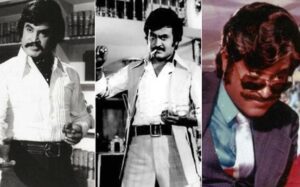
The change started in the late 1970s. He became a lone hero thanks to Bairavi. He was forcefully thrust into the spotlight by Murattu Kaalai, Billa, and Aarilirunthu Arubathu Varai. However, he was never completely clean. He turned his rough edges into bravery. Superstar, a hero who appeared to have lived a life before the opening titles rolled, was born there.
Rajinikanth: The Icon of Style
Rajinikanth is easily reduced to sunglasses and cigarette flips. However, he addressed a more profound query for a whole generation: What does it take to feel like a hero?
It became legendary when he flipped a cigarette. Like a joke, he popped chewing gum. He made shawl draping and sleeve adjustments into choreography. For fifty years, he made slow-motion walking appear new every time. He eliminated the gap between the audience and the screen with style.
This is when the phrase “En vazhi, thani vazhi” (My path is my own way) turns into a philosophy (Padayappa). Rajinikanth never strayed from his own path in terms of style, sentence delivery, or on-screen persona. He constructed his own.
As his roles and times changed, so did his wardrobe. He was outfitted in basic shirts and pants by Moondru Mudichu and 16 Vayathinile in the 1970s to reflect their turbulent, working-class lifestyles. Urban cool was defined in the late 1970s and early 1980s by Billa and Johnny, who popularized fitting T-shirts, denim jackets, dark glasses, and smokes. While Baashha employed simple shirts and pants to conceal a tempest beneath the surface and the suits and coats showed his swag, rural dramas like Muthu and Annamalai leaned toward veshtis and shawls.
Oversized jackets, denim, whites, and shawls were transformed into declarations of authority and youth by Padayappa, Uzhaippali, Raja Chinna Roja, and Baba. With Sivaji’s ostentatious suits and Enthiran’s futuristic designs, the 2000s embraced flamboyance. He was stripped back into textured blacks and greys in later movies like Kabali, Kaala, Petta, and Jailer, which represented his age, experience, and subdued strength.
These outfits were removed from the screen. They entered small-town streets, buses, and college hallways. Theatres become fashion runways, and Coolie repeats the trend decades later with a metal emblem and a denim-on-denim style. Rajinikanth never gave the impression that he was imitating a celebrity. They felt free to be larger than life because of him.
Rajinikanth: The Man of the People
Examine his most beloved movies, Baashha, Muthu, Annamalai, and Padayappa, without the songs and fanfare. They all say the same thing: anyone may fight back, ascend, or fall.
A bus driver turns into a landlord. An car driver conceals a terrifying past. A humiliated guy makes a dignified comeback. Rajini wore these roles in addition to playing them. Behind every frame was his personal journey from bus conductor to superstar.
“Naan solrathaiyum seiven, sollathathayum seiven” is a statement in Annamalai that serves as a metaphor for his work ethic. Both what I say and what I don’t say will be carried out.
Rajinikanth broke a tacit norm for generations of young people from poor and middle-class backgrounds. Up until then, heroes typically had a particular appearance. Without saying it out loud, he stood there and said, “You can be a hero too.” He turned into the man next door as well as the god on the poster.
The Experimenter, Rajinikanth
There is a lazy perception that Rajinikanth has always been cautious. Contrary to what his filmography suggests. Sivaji used a huge Shankar extravaganza to combat corruption and black money. Enthiran urged viewers to embrace him as a monster and a scientist. 2.0 held the burden of the most ambitious science fiction scale in India. Long before it was popular, Baba combined mass filmmaking with spirituality.
The big-star horror-comedy trend was revived by Chandramukhi. When Indian cinema hardly grasped the technology, Kochadaiiyaan tried motion capture. Kaala and Kabali had a strong interest in politics, caste, and identity. Although there aren’t many experimental movies, the ones he tried demonstrate that the actor wasn’t afraid to take chances.
Rajinikanth: The Resurrections
The ascent of Rajinikanth’s career was never easy. There were failures. There were periods of uncertainty. “Naan veezhven endru ninaithayo (Did you think I would fall)?” was the next line that came after him.
Baba faltered. Chandramukhi let out a shout. Kabali caused frenzy following Kochadaiiyaan and Lingaa. Petta restored classic swagger when the graph declined. Theaters were once again transformed into festivals by Jailer.
And then there’s Muthu: “Naan eppo varuven, epdi varuvennu yarukkum theriyathu aana vara vendiya nerathula varuven (No one knows when or how I’ll arrive, but I always come when the time is right).” It still fits after fifty years.
The man on screen is Rajinkanth.
The contrast is stark off-screen. The punchline man had a quiet voice. The fashion star, a former smoker, now opposes smoking. Wearing a basic kurta and slippers, the unstoppable hero enters the stage. He frequently talks about his “Duryodhana moment,” when he realized that changing things was important. Every action he took, including sitting, laughing, and even turning his head, had a purpose. Although the style appeared natural, it was constructed. The key is that equilibrium. He plays Sivaji on screen, asking everyone to shudder. He is Shivaji Rao off-screen, making fun of his own myth.
Rajinikanth is more than just a celebrity at 75. He is evidence that, with hard work, faith, and conviction, one can emerge from nowhere and transform popular culture. Rajinikanth continues to open movies like a man in his prime in a business where trends shift every Friday. Jailer 2 is already a topic of conversation if Coolie turns into a festival.
Stars come and go. However, “Thalaivar nirandharam” seems to be more true than ever. The leader never dies.