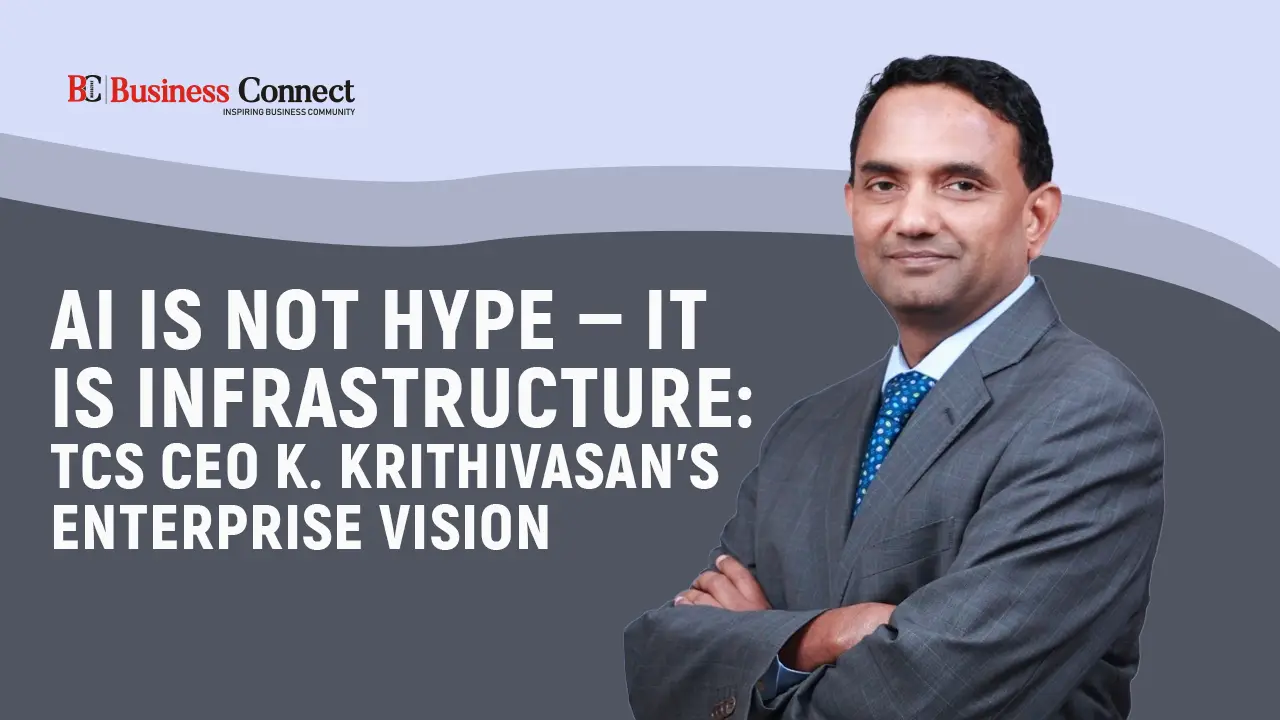
When Tata Consultancy Services (TCS) speaks about Artificial Intelligence, the global business community listens closely. As one of the world’s largest IT services firms, TCS sits at the center of digital transformation across banking, manufacturing, retail, healthcare, and government sectors. Under the leadership of CEO K. Krithivasan, the company’s stance on AI is both pragmatic and forward-looking: AI is not a hype cycle—it is a foundational shift in enterprise technology.
AI as a Productivity Multiplier, Not a Job Destroyer
Krithivasan has consistently emphasized that AI, particularly Generative AI, should be viewed as a productivity accelerator rather than a mass job eliminator. According to him, AI will automate repetitive tasks, streamline workflows, and enhance decision-making—but it will not eliminate the need for human talent. Instead, roles will evolve.
At TCS, AI is being integrated into software development lifecycles, testing processes, cybersecurity systems, and customer support platforms. Developers are using AI-assisted coding tools to reduce development time. Analysts are leveraging AI to extract insights from massive datasets within minutes. The result is improved speed, efficiency, and accuracy.
However, Krithivasan underscores that human judgment, domain expertise, and ethical oversight remain irreplaceable. AI may write code, but humans design systems. AI may analyze patterns, but humans define strategy.
Enterprise AI Must Be Responsible AI
Unlike startups chasing rapid AI disruption, TCS approaches AI with an enterprise lens. Krithivasan highlights governance, data privacy, compliance, and explainability as critical pillars. For large enterprises—especially in regulated sectors like banking and healthcare—AI adoption must be responsible and transparent.
TCS is investing heavily in AI frameworks that ensure bias mitigation, secure data handling, and compliance with emerging global regulations. The CEO believes that trust will determine the long-term winners in AI. Businesses that deploy AI without governance risk reputational and financial damage.
Reskilling at Scale
One of the strongest messages from TCS leadership is the importance of reskilling. With over 600,000 employees globally, workforce transformation is not optional—it is strategic. Krithivasan has emphasized structured learning programs to train employees in AI, machine learning, cloud technologies, and data science.
Instead of hiring entirely new talent pools, TCS is upskilling existing employees to stay relevant in the AI era. This reflects a broader belief: the future workforce will be hybrid—combining human intelligence with machine capability.
AI and the Future of IT Services
TCS sees AI not merely as a service offering but as an embedded layer across all solutions. From intelligent automation in supply chains to predictive analytics in financial services, AI is becoming the core engine of digital transformation projects.
Krithivasan also notes that client expectations are changing. Enterprises no longer ask whether to adopt AI; they ask how quickly and securely they can implement it. This shift signals that AI has moved beyond experimentation into mission-critical operations.
A Balanced Vision
In summary, TCS’ CEO envisions AI as transformational but not uncontrollable. It is a tool for augmentation, not replacement. It is an opportunity for innovation, not fear. Businesses that invest in AI responsibly, reskill their workforce, and integrate AI strategically will lead the next decade.
For global enterprises—and especially Indian corporations watching the AI wave—TCS’ message is clear: the AI era is not coming. It is already here.