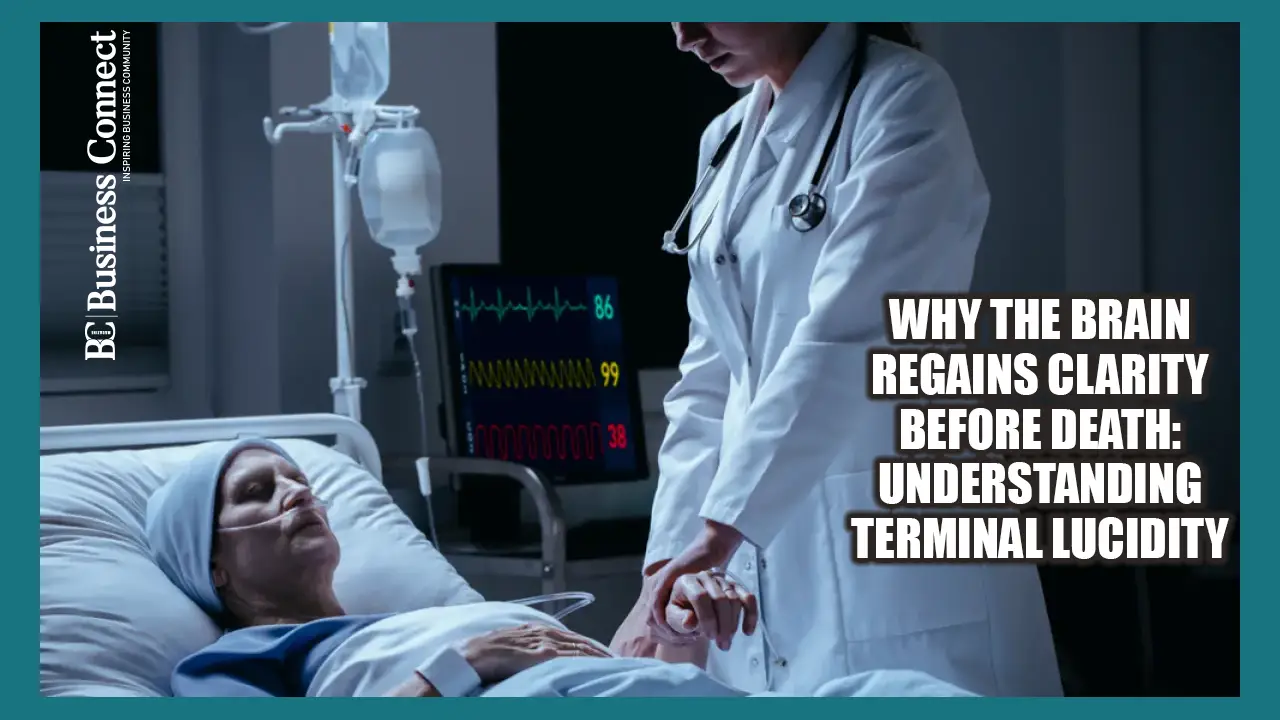
Why the Brain Regains Clarity Before Death: Understanding Terminal Lucidity
-by Jaya Pathak
You might have heard the story of a dying relative who suddenly wakes up into sharp awareness which brings both wonder as well as confusion. Imagine that a person who has not recognised his own children for months suddenly calls them and ask clear questions and gives specific instructions and afterwards dies shortly. In medical terms, this striking return near the end of life is known as terminal lucidity.
In this blog, we are going to understand why the brain regains clarity before death.
What is terminal lucidity?
Wikipedia defines terminal lucidity as “an unexpected return of consciousness, mental clarity or memory shortly before death in individuals with severe psychiatric or neurological disorders”. Henceforth, it is quite clear that it appears shortly before death, most often in people with dementia, brain injury and other degenerative conditions.
What are the typical features of terminal lucidity?
- A person who only used to be unresponsive suddenly becomes communicative and alert.
- Recognition of relatives or familiar people returns, sometimes very precisely.
- The episode lasts minutes to hours, and in most reported cases, death follows within a day or two.
Studies that reviewed historical case reports found that a large majority of patients who had such episodes died within a week, and many within 24–48 hours.
What Might Be Happening in the Brain?
There is no any single accepted explanation but several plausible mechanisms have been suggested by the experts. Some of them are listed below-
- Surges in Brain Activity
As per a study on dying patients, surges in brain activity have been found out. Let us organised in high frequency activity especially the gamma waves which is usually associated with conscious awareness, memory and sensory integration. After withdrawal of life support when the oxygen levels fall and heart rate is failing, this brain activity has been recorded. The dying process itself temporarily increases connectivity in cortical networks.
This short-lived increase in coordination between brain regions—especially in areas linked to conscious experience—could support a final window of coherent thought and memory access, even in a damaged brain.
- Disinhibition and “Last Energy Use”
Some scientists propose that as oxygen drops and brain cells become stressed, inhibitory systems weaken first. When the innovation fails the previously suppressed circuits fire together freely which creates a temporary state of heightened integration before the actual shutdown.
A cascade of neurotransmitters and stress related chemicals may be released which can briefly boost signal transmission in surviving neural networks. This combination—loss of inhibition plus a chemical surge—could unlock functions that had appeared lost.
- Preserved Islands of Function
Not every part of a diseased brain is equally damaged. There are certain reasons and pathways which remain structurally intact but it functions offline under chronic metabolism stress, inflammation or disrupted connectivity. when a person is near death, shift in blood flow, oxygen use and inflammation can provide temporary relief from the burden and allow certain circuits to reengage for speech or any other deliberate action.
Why It Matters Emotionally and Spiritually
For families, terminal lucidity is rarely a “clinical” event. It is remembered as a deeply personal encounter. A parent who has not spoken for weeks might suddenly say “thank you,” ask for a specific relative, or talk about unfinished business.
Common themes include:
- Expressions of love, gratitude, or apology
- Requests to see particular people or perform certain rituals
- Clear decisions about possessions, care, or spiritual matters
Many cultures have traditional name and people have interpretations for it. the religious view see it as the soul preparing to depart from this world baras the secular perspective see it as a psychological as well as relational moment regardless of the metaphysical believes. in terms of neurology, This is often seen as a final and last chance to recognise and be recognised, to spell the words which was once impossible for several months or years.
Challenges in Studying Terminal Lucidity
Scientifically, terminal lucidity is difficult to study. It is unpredictable, brief, and usually occurs in patients too frail for intensive monitoring. It mostly comes from the families and healthcare staff rather than real time recordings.
Some of the major challenges associated with it are listed below-
- Ethical limits on invasive research at the end of life
- Short duration of episodes, often without prior warning
- Variability across diagnoses, settings, and cultures
Nevertheless, more systematic work is beginning to appear. The studies related to brain activity of dying individuals are coming into broader picture. Its mechanism and frequency is still being clarified by the medical professionals.
Some key points for caregivers and relatives are:
- A lucid episode near the end is usually not a sign of long-term recovery; it is more often a sign that death is close.
- If such a moment appears, it may be wise to assume that important words or decisions should not be postponed.
- Staff can prepare families by explaining that a “rally” can happen and that it may be emotionally powerful but brief.
From a palliative care perspective, recognizing terminal lucidity encourages presence rather than withdrawal. It invites relatives to stay open to the possibility that meaningful contact can occur even when someone has been unreachable for a long time.
Mind, Brain, and the “Last Window”
Terminal lucidity naturally feeds larger debates about consciousness. Some see it as evidence that the “self” is not fully tied to the current state of brain tissue, pointing to the sudden reappearance of personality and memory in severely damaged brains. Others argue that the same event can be understood as the brain’s final burst of organized activity under extreme stress, without invoking anything beyond biology.