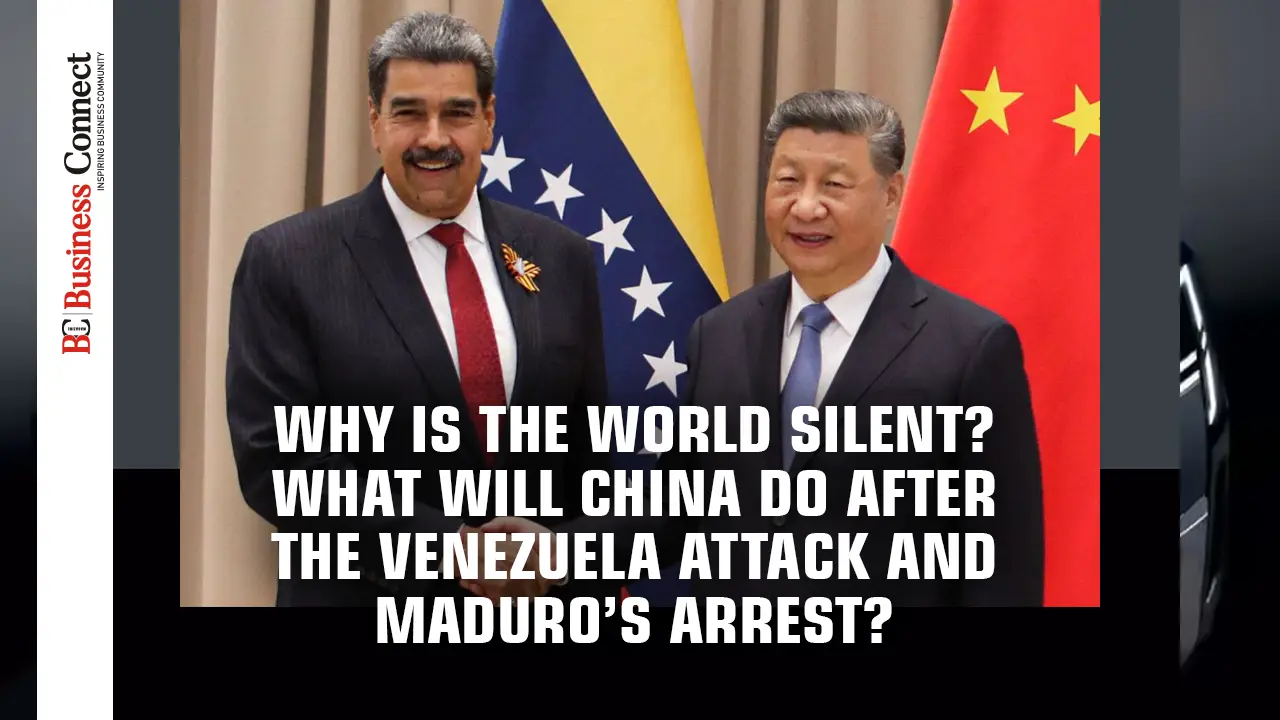
The President of Venezuela is currently being held in a New York jail, and former U.S. President Donald Trump is calling it his biggest victory yet, proudly wearing the label of a “peace president.” In the heat of celebration, threats are now being directed at other Latin American nations as well.
Why Is the World Silent on Venezuela? China’s Likely Response After Maduro’s Arrest
However, this operation—carried out by sidelining international law—has raised serious and unsettling questions. What kind of precedent has the United States set? If a powerful country can forcibly abduct the sitting president of a sovereign nation from his own bedroom, what stops another nation from using the same justification tomorrow? Has the U.S. opened a door that may now be impossible to close?
These questions are not limited to Washington alone—they confront the entire international community. Europe, which reacted with outrage and imposed sanctions after Russia’s attack on Ukraine, is conspicuously silent today. Why has the same moral outrage vanished? Is this silence a matter of convenience, or of intent?
There are deeper questions about America’s real motives. Was this operation truly about democracy and justice, or is it once again driven by an unquenched hunger for oil? What happens next in Venezuela? If the military operation was executed with such precision, why does the political roadmap that follows appear so unclear?
The Venezuelan opposition—nurtured for years by the U.S. and Europe—now seems pushed to the margins. And the government that was once labeled illegitimate: is Washington now negotiating with the very same power it previously rejected?
These are the questions we seek to answer today.
Hello, my name is Anurag Tiwari, and you are reading the News Column of Business Connect Magazine.
First, understand the story behind the American operation.
It was the evening of January 2. As the sun set, Donald Trump was having dinner at his Palm Beach residence in Florida. His senior advisers were present. It appeared to be a routine evening—casual conversations, light moments. Just a few hours earlier, Trump had returned from shopping for marble and stone for the White House.
During dinner, his advisers informed him that they would call at 10:30 PM for final approval. As night fell, the call came. Trump gave his approval over the phone. At 10:46 PM, he walked into a secure room inside his residence, where his national security team was already waiting.
“Good luck, and Godspeed,” Trump reportedly told them.
With that, Operation Absolute Resolve was set in motion—described by sections of the U.S. media as one of the most high-risk military operations of the 21st century.
The first phase was cyber warfare.
Caracas, the capital of Venezuela, was plunged into darkness. The power grid was disabled, and the city went black. Soon after, a low rumble echoed across the night sky. It was 2:00 AM in Caracas. The city was fast asleep.
Unbeknownst to its residents, more than 150 American aircraft—fighter jets, bombers, and drones—were flying overhead. These aircraft had taken off simultaneously from 20 different military bases on land and at sea.
The first explosions struck Fuerte Tiuna, Venezuela’s largest military base, located in Caracas itself. The blasts reportedly destroyed key radar systems of Venezuela’s air defense network. Fuerte Tiuna was not only a strategic base—it was also where President Nicolás Maduro was believed to be staying, along with senior government officials.
This raised a critical question: How did the U.S. know?
Maduro was known to frequently change his sleeping location due to security threats. Yet, according to American media reports, preparations for this operation had been underway for months. As early as August 2025, a covert CIA team had allegedly entered Venezuela. Reports suggest that U.S. intelligence had an internal source within the Venezuelan government.
The American military allegedly knew not just where Maduro was sleeping, but also intimate details—what he ate, what he wore, even information about his pets. Based on this intelligence, Delta Force commandos reportedly constructed an exact replica of Maduro’s residence at a secure facility in Kentucky, where rehearsals were conducted for months.
Back in Caracas, at 2:00 AM, American commandos landed on the ground. This was Delta Force, transported by the elite Night Stalkers helicopter unit. The helicopters reportedly flew just 100 feet above sea level, avoiding radar detection.
Breaking into Maduro’s residence was not easy. Trump later described it as “fortress-like,” surrounded by solid steel walls. Delta Force carried blowtorches designed to cut steel—but they didn’t need them. The door was blown open with explosives.
Inside, Maduro and his wife, Cilia Flores, were asleep. Awakened by the blast, they ran toward a panic room—a reinforced steel safe room designed to be impenetrable.
Trump later claimed that Maduro reached the door but failed to secure it in time.
Within 47 seconds of the breach, American commandos had reached Maduro.
Maduro tried to flee, but escape was impossible.
Thousands of miles away, inside Trump’s residence, multiple screens were switched on. Live footage streamed in from satellite feeds and cameras mounted on helicopters. Present in the room were Donald Trump, U.S. Secretary of State Marco Rubio, and Defense Secretary Pete Hegseth.
Trump later said he watched the operation “like a television show.”
He also remarked on what stood out most to him: “The speed and the violence. The speed and violence were extraordinary.”
The most difficult phase came afterward—extracting Maduro alive.
Loyalist Venezuelan troops opened fire. American helicopters were hit by gunfire; one aircraft reportedly took a direct hit but managed to stay airborne. Trump later acknowledged that some U.S. soldiers were injured, but insisted no fatalities occurred.
At 4:29 AM, the helicopters crossed Venezuelan airspace and moved over open waters. In the Caribbean Sea, a U.S. warship—the USS Iwo Jima—was waiting.
Maduro and his wife were transferred onboard. It was here that the photograph later posted by Trump on social media was taken—the image that went viral. Maduro was seen wearing a grey tracksuit, a black blindfold covering his eyes.
From there, he was flown to Guantánamo Bay, and later transferred to New York, where he is now being held in a federal detention facility. U.S. officials say he will be tried under American law.
What the operation revealed
Beyond the dramatic details, several deeper realities emerged.
According to a report by U.S. news outlet Axios, Trump’s advisers initially favored Plan A—forcing Maduro to step down voluntarily. Trump reportedly spoke to Maduro multiple times, including just one week before the attack, urging him to surrender and relinquish power.
Maduro was willing to negotiate—but refused to leave Venezuela.
That refusal, reports suggest, is what led Trump to authorize the military operation.
The biggest question: What happens next?
While the military plan to capture Maduro appeared precise and decisive, the political roadmap afterward remains unclear—a familiar criticism often directed at U.S. foreign interventions.
Trump has announced that the United States will now “run the country.” But how?
Will Washington govern remotely, or will American troops remain on Venezuelan soil? Trump has openly stated that sending troops is no longer off the table, adding that the U.S. has “no fear” of doing so.
For now, the future of Venezuela appears to rest entirely in American hands.
Political chaos in Caracas
On January 3, as news of Maduro’s arrest broke, Venezuela’s opposition erupted in celebration.
Opposition leader and 2025 Nobel Peace Prize winner María Corina Machado praised Trump’s actions. For her, the path to the presidency suddenly seemed clear. She declared that the “time for freedom” had arrived and called on the Venezuelan military to side with the opposition and support a democratic transition.
Much of the Western world had long recognized Edmundo González as the legitimate winner of the 2024 election, reinforcing opposition hopes that power would soon shift.
But those hopes were short-lived.
At a press conference, Trump was asked whether Machado would have any role in Venezuela’s new political setup. His response stunned observers.
Trump said he had no contact with her. While he described her as “a good woman,” he emphasized that she lacked both domestic support and respect inside Venezuela.
The remark was particularly surprising because Machado has been a vocal supporter of Trump and had even dedicated her Nobel Prize to him.
A surprising shift: Delcy Rodríguez
Trump’s attention appeared to focus instead on Delcy Rodríguez, Venezuela’s Vice President.
He claimed Rodríguez was willing to “work with the United States” and follow Washington’s directives. U.S. media reports suggest Rodríguez managed to keep Venezuela’s oil industry operational—and even increase production—despite heavy sanctions. That, analysts say, makes her a viable option in Washington’s eyes.
This is where the deepest contradiction emerges.
The same government the U.S. labeled “illegitimate” for years now appears to be a potential partner. Meanwhile, the opposition—long backed by the U.S. and Europe—has been pushed to the margins.
However, Rodríguez may already be disappointing American expectations. In a recent address, she accused the U.S. of conducting an illegal attack and stated clearly that Maduro remains Venezuela’s legitimate president.
Maduro Tried to Escape, but the Plan Left No Room for Failure
Nicolás Maduro reportedly attempted to flee, but escape was never an option. Thousands of miles away, inside Donald Trump’s residence, a large screen was set up, receiving live satellite and helicopter footage of the operation. Trump, along with Secretary of State Marco Rubio and Defense Secretary Pete Hegseth, watched the mission unfold in real time.
Later, Trump said he watched the operation “like a television show.” He described the speed and intensity of the action as “extraordinary,” openly praising the violence involved. According to Trump, the most difficult part of the mission was extracting Maduro alive.
As the operation progressed, loyal Venezuelan soldiers opened fire. American helicopters came under heavy gunfire; one was reportedly hit but continued flying. Trump acknowledged that some US soldiers were injured, though none were killed.
At 4:29 a.m., the helicopters crossed Venezuela’s border and moved over the sea, where the US warship USS Iwo Jima was waiting in the Caribbean. Maduro and his wife were transferred there. It was on this ship that the now-viral photograph was taken—Maduro dressed in a grey tracksuit, blindfolded, an image Trump later shared on social media.
From there, Maduro was flown to Guantanamo Bay and later transferred to New York, where he is currently being held in a federal prison. He will now face trial under US law.
A Strong Military Plan, But a Weak Political Roadmap
While the military execution appears precise, deeper questions have emerged. According to a report by US news outlet Axios, Trump’s advisors initially pursued “Plan A,” hoping Maduro would step down voluntarily. Trump reportedly spoke to Maduro multiple times, including one week before the attack, demanding his surrender.
Maduro was open to talks—but refused to leave the country. That refusal reportedly led Trump to authorize the military operation.
The biggest uncertainty now is what comes next.
The United States clearly had a solid military plan to capture Maduro. However, its political strategy for Venezuela’s future appears vague and underdeveloped—echoing a long-standing pattern in American foreign policy.
Trump has announced that the US will now “run” the country. But how? Will Washington govern remotely, or will American troops remain stationed on Venezuelan soil? Trump has already stated that sending soldiers no longer concerns him.
For now, everything rests in US hands.
Opposition Celebrates—Then Gets Sidelined
When the news broke on January 3, Venezuela’s opposition erupted in celebration. Opposition leader and 2025 Nobel Peace Prize winner María Corina Machado praised Trump’s action, declaring that the path to the presidency was now clear. She announced that the time for freedom had arrived and called on Venezuela’s armed forces to stand with the opposition.
Much of the Western world had already considered opposition candidate Edmundo González the rightful winner of the 2024 election, reinforcing hopes that power would shift quickly.
But those hopes were short-lived.
During a press conference, Trump was asked whether Machado would have a role in the new political setup. He responded bluntly: he had no contact with her. While calling her a “nice woman,” Trump added that she lacked real support and respect within Venezuela.
The statement shocked many. Machado had openly supported Trump and even dedicated her Nobel Prize to him.
Instead, Trump’s interest appeared focused on Venezuela’s Vice President Delcy Rodríguez. Trump claimed Rodríguez was willing to cooperate with the US and “get things done” as Washington demands.
US media reports suggest Rodríguez managed to keep Venezuela’s oil industry functioning despite harsh sanctions—and even increased production. This made her a practical option in Washington’s eyes.
A Stark Contradiction
Here lies the central contradiction.
The same government Washington labeled “illegal” until yesterday is now being considered a partner. Meanwhile, the opposition—backed for years by the US and Europe—has been pushed aside.
Even so, Rodríguez may not meet American expectations. In her latest address, she accused the US of carrying out an illegal attack and insisted that Maduro remains Venezuela’s legitimate president.
The operation may have been militarily flawless, but politically, the future remains deeply uncertain.
What kind of precedent has the US set for international law?
And once the dust settles, who truly governs Venezuela?
Have We Opened a Door That Can Never Be Closed?
If the world’s most powerful country can bomb a neighboring nation and abduct its sitting president, what stops Vladimir Putin—or any other global leader—from using the same justification tomorrow? Have we crossed a line that cannot be reversed?
At the heart of this debate lies the question of law.
As we explained earlier, abducting the president of another sovereign nation is not legal under international law. The next and even more serious question is Donald Trump’s declaration that the United States will now “run Venezuela.” Does such a claim fall within any legal framework?
New York Times journalist Charlie Savage addressed this issue in a detailed investigative report, speaking with multiple legal experts. The conclusion is unambiguous: the United States has no legal authority to govern Venezuela. Under international law, such an action would amount to illegal occupation.
Even under US domestic law, the president does not have the power to administer another country unless Congress explicitly authorizes funding for such an operation. Without congressional approval, even American law does not permit it.
History Offers a Warning
Looking back, the closest parallel is the 1989 Panama invasion, when President George H.W. Bush ordered military action to capture dictator Manuel Noriega. Yet even then, the US did not claim it would govern Panama. Instead, it recognized election winner Guillermo Endara, facilitated a transition, and withdrew.
Trump’s statement—“We will run the country”—marks a sharp departure from that precedent.
The Bombing Question
Another unresolved issue is the scale of force used. If the objective was arrest, why was large-scale bombing necessary?
US Secretary of State Marco Rubio defended the airstrikes by stating they were carried out to protect officers executing an arrest warrant. However, critics argue that bombing a city to make an arrest sets a dangerous precedent.
Does a President Have Legal Immunity?
There is also the question of presidential immunity. International law generally grants sitting heads of state immunity from prosecution in foreign courts. Maduro’s legal team is expected to argue exactly this.
However, according to the New York Times, the Trump administration has already prepared its counter-argument.
The US Supreme Court has ruled that determining which foreign government is legitimate is the exclusive authority of the American president. Since 2019, the US has refused to recognize Maduro as Venezuela’s president at all. From Washington’s perspective, Maduro is not a head of state—therefore, presidential immunity does not apply.
What Kind of World Are We Entering?
So what happens next?
Are we stepping into a darker and more dangerous global order—one where international law is no longer necessary, only optional? A world where power, not legality, determines what is acceptable?
These questions will continue to be debated. But one thing is clear: the precedent has been set, and the consequences may reach far beyond Venezuela.