Namsai is located at the easternmost edge of India where the morning light touches the hills before it reaches the rest of the country. For years, however, that early sunrise did not translate into better opportunity in terms of education and progress.
The fact is that in large parts of Arunachal Pradesh, access to higher education once meant distance, be it geographical, financial, and emotional. Students often travelled thousands of kilometer to pursue degrees. Many did not return. Some did not complete. Ambition was abundant, infrastructure was not. It is within this context that World Education Mission (WEM), positioned itself, not as an expansionist education promoter, but as a regional corrector.
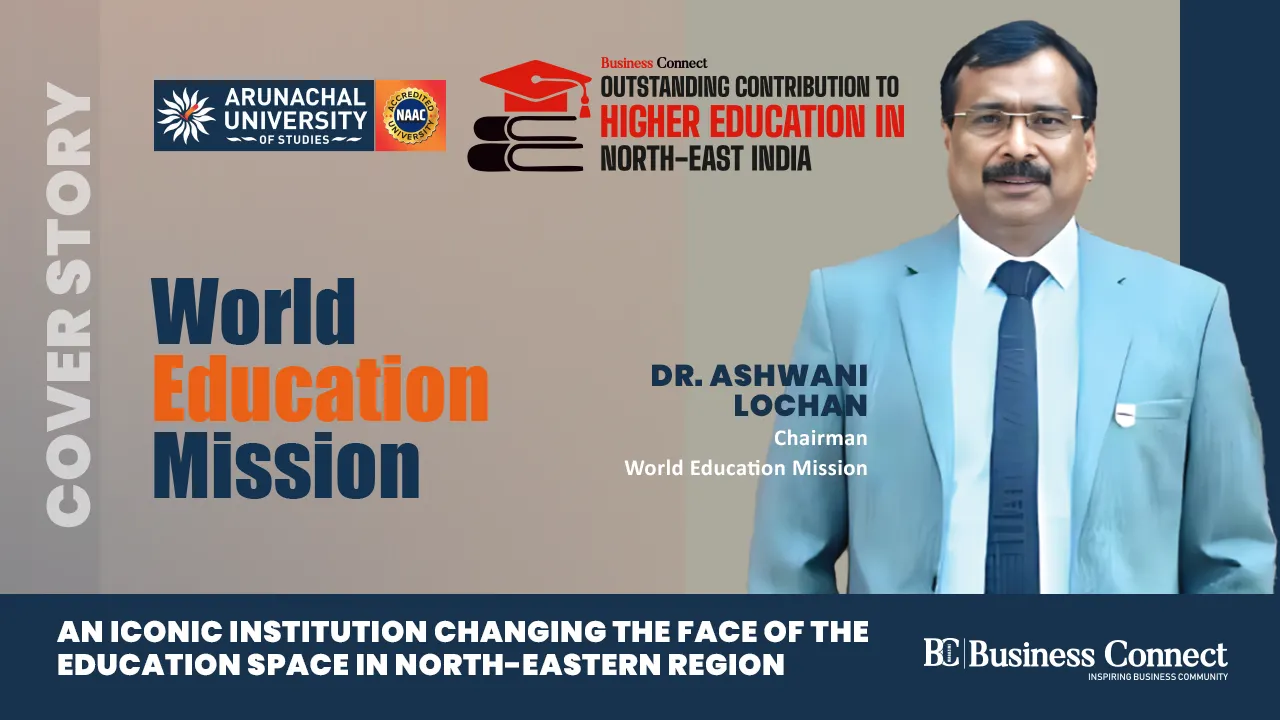
In a special talk with the chairman of the institution, Dr. Ashwani Lochan, the vision was unveiled by him,
We strive to be a harbinger of new beginnings, knowledge dissemination, and socio-economic transformation in one of the most remote and culturally rich regions of the country. Rest of the insightful conversation has been narrated as following:
Education as Regional Equity
World Education Mission was founded on the conviction that education is not merely an academic pursuit; it is a structural equalizer. In a country where geography often determines opportunity, institutional presence can redefine economic futures.
WEM functions as the sponsoring body of:
- Arunachal University of Studies, Namsai, Arunachal Pradesh
- EdTech Skills University, Tinsukia, Assam
- EdTech Skills University, Sikkim
These institutions were not conceptualized as duplicates of metropolitan universities. They were designed around regional socio-economic needs, employability gaps, skill deficits, local industry patterns, and the migration pressures unique to the North-East.
The approach reflects a larger policy shift in India’s higher education landscape over the past decade, from degree accumulation to outcome-based learning, skill integration, and regional alignment. But, policy intent alone does not create infrastructure. Institution-building does.
Arunachal University of Studies
Anchoring Higher Education in Namsai, Arunachal University of Studies was established through the Arunachal University of Studies Act, 2012 (Act No. 9 of 2012) by the Government of Arunachal Pradesh, and sponsored by World Education Mission, Arunachal University of Studies (Arunachal University of Studies) began with limited physical infrastructure but an expansive mandate.
Its location in Namsai carries both symbolic and developmental significance. In 2018, Namsai district was identified under the Government of India’s Aspirational Districts Programme, spearheaded by NITI Aayog, an initiative aimed at accelerating development in districts facing socio-economic challenges.
Before Arunachal University of Studies was established, students from eastern Arunachal frequently migrated to Assam, West Bengal, Delhi, and other states for higher education. This migration carried costs i.e. tuition, relocation, cultural adaptation, and, for many families, unsustainable financial pressure. The most distinguishing factor was the fact that the University has allowed easier access to undergraduate, postgraduate, doctoral, diploma, and certificate programmes.
Arunachal University of Studies began reducing that educational outflow where students had to leave their home lands in pursuits of higher education. To be honest, access to higher education in such remote regions like these, is not a slogan, but retention.
Land, Trust, and Community Ownership
Talking of credibility, the chairman asserted that it is clearly indicated in community investment and not the enrollment figures. With their price, he shared that the University has expanded its land footprint from an initial 30 acres to 82.5 acres, with a significant portion made possible through voluntary land donations from local residents.
The biggest fact is that the region where land carries emotional, ancestral, and cultural meaning, such contributions signal a huge respect and trust from the local people. Communities rarely donate land to institutions they perceive as temporary and not trustworthy, which is very much true.
Built within a district that was previously classified as having inadequate infrastructure, the campus now comprises roughly 41,639 square meters of a well- developed infrastructure, including classrooms, labs, administrative buildings, and academic facilities. In urban India, institutions respond to demand, but in frontier regions they must create it—an ethos embodied by Arunachal University of Studies through its commitment to transformative education and regional growth.
Leadership with Developmental Patience
We were curious to ask Dr. Ashwani Lochan about his perception as a leading face of the institution. Well, his leadership philosophy reflects long-horizon thinking. His thought model emphasises layered growth rather than pursuing rapid, highvolume expansion. Accreditation, regulatory compliance, research capability, faculty development, and skill alignment, all is taken care with utmost sincerity done with substantial time spent on research.
He has often articulated that a university must generate knowledge, not merely transmit it. That distinction is critical in regions where higher education historically functioned as a pipeline to exit rather than as a driver of local innovation.
Under his stewardship, Arunachal University of Studies aligned itself with national initiatives for the well-being of alumni:
- National Education Policy (NEP) 2020
- Skill India
- Digital India
- Atmanirbhar Bharat
These alignments are not symbolic references but deep influence curriculum structure, vocational integration, digital adoption, and employability frameworks.
Academic Architecture written with Purpose
Arunachal University of Studies operates through eight constituent faculties:
- Faculty of Agricultural & Life Sciences
- Faculty of Arts & Social Sciences
- Faculty of Commerce & Management
- Faculty of Education, Special Education & Sports
- Faculty of Library & Information Sciences
- Faculty of Legal Studies
- Faculty of Medical Sciences
- Faculty of Science & Technology
Rather than being a specialised institute, this multidisciplinary structure reflects a comprehensive university model. Crucially, the program design integrates skill-linked training and practical exposure, which is especially pertinent in an area where employment in the public sector has historically dominated aspirations.
The university aims to connect academic learning with employability through industry partnerships, incubation support, and skill development centers.
Research from the Periphery
Arunachal University of Studies has been well-regarded for its research orientation despite geographical constraints. To enhance its research capabilities, the university has engaged in collaborations with national institutions including:
- Bhabha Atomic Research Centre
- Space Applications Centre (SAC–ISRO)
- Central Agroforestry Research Institute
- National Research Centre on Yak
A research agenda based on regional ecology and Himalayan environmental dynamics is demonstrated by initiatives like the construction of a Radon Geo-Station and HIMADRI monitoring sites in alpine ecosystems.
Research that is locally anchored has national significance becArunachal University of Studiese of Arunachal Pradesh’s distinctive agroclimatic conditions, biodiversity, and seismic sensitivity. Knowledge creation is shifting from the center outward, which is a subtle but significant change.
Accreditation and Institutional Milestones
Arunachal University of Studies has secured NAAC accreditation across two cycles and holds ICAR accreditation for relevant programmes. It has implemented central government skill initiatives including DDUGKY and PMKVY (3.0 and 4.0), and established an MSME Incubation Centre to encourage entrepreneurship.
We very well know that credibility in India’s cutthroat higher education market depends on regulatory compliance and quality benchmarking, which are demonstrated by such recognitions. The underlying influence, though, is sociocultural. Accreditation is more than just a mark of quality in remote areas. It gives parents and students who are putting their generational trust in a new institution a sense of legitimacy.
Workplace Culture in a Difficult Location
Places which are remote and far away from urban areas, finding and keeping talented faculty can be structurally difficult. Participatory governance, support for professional growth, and an inclusive workplace culture that prioritises academic freedom and gender equity are some of the ways Arunachal University of Studies has addressed this. Internal emphasis is placed on capacity building, research participation, and cooperative decision-making. Institutions in challenging locations need to foster culture in addition to infrastructure.
Credibility in Marketing
Arunachal University of Studies uses a reputation-based outreach strategy, in contrast to forceful urban education brands. Its marketing strategy is based on community programs, alumni advocacy, educational fairs, and digital engagement. This strategy demonstrates a long-term outlook since long-term effects are more reliable than temporary publicity in fostering institutional equity. In a setting where word-of-mouth still has sway, trust grows subtly.
Sustainability as Strategy
Future expansion plans include academic diversification, interdisciplinary programmes, enhanced research ecosystems, digital platform expansion, and global collaborations
Equally significant is the integration of sustainable practices, rainwater harvesting, renewable energy usage, and ecoconscious campus planning. In a Himalayan ecosystem sensitive to climate change and environmental degradation, sustainability is not branding; it is responsibility.
Changing Migration Patterns
Perhaps the most meaningful transformation lies in the gradual reduction of educational migration from eastern Arunachal for foundational degrees. When students can access quality education locally, families experience financial relief. Cultural continuity is preserved. Regional talent pools strengthen. Institution-building, in such contexts, becomes economic stabilization.
A Broader Message for Indian Education
Before leaving the conversation, the chairman conveyed an inspiring message with our readers, “World Education Mission and Arunachal University of Studies are showing India’s private education sector something crucial. You do not just measure how good an educational institution is by how high it ranks or how well known it’s in the city. You measure it by how it helps the area around it.
For us, starting education projects is closely tied to contribute to the country’s bright future. He tells people who want to start their own businesses to always remember why they are doing it to focus on making something that will last longer and to think about how they can help people rather than solely focusing on money making.
The World Education Mission and Arunachal University of Studies are doing this in the North-East, where there are challenges but also many opportunities. We are working to make education fair and accessible in the region. This is not happening quickly, but at a gradual pace and it is making a big difference. The sun is rising in Namsai and it is not a beautiful sight it is a sign of new development and progress.”
Add Business Connect magazine to your Google News feed
Read Also: