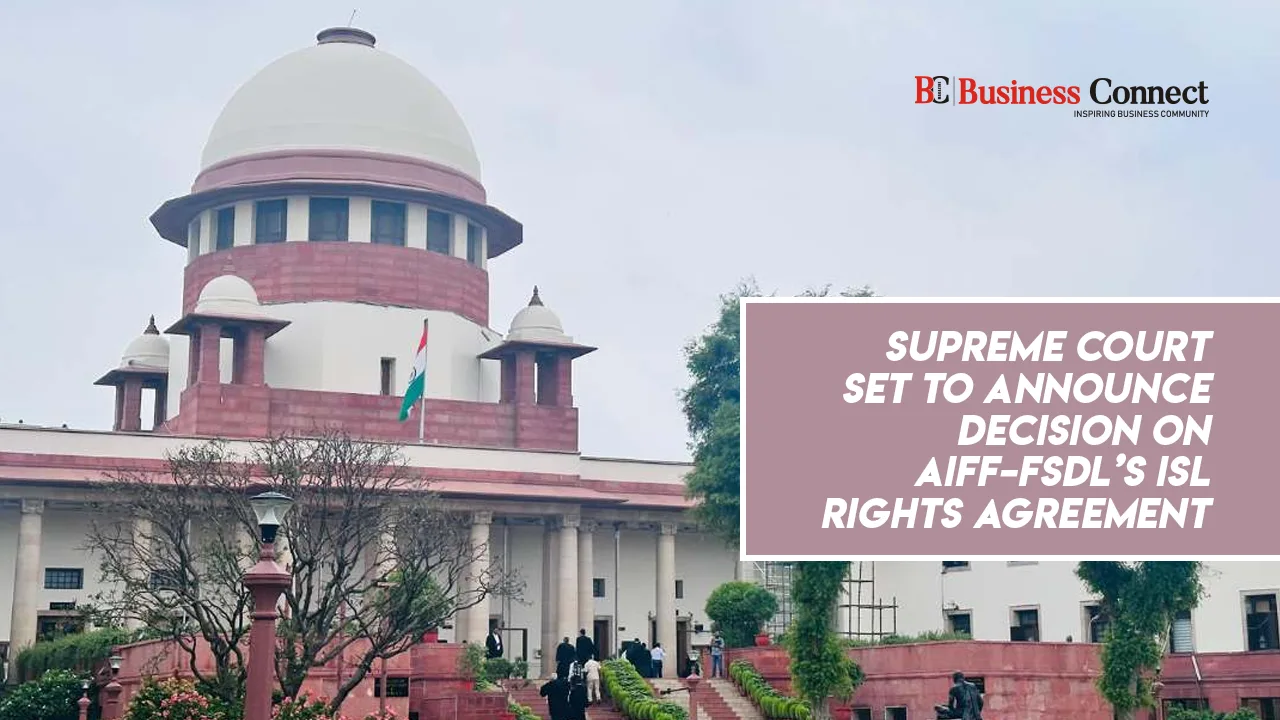
Supreme Court Reserves Order on AIFF–FSDL Master Rights Agreement for ISL
The Supreme Court on Monday reserved its order on the renewal of the master rights agreement, a crucial arrangement for conducting Indian Super League (ISL) matches this season.
A bench comprising Justices P.S. Narasimha and Joymalya Bagchi said it will issue a short order on the agreement first, followed by a verdict on the All India Football Federation’s (AIFF) constitution. “First, we will pronounce a short order and then we will pronounce the verdict on the constitution. The judgment is ready but we have not pronounced it as there is uncertainty over the Act coming into force,” Justice Narasimha observed.
The court sought clarity from Additional Solicitor General (ASG) K.M. Nataraj on the timeline for enforcing the National Sports Governance Act, 2025. The ASG replied that the process could take between one to six months. The bench, however, stressed it could not wait that long and clarified that its judgment would remain valid until the Act comes into effect.
Senior advocate Maneka Guruswamy argued that the ruling should not be construed as upholding the Act’s constitutionality, as several provisions—such as bringing state associations under the central law—would likely face legal scrutiny. The bench agreed, stating challenges to the law would remain open and would be noted in its judgment.
Representing the AIFF, senior advocate Ranjit Kumar assured the court that the federation would hold an open, transparent, and competitive process to select a commercial partner for managing the ISL, in line with international best practices. This tender process, Kumar said, would follow the National Sports Development Code 2011, the National Sports Governance Act 2025, the AIFF constitution, and FIFA/AFC regulations. He added that the process could be overseen by a reputed professional firm, though the bench expressed scepticism over engaging “Big Four” consultancies.
Kumar further informed that AIFF and Football Sports Development Limited (FSDL) have agreed to conclude the process by October 15, ensuring certainty for clubs, broadcasters, sponsors, and stakeholders ahead of the league’s December kickoff.
Background of the Case
On August 28, the apex court underscored India’s “excellent football talent” and reaffirmed its commitment to finalising the AIFF draft constitution to strengthen the sport. Amicus curiae and senior advocate Gopal Sankaranarayanan had earlier pointed to FIFA’s letter to AIFF, setting an October 30 deadline for securing Supreme Court approval of the revised constitution and aligning it with FIFA and AFC statutes.
The court had previously directed AIFF and FSDL to resolve the standoff over renewing the master rights agreement, which has cast uncertainty over the ISL’s upcoming season.
Earlier, on August 18, the bench agreed to hear the dispute after 11 ISL franchises warned that they faced the “real possibility of shutting down entirely” if the impasse continued, leaving the future of India’s top-tier football competition in jeopardy.
(With inputs from PTI)
FAQ: Supreme Court Reserves Order on AIFF–FSDL ISL Agreement
Q1. What case is the Supreme Court currently reviewing related to Indian football?
The Supreme Court is reviewing the renewal of the master rights agreement between the All India Football Federation (AIFF) and Football Sports Development Limited (FSDL), which is critical for holding Indian Super League (ISL) matches this season.
Q2. Which judges are handling the case?
The matter is being heard by a bench comprising Justices P.S. Narasimha and Joymalya Bagchi.
Q3. What did the bench say about the order?
The bench stated that it will first issue a short order regarding the master rights agreement, followed by a detailed verdict on the AIFF’s constitution.
Q4. How does the National Sports Governance Act, 2025, affect this case?
The court sought clarity on the enforcement timeline of the new Act. Since it could take one to six months to come into force, the court clarified that its judgment would remain valid until the Act is enforced.
Q5. Did the court address the constitutionality of the new Act?
Yes. The court noted that its ruling should not be seen as upholding the Act’s constitutionality. Provisions like bringing state associations under central law can still be legally challenged.
Q6. What did AIFF propose regarding the management of ISL?
AIFF, represented by senior advocate Ranjit Kumar, assured that it would hold an open, transparent, and competitive tender process to select a commercial partner for managing the ISL, in line with global best practices and FIFA/AFC guidelines.
Q7. By when will the AIFF-FSDL process be completed?
Both AIFF and FSDL have agreed to conclude the process by October 15, 2025, to ensure certainty for clubs, sponsors, broadcasters, and stakeholders before the league begins in December.
Q8. Why did FIFA issue a deadline to AIFF?
FIFA set an October 30, 2025 deadline for AIFF to secure Supreme Court approval of its revised constitution and ensure full alignment with FIFA and AFC statutes.
Q9. What risk are ISL franchises facing due to this dispute?
The 11 ISL clubs have warned that without resolving the agreement issue, they face the “real possibility of shutting down entirely”, jeopardizing the future of India’s top-tier domestic football league.
Q10. What happens next?
The Supreme Court will soon pronounce its short order on the master rights agreement, followed by a judgment on the AIFF constitution, both of which are expected to shape the future of ISL and Indian football governance.
Q11. What is the Master Rights Agreement (MRA)?
The MRA is a key commercial agreement between AIFF and FSDL that governs the organization, management, and commercial rights of the Indian Super League (ISL). Without it, ISL matches cannot be conducted smoothly.
Q12. Why is the renewal of the MRA so critical this year?
The MRA renewal is essential to provide financial and operational certainty to ISL clubs, broadcasters, sponsors, and fans ahead of the December 2025 season. Without renewal, the future of the league remains uncertain.
Q13. What role does FSDL play in ISL?
Football Sports Development Limited (FSDL), a subsidiary of Reliance-backed IMG-Reliance, is the commercial partner of AIFF responsible for organizing and promoting ISL.
Q14. Why is the Supreme Court involved in a sports agreement?
The case has legal implications due to the AIFF’s governance structure and the introduction of the National Sports Governance Act, 2025. The court’s involvement ensures transparency, compliance with law, and alignment with FIFA/AFC statutes.
Q15. How will the AIFF select a new commercial partner if needed?
The AIFF has committed to an open and transparent tender process or a similar mechanism, potentially managed by a reputed independent professional firm, to select its commercial partner.
Q16. Why did the bench express scepticism over ‘Big Four’ firms?
While AIFF suggested global consulting giants like Deloitte, PwC, KPMG, or EY could manage the tender process, the bench raised concerns about over-reliance on such firms and stressed accountability.
Q17. When will the new ISL season start?
The new season of the Indian Super League is scheduled to kick off in December 2025, subject to resolution of the MRA issue.
Q18. What happens if the MRA is not renewed or a new partner is not chosen in time?
If the issue is not resolved by October 15, clubs may face operational collapse, broadcasters and sponsors could withdraw, and ISL’s upcoming season may face cancellation.
Q19. How does this case affect Indian football beyond ISL?
The outcome will influence how football in India is governed, the level of transparency in sports contracts, and compliance with both national law and international football bodies like FIFA and AFC.
Q20. What did the Supreme Court previously say about Indian football talent?
On August 28, the court highlighted India’s “excellent talent” and reaffirmed its commitment to strengthening AIFF’s governance structure to unlock the potential of Indian football at a global level.
Q21. What is the National Sports Governance Act, 2025, and why is it important here?
The Act sets new standards for transparency, accountability, and governance in sports federations. Since AIFF falls under this framework, its agreements must comply with the new law once it comes into force.
Q22. Why did the Supreme Court delay pronouncing the AIFF constitution verdict?
The bench noted uncertainty about when the National Sports Governance Act, 2025, would come into effect. They decided to issue a short order on the ISL agreement first, then finalize the AIFF constitution verdict.
Q23. What is FIFA’s role in this dispute?
FIFA has urged AIFF to align its constitution with global football regulations. It also set an October 30 deadline for securing Supreme Court approval of the revised AIFF constitution, failing which sanctions could follow.
Q24. Could India face suspension from FIFA like before?
Yes, if AIFF does not comply with FIFA/AFC rules and if governance issues persist, FIFA could impose sanctions. India was briefly suspended in 2022, so the risk remains.
Q25. How are ISL clubs affected by the uncertainty?
ISL franchises say they face the “real possibility of shutting down entirely” if the MRA is not renewed soon. Without commercial clarity, clubs risk financial losses and inability to prepare for the season.
Q26. What is at stake for sponsors and broadcasters?
Sponsors and broadcasters need certainty about league rights and schedules. Without the MRA, they may withdraw or withhold funds, jeopardizing ISL’s visibility and finances.
Q27. Will the new agreement include stricter governance rules?
Yes, the AIFF has assured that the selection of a commercial partner will align with:
-
The National Sports Development Code, 2011
-
The National Sports Governance Act, 2025
-
AIFF constitution
-
FIFA/AFC regulations
Q28. Why is the October 15 deadline significant?
AIFF and FSDL agreed to finalize the commercial partner selection by October 15 to give clubs and stakeholders certainty before the league’s scheduled start in December.
Q29. What happens to grassroots football if ISL suffers delays?
Grassroots development, scouting, and youth academies depend heavily on ISL clubs’ finances. Any disruption in ISL could slow down India’s long-term football growth.
Q30. How will fans be impacted if the agreement is not resolved?
Fans may face delays or even cancellation of the ISL 2025 season, leading to disappointment and reduced momentum for football’s growth in India.
Add Business Connect magazine to your Google News feed
Must Read:-
-
- Starlink India Release: Price, Speed, Availability and Everything You Need to Know
- Top 10 Richest People in the World Living with Disabilities
- Top 10 Richest Actors in the World 2025, Highest-paid Actors list
- Top 10 Richest Cricketers in India
- Top 10 Richest Pakistani Actress in 2025 – Who Is Your Favorite?
- Top 10 Richest Pakistani Male Actors in 2025 – Who Is Your Favorite?
- Top 10 Richest Korean Actresses in 2025: Net Worth, Career, and Luxury Endorsements
- Top 10 Richest South Korean Actors in 2025: Net Worth and Career Breakdown
- Top 10 Popular Bollywood Singers in 2025