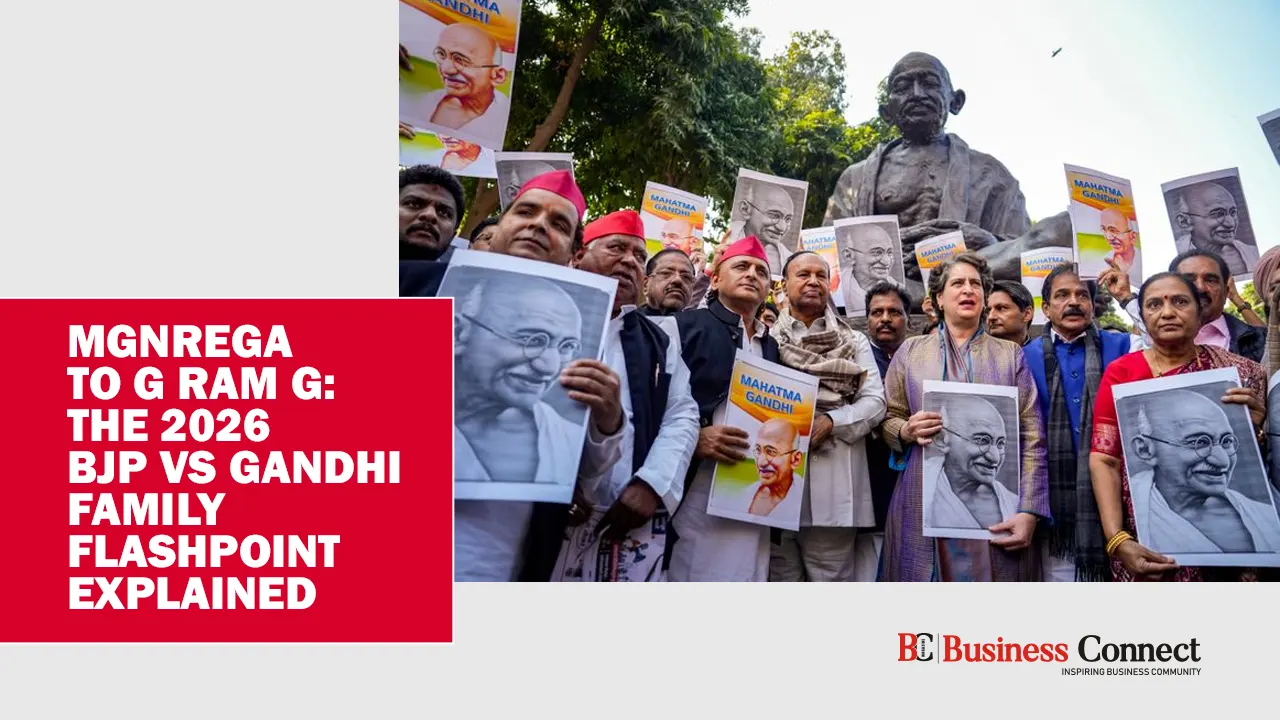
As the year 2025 draws to a close, the BJP’s ongoing tussle with the Congress-led Opposition has intensified over the government’s decision to replace the two-decade-old Mahatma Gandhi National Rural Employment Guarantee Act (MGNREGA) with the new Viksit Bharat–Guarantee for Rozgar and Ajeevika Mission (Gramin), or VB-G Ram G Act. While the new law may have its proponents, the Congress is gearing up for a nationwide campaign against the move, highlighting the political stakes ahead.
The MGNREGA, introduced in 2005 by the Congress-led UPA government, guaranteed 100 days of unskilled work per year for every rural household. The VB-G Ram G Act, enacted in the final week of Parliament’s winter session, replaces MGNREGA while extending the guaranteed work to 125 days annually. Beyond the numerical change, the scrapping of Mahatma Gandhi’s name has drawn criticism. The BJP defends the renaming, stating that “Pujya Bapu ji” also envisioned a “Ram Rajya,” and the new legislation’s title emphasizes Ram, reflecting the party’s enduring cultural and political connection with the figure, even after the completion of the Ram temple in Ayodhya.
The MGNREGA’s association with the Nehru-Gandhi family has made it a political touchstone for the Congress. The law was conceptualized under the National Advisory Council (NAC) led by Sonia Gandhi in 2004. While she chose not to assume the prime ministership, handing the post to Dr. Manmohan Singh, she oversaw the NAC with cabinet rank, guiding the government on policies including the right to employment, right to information, right to education, and right to food. MGNREGA, added in 2009 to reflect Gandhi’s mission of “wiping the tears of the last person,” became a defining achievement of the UPA era.
The repeal of MGNREGA has been met with protests in Parliament and across the country, led by Priyanka Gandhi Vadra and other opposition leaders. Whether the Congress can leverage this issue to mobilize public opinion remains a key question for 2026.
Renaming schemes and institutions has been a familiar BJP strategy to imprint its ideological vision. Examples include renaming Aurangzeb Road to A.P.J. Abdul Kalam Road, Rajpath to Kartavya Marg, and the new Prime Minister’s Office complex as part of the Central Vista project to Seva Teerth. Yet, the party did not alter MGNREGA for 11 years after coming to power, cognizant of its importance to rural voters and the underprivileged, a demographic crucial for electoral success—a lesson consistently reflected from Indira Gandhi’s 1971 “Garibi Hatao” campaign to Narendra Modi’s outreach to backward classes and Dalits since 2014.
The VB-G Ram G Act represents more than just a policy change; it is a new political flashpoint that could shape BJP vs Gandhi family dynamics in 2026, blending rural development, symbolic politics, and electoral strategy in one contentious legislative move.
The government’s decision to do away with MGNREGA has raised questions, particularly about its potential impact on the rural poor. Last year, the scheme provided an average of only 50 workdays nationally, yet it remained a crucial safety net for millions.
Unlike the demand-driven MGNREGA, the new G Ram G scheme will operate on a supply-based allocation system, with workdays set at 125 days per year as determined by the Centre. Funding will also differ: while MGNREGA was fully financed by the Centre, G Ram G will require shared funding between the Centre and the states in a 60:40 ratio, except for Northeastern and hilly states and Union Territories. Experts warn that several fiscally strained states may struggle to meet their share, potentially reducing average workdays below 50. If states cannot fulfill their contribution, the Centre may also reduce support, which could depress rural wages.
The Opposition has accused the government of potential bias, alleging that funding for the G Ram G scheme may favour BJP-ruled states over those led by non-BJP parties.
The controversy comes at a time when the government faces a complex trade situation, with mounting pressure from US President Donald Trump to open India’s farm sector. While some stakeholders push for a trade deal with the US, the farm lobby has opposed the entry of cheaper American agricultural products, creating further tension.
Additionally, the G Ram G law allows for a 60-day pause in work during peak agricultural seasons, a provision that may prove unpopular with farm workers who rely on consistent employment for their livelihood.
While the G Ram G scheme may have certain merits, its introduction represents a major overhaul of rural employment policy, affecting millions of workers across the country. The Congress, sensing a political opportunity, is preparing to launch a nationwide campaign against the government over this contentious issue.
| Question | Answer |
|---|---|
| What is the VB-G Ram G Act? | The VB-G Ram G Act (Viksit Bharat–Guarantee for Rozgar and Ajeevika Mission, Gramin) is the new law replacing the two-decade-old MGNREGA. It aims to provide unskilled rural employment for 125 days annually. |
| Why was MGNREGA repealed? | The government replaced MGNREGA with VB-G Ram G to restructure the rural employment framework. While it extends guaranteed workdays, it shifts from a demand-driven system to a supply-based allocation system, and introduces shared funding between the Centre and states. |
| How many workdays does the new scheme offer? | The VB-G Ram G Act guarantees 125 workdays per rural household per year, compared to 100 days under the original MGNREGA. |
| How is the funding for VB-G Ram G different from MGNREGA? | Unlike MGNREGA, which was fully funded by the Centre, the VB-G Ram G scheme is funded 60:40 by the Centre and states (except Northeastern and hilly states and Union Territories). This has raised concerns about financially strained states being unable to fully fund their share. |
| What is the potential impact on rural wages? | Experts warn that if states cannot contribute their share, the Centre may reduce funding, which could depress rural wages and lower the average number of workdays below 50. |
| Why has the scheme’s name changed? | Mahatma Gandhi’s name was removed. The BJP defends the name VB-G Ram G, stating it reflects “Ram Rajya” and emphasizes the party’s cultural and political connection with Ram, even after the Ram temple’s completion in Ayodhya. |
| What was MGNREGA’s significance historically? | MGNREGA, enacted in 2005 and later aligned with Gandhi’s mission in 2009, provided 100 days of guaranteed work and became a political symbol for the Congress and the Nehru-Gandhi family. It was conceptualized under Sonia Gandhi’s National Advisory Council to promote employment rights. |
| How has the Opposition reacted? | The Congress has protested the repeal both in Parliament and across the country, led by Priyanka Gandhi Vadra. The party is preparing a nationwide campaign against the government over this issue. |
| Are there concerns about political bias in funding? | Yes, the Opposition alleges that funding for VB-G Ram G may favour BJP-ruled states over non-BJP-ruled states. |
| Does the new law affect agricultural seasons? | Yes, the VB-G Ram G Act allows a 60-day pause in work during peak agricultural seasons, which may affect farm workers dependent on consistent employment. |
| Why is this move significant politically? | The repeal of MGNREGA and introduction of VB-G Ram G is a major political flashpoint, potentially shaping BJP vs Gandhi family dynamics in 2026. It combines rural development, symbolic politics, and electoral strategy in one legislative move. |
| What are the key differences between MGNREGA and VB-G Ram G? | 1. Workdays: 100 days (MGNREGA) vs 125 days (VB-G Ram G)2. Funding: Fully Centre-funded (MGNREGA) vs 60:40 Centre-State split (VB-G Ram G)3. System: Demand-driven (MGNREGA) vs Supply-based (VB-G Ram G)4. Seasonal pause: Only in VB-G Ram G (60 days during peak agricultural season) |
| Could this impact India’s rural workforce? | Yes, as millions of rural households rely on guaranteed employment, changes in allocation, funding, or seasonal pauses could affect income stability and livelihoods. |