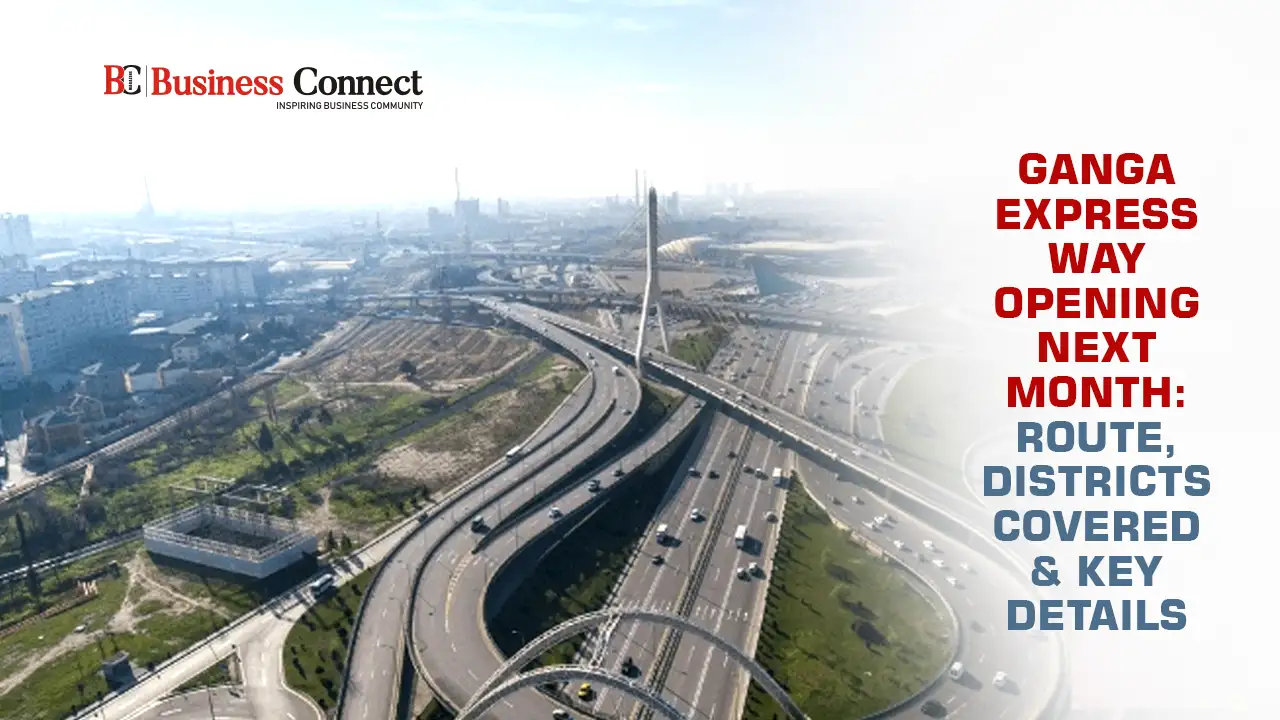
After a successful testing of FASTag-operated toll booths on the Ganga Expressway, which stretches 594 km from Meerut to Prayagraj, the longest expressway in India is scheduled to open for traffic next month. Experiments verify that the contactless tolling system is effective and that the boom barriers are operating as intended.
Ganga Expressway Opening Update: Route Details and 12 Districts Connected
The development of this motorway, which crosses 12 districts in Uttar Pradesh, will significantly expedite travel between the state’s western and eastern regions. Officials claim that improvements include an enormous number of bridges, underpasses, and safety services designed to improve commuter safety. Reports state that the construction is nearly finished.
The state government has partnered with Swiss organizations to implement the highest safety standards in road management in an effort to further advance efficiency and safety. It is anticipated that the expressway’s completion will further boost the growth of the local economy.
Commuters and transporters have been looking forward to the expressway’s opening since it will offer faster, safer, and more effective transportation services in Uttar Pradesh’s most populated areas. The expressway will set the standard for subsequent infrastructure projects in India because its FASTag methodology has been validated.
FASTag toll experiments are finished, and the Ganga Expressway will shortly open.
The 594 km Ganga Expressway, which will be the longest in the nation, is prepared for opening next month after the FASTags on toll booths were successfully tested. Twelve districts—Meerut, Hapur, Bulandshahr, Amroha, Sambhal, Budaun, Shahjahanpur, Hardoi, Unnao, and others—are covered by this expressway, which is still being built.
The trial-run procedure has demonstrated the effectiveness of the contactless FASTag toll payment system, according to the Uttar Pradesh Expressways Industrial Development Authority (UPEIDA). The boom barriers were observed to function flawlessly during the trial period, opening as soon as the vehicle slowed down and the FASTag was scanned. The trial phase has demonstrated that the system is prepared for launch, according to the authorities.
In addition to seven road overbridges, 17 interchanges, 14 major bridges, 126 minor bridges, 28 flyovers, 50 vehicle underpasses, 171 light vehicle underpasses, 160 small vehicle underpasses, and 946 culverts, the expressway crosses 140 bodies of water.
Senior state government officials claim that the Ganga Expressway is nearly finished and in the final stages of operation. In order to make the expressway safe for passengers, the state government has also inked a contract with the RTDT Laboratorie AG of Switzerland and the ETH Zurich University.
FAQs on Ganga Expressway Opening and FASTag Testing
When will the Ganga Expressway open for traffic?
The Ganga Expressway is scheduled to open for traffic next month after the successful completion of FASTag-operated toll booth trials.
What is the total length of the Ganga Expressway?
The Ganga Expressway stretches 594 km from Meerut to Prayagraj, making it the longest expressway in India.
Which districts will the Ganga Expressway connect?
The expressway passes through 12 districts in Uttar Pradesh, including Meerut, Hapur, Bulandshahr, Amroha, Sambhal, Budaun, Shahjahanpur, Hardoi, Unnao, and others.
Has FASTag testing been completed on the Ganga Expressway?
Yes, FASTag-operated toll booth trials have been successfully completed, confirming that the contactless toll collection system works efficiently.
How did the FASTag toll system perform during trials?
During the trial runs, boom barriers opened seamlessly as vehicles slowed down and FASTags were scanned, indicating smooth and reliable toll operations.
Who conducted the FASTag trial verification?
The trial runs were overseen by the Uttar Pradesh Expressways Industrial Development Authority (UPEIDA), which confirmed the system’s readiness.
What infrastructure facilities are included on the Ganga Expressway?
The expressway includes 17 interchanges, 14 major bridges, 126 minor bridges, 28 flyovers, 50 vehicle underpasses, 171 light vehicle underpasses, 160 small vehicle underpasses, 946 culverts, and crossings over 140 water bodies.
Is construction of the Ganga Expressway complete?
Officials state that the construction is nearly complete and the project is in its final operational stages.
What safety measures are being implemented on the expressway?
The state government has partnered with RTDT Laboratorie AG of Switzerland and ETH Zurich University to ensure high international safety standards in road management.
How will the Ganga Expressway benefit Uttar Pradesh?
The expressway will significantly reduce travel time between western and eastern Uttar Pradesh, improve road safety, and boost local economic growth.
Why is the Ganga Expressway important for commuters and transporters?
It will provide faster, safer, and more efficient transportation across some of the most densely populated regions of Uttar Pradesh.
Will the Ganga Expressway set a benchmark for future projects?
Yes, authorities believe the successful FASTag implementation and safety standards will serve as a model for future infrastructure projects in India.
Who is developing the Ganga Expressway?
The Ganga Expressway is being developed by the Uttar Pradesh Expressways Industrial Development Authority (UPEIDA).
Where does the Ganga Expressway start and end?
The expressway starts from Meerut in western Uttar Pradesh and ends at Prayagraj in eastern Uttar Pradesh.
Why is the Ganga Expressway considered a landmark project?
With a total length of 594 km, the Ganga Expressway will become the longest expressway in India, significantly improving state-wide connectivity.
How will the expressway reduce travel time?
By offering a high-speed, access-controlled corridor, the expressway will cut down long-distance travel time between western and eastern Uttar Pradesh.
Is the Ganga Expressway access-controlled?
Yes, the expressway is designed as a fully access-controlled highway to ensure smooth traffic flow and enhanced safety.
What type of toll system will be used on the Ganga Expressway?
The expressway will use a FASTag-based contactless toll collection system, which has already been successfully tested.
Will manual toll payment be allowed on the expressway?
Authorities have indicated that FASTag will be the primary toll payment method, ensuring quicker and congestion-free toll operations.
How many interchanges does the Ganga Expressway have?
The expressway features a total of 17 interchanges to provide seamless entry and exit points along the route.
How many bridges are part of the Ganga Expressway project?
The project includes 14 major bridges and 126 minor bridges, along with multiple underpasses and flyovers.
Does the expressway cross rivers or water bodies?
Yes, the Ganga Expressway crosses 140 water bodies, supported by extensive bridge and culvert infrastructure.
What role do Swiss institutions play in this project?
Swiss institutions RTDT Laboratorie AG and ETH Zurich University are involved to help implement advanced road safety and management standards.
How will the Ganga Expressway impact the local economy?
The expressway is expected to boost trade, logistics, employment opportunities, and overall economic development in connected regions.
Why are transporters eagerly waiting for the expressway’s opening?
Transporters anticipate reduced travel time, lower fuel costs, and improved road safety once the expressway becomes operational.
What makes the Ganga Expressway different from other expressways in India?
Its record length, advanced safety features, extensive bridge infrastructure, and validated FASTag tolling system set it apart from existing expressways.