
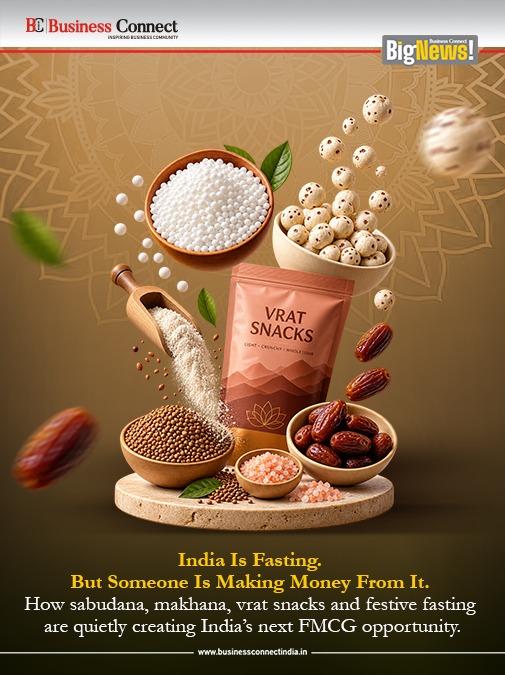
How sabudana, makhana, vrat snacks and festive fasting are quietly creating India’s next FMCG opportunity.
There is something fascinating happening in India.
Millions of people are choosing *not to eat*.
And yet, an entire industry is finding ways to sell them *more food*.
Think about it.
During Navratri, shelves fill with sabudana, makhana, kuttu atta and vrat-friendly snacks.
During Janmashtami, the same story repeats.
During Ramadan, the food conversation changes completely—dates, fruits, iftar snacks and traditional favourites take centre stage.
During Lent, another set of food habits comes into play.
And then there is the modern consumer—the one who isn’t fasting for religion at all.
They’re fasting for fitness.
For weight management.
For wellness.
For a Monday “detox.”
Different reasons.
Different rituals.
Different rules.
*One remarkably similar business opportunity.*
Fasting has become a marketplace.
And FMCG brands are beginning to notice.
The Most Interesting FMCG Category Might Be the One People Eat Only Occasionally
For decades, fasting food lived in a very different world.
It wasn’t really a “category.”
It was something your mother knew how to make.
Something your grandmother taught you.
Something you bought from the neighbourhood kirana when a festival arrived.
Sabudana was sabudana.
Makhana was makhana.
Kuttu was kuttu.
There was no need for sophisticated packaging, celebrity endorsements or Instagram campaigns.
Tradition did the marketing.
But India has changed.
Urbanisation has changed how we eat.
Dual-income households have changed how we cook.
Quick commerce has changed how we shop.
And social media has changed how we discover food.
Suddenly, the consumer who doesn’t have 90 minutes to prepare a vrat meal is perfectly happy to spend ₹99 on a packaged alternative.
That’s the inflection point.
When tradition meets convenience, a category is born.
Welcome to the Age of Branded Fasting
Look closely at today’s shelves and digital storefronts.
You will find everything from fasting flours and sabudana preparations to makhana, banana chips, vrat namkeen, ready-to-cook products and packaged Farali snacks.
Even quick-commerce platforms are merchandising dedicated vrat-snack collections.
That is not just a change in assortment.
It’s a change in consumer behaviour.
Because once consumers begin asking:
> “Which brand should I buy?”
instead of:
> “Where can I find this ingredient?”
the game changes completely.
The product has moved from *commodity to brand*.
And that is where the real money starts.
The Big FMCG Players Don’t Need to Invent a New Culture
They simply need to package the culture that already exists.
That’s why established names such as *Tata, Haldiram’s and Bikaji* are interesting to watch.
They already understand distribution.
They understand packaging.
They understand pricing.
Most importantly, they understand something that new-age brands sometimes forget:
India doesn’t buy products. India buys trust.
If a familiar brand puts a fasting-friendly product on the shelf, the consumer doesn’t have to spend much time thinking.
The brand has already answered the most important question:
Can I trust this?
And specialised brands are taking the opposite route.
Instead of adding fasting food to a massive portfolio, they’re building their entire proposition around it.
That’s a completely different strategy.
One sells fasting products.
The other sells *expertise in fasting*.
And the second one can be surprisingly powerful.
But Here’s Where It Gets Really Interesting
Fasting isn’t one consumer segment.
It’s an umbrella.
Underneath it are several very different consumers.
The Devotee
For whom ingredients aren’t negotiable.
They want authenticity, trust and adherence to tradition.
The Busy Professional
They may be fasting—but they also have meetings at 10, a presentation at 2 and a commute at 7.
They don’t want to cook.
They want convenience.
The Health Seeker
They’ve discovered intermittent fasting, clean eating and mindful consumption.
They may have zero connection with religious fasting.
But they’re shopping from some of the same shelves.
The Gen Z Consumer
They discover food on Instagram.
They buy on quick-commerce.
And they’re perfectly comfortable turning a traditional ingredient into a modern snack.
The Family Buyer
One person is fasting.
Four people are eating.
And suddenly, a “fasting” purchase becomes a household purchase.
That’s the category’s hidden scale.
And Then Came Quick Commerce
This may be the biggest disruption of them all.
Earlier, fasting meant planning.
Now?
It can mean opening an app.
Forgot makhana?
Tap.
Need sabudana?
Tap.
Want a fasting snack before your next meeting?
Tap.
The distance between *craving and consumption* has collapsed.
And that matters enormously for FMCG.
Because the best food brands aren’t necessarily competing for shelf space anymore.
They’re competing for a position on your phone screen.
The first brand you see.
The product with the best thumbnail.
The snack available in 10 minutes.
The pack that looks good enough to share on Instagram.
Discovery, consideration and purchase can now happen in the same five minutes.
That’s not retail.
That’s a completely new consumer behaviour.
India’s Fasting Calendar Is Also a Marketing Calendar
Here’s another reason this category deserves attention.
India doesn’t have one fasting season.
It has a calendar full of them.
Navratri.
Janmashtami.
Mahashivratri.
Shravan.
Ekadashi.
Ramadan.
Lent.
And countless regional and community traditions.
For marketers, that means something very valuable:
Recurring consumption occasions.
Every occasion brings a new wave of search behaviour.
New recipes.
New social conversations.
New grocery lists.
New product discovery.
New offers.
New demand.
And every year, the consumer comes back.
That is exactly the kind of repeatable behaviour FMCG marketers dream about.
The Real Opportunity Isn’t “Vrat Food”
This is where brands need to think bigger.
Don’t call it just vrat food.
That’s a limitation.
Because the moment you define the category too narrowly, you define the consumer too narrowly.
What if the same makhana is positioned as:
A vrat snack in September.
A healthy office snack in October.
A movie-night snack in November.
A guilt-free evening snack in December.
Same product.
Different occasion.
Different story.
Different consumer trigger.
That’s the power of positioning.
The future winner may not be the brand that owns fasting.
It may be the brand that owns *better snacking*—and happens to win fasting occasions too.
From ₹10 Trial Packs to ₹999 Fasting Boxes
The pricing opportunity is equally interesting.
Imagine a category that can sell:
*₹10–₹20* impulse packs.
*₹30–₹50* everyday snacks.
*₹99–₹199* premium snack combinations.
*₹299–₹499* vrat meal kits.
*₹999+* curated festive fasting boxes.
Now add:
D2C.
Amazon.
Quick commerce.
Modern retail.
Kirana.
Corporate gifting.
Festival hampers.
Subscriptions.
Suddenly, we’re not talking about a tiny niche anymore.
We’re talking about an ecosystem.
The Smartest Brands Will Do One More Thing
They will stop treating fasting as a restriction.
They’ll start treating it as a *lifestyle choice*.
That subtle shift in language can transform the entire category.
Instead of:
“Food you can eat while fasting.”
Think:
Food that fits the way you choose to eat.
See the difference?
One talks about restriction.
The other talks about identity.
And modern consumers buy identity.
This Is Bigger Than Sabudana
That’s the real story.
The opportunity isn’t hiding inside one ingredient.
It’s hiding inside a behavioural shift.
India is moving from:
Loose → Packaged
Traditional → Branded
Local → Digital
Occasional → Discoverable
Ingredient → Experience
And perhaps most importantly:
Restriction → Lifestyle
That is how categories are created.
Not overnight.
But one consumer habit at a time.
The Billion-Rupee Question Isn’t “What Do Indians Eat While Fasting?
The better question is:
“What will Indians buy because they are fasting—and continue buying after the fast is over?”
That’s where the real opportunity lives.
Because if a consumer discovers a delicious makhana snack during Navratri…
and keeps eating it in November…
you didn’t just win a fasting customer.
*You won a customer.*
And that’s the difference between a seasonal product and a scalable FMCG brand.
The Final Bite
Fasting may be ancient.
But the business around fasting is becoming remarkably modern.
Traditional recipes are getting packaged.
Local ingredients are becoming brands.
Festival demand is becoming digital commerce.
Quick-commerce is turning preparation into convenience.
And marketers are discovering that a consumer who chooses to eat less can still become a very valuable customer.
So the next time you see a shelf full of sabudana, makhana, vrat chips and fasting snacks, don’t just see food.
See a category being built in real time.
Because in India, even when millions of people decide to stop eating…
the FMCG industry has found something new to sell them.
And that might be the most interesting part of the story.
What’s your go-to fasting snack?
Sabudana khichdi, makhana, fruits, vrat chips—or something your family makes that no brand has managed to beat yet? 👇