
From Images to Relief Art: A New Way to Give Flat Designs Physical Depth
A picture does not have to remain flat.
A photograph can become a piece of wall art. An illustration can become a decorative object. A logo can become a raised emblem. Even a simple pattern can take on a completely different character when parts of its surface are lifted above others.
This is the idea behind 3D relief.
Unlike a conventional 3D model, which is designed to exist as a complete object that can be viewed from all directions, a relief focuses on depth across a surface. Different areas of an image can be represented at different heights, creating a physical interpretation that still preserves the visual composition of the original artwork.
For artists, makers, hobbyists, and designers, this offers an interesting way to move from digital artwork toward physical creation.
And with AI-assisted tools, creating a relief no longer necessarily starts with manually modeling every layer.
What Makes Relief Different From a Regular 3D Model?
The easiest way to understand relief is to think about a traditional sculpture and a carved panel.
A sculpture occupies three-dimensional space from every direction. Its back, sides, and front all contribute to its form.
A relief, by contrast, is closely connected to a surface. The front-facing composition carries most of the visual information, while variations in height create the sense of depth.
This makes relief particularly suitable for images.
A portrait, decorative pattern, illustration, emblem, or landscape can retain its original composition while gaining physical dimension.
The result sits somewhere between a picture and a sculpture.
It can be displayed like artwork, but its surface can also have visible changes in height and texture.
Why Flat Artwork Works So Well as a Starting Point
Many visual designs already contain a natural sense of hierarchy.
A foreground object may stand out against a background.
A person’s face may be separated from the surrounding area.
Letters may have strong outlines.
A logo may contain clearly defined shapes.
A decorative pattern may repeat across a surface.
These visual differences can provide useful information for creating depth.
Instead of inventing an entirely new object, a relief can reinterpret the relationships that already exist inside the image.
This makes the process particularly interesting for people who work primarily with 2D media.
They do not necessarily need to abandon their existing creative style when moving into 3D.
They can use familiar artwork as the foundation for a different physical medium.
Giving Photographs a New Dimension
Photography is an obvious starting point.
A photograph normally captures light, color, and composition. A relief adds another visual characteristic: physical depth.
Portraits are one example.
A photograph of a person can potentially be transformed into a raised artwork where facial features and other visual elements are represented through differences in surface height.
The result does not need to reproduce every physical characteristic of the person.
Instead, it creates a stylized physical interpretation of the photograph.
The same concept can apply to photographs of buildings, landscapes, objects, pets, or other subjects.
The original photograph remains important, but its role changes.
It becomes the source material for a dimensional artwork.
Turning Illustrations Into Decorative Pieces
Illustrators can also use relief to extend their work beyond the screen.
A digital illustration may originally have been designed for a website, poster, book, or social media post.
A relief version can introduce a completely different presentation.
Instead of viewing the illustration only through a display, people can see how its shapes interact physically.
This can work particularly well with artwork that has strong silhouettes and clearly separated visual elements.
A simple illustration can sometimes be more effective as a relief than a highly detailed photograph because its shapes are already visually organized.
The physical depth reinforces those relationships.
Logos Can Become More Than Graphics
A logo is usually designed to be recognizable at a glance.
Its shapes, lines, and typography are carefully arranged so that the identity remains clear even when the logo is reproduced at different sizes.
These characteristics can also make logos interesting candidates for dimensional treatment.
A flat logo can potentially become a raised emblem, sign, decorative plaque, or display piece.
For a small business or creative brand, this provides another way to use an existing visual identity.
Instead of appearing only on a screen or printed surface, the same graphic language can become part of a physical environment.
A logo on a desk, wall, display stand, or event backdrop can have a different visual impact from the same logo printed on paper.
Patterns Can Become Tactile Designs
Not every relief needs to depict a recognizable object.
Patterns can also work.
Geometric shapes, floral motifs, abstract compositions, cultural patterns, and decorative graphics can all be reinterpreted through variations in surface height.
This opens up possibilities for decorative design.
A repeating pattern that normally exists only as a digital graphic can become a textured panel or ornamental surface.
The important thing is that the original pattern remains recognizable while its physical structure adds another layer of visual interest.
In this sense, relief is not simply a method of converting images into objects.
It is a way of translating graphic language into physical form.
Creating Personalized Wall Art
One practical use of relief is personalized decoration.
People often want wall art that feels connected to their own experiences rather than something selected from a generic catalog.
A photograph of a memorable place, a family illustration, a personal symbol, or an original piece of artwork can serve as the starting point for a custom design.
A relief gives the image a physical presence.
With a photo to 3d model process, a personal image can be transformed into a tangible relief that can be framed, mounted, displayed independently, or incorporated into a larger decorative arrangement. B
Because the source can be a personal image, the resulting object can also have a strong connection to the person who created or commissioned it.
This makes relief an interesting option for gifts and personalized artwork as well.
The Importance of Depth
Adding depth does not automatically make a design better.
The relationship between different levels is what creates the visual effect.
If everything has roughly the same height, the result may feel almost flat.
If the depth changes are too aggressive, the original composition may become difficult to recognize.
This means that relief design involves a balance.
The creator needs enough depth to make the object feel dimensional while preserving the important characteristics of the source image.
AI-assisted tools can help creators experiment with this translation without requiring them to manually construct every layer.
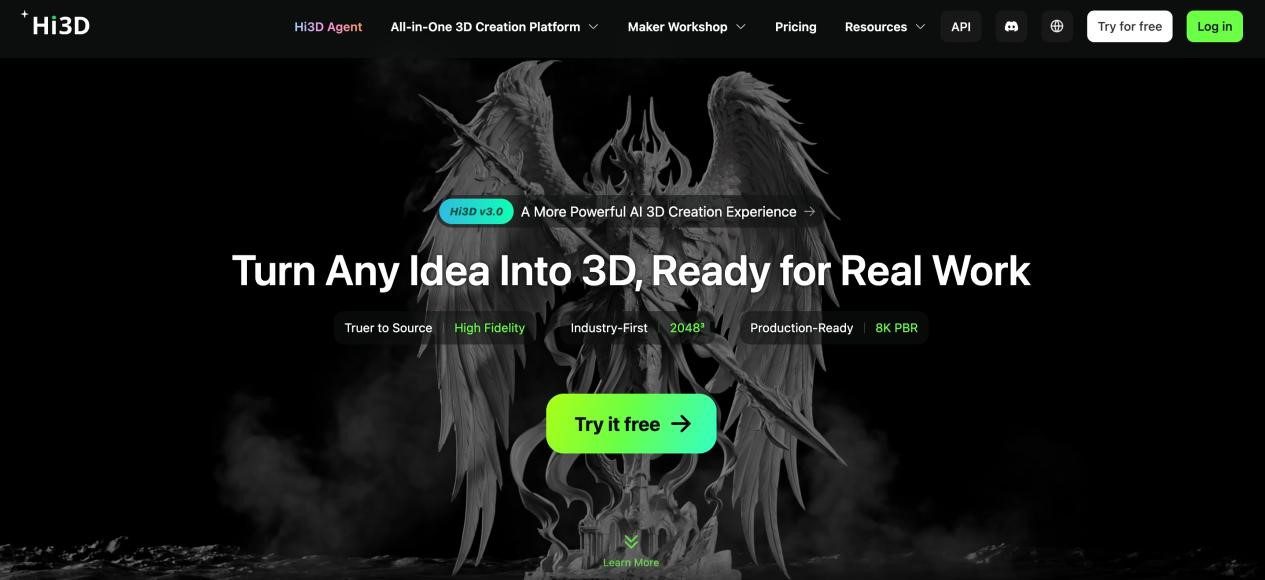
Hi3D includes a dedicated 3D Relief tool designed to transform images into relief-style 3D assets, providing a starting point for this kind of experimentation.
Relief Does Not Have to Look Photorealistic
There is also no rule that a relief needs to imitate reality.
A creator may deliberately want an artistic result.
An illustration could be transformed into a stylized relief where the important outlines are emphasized. A portrait could use exaggerated depth. An abstract design could combine several levels to create a sculptural effect.
This is where the boundary between modeling and visual art becomes interesting.
The objective is not always to reproduce the source image exactly.
Sometimes the goal is to interpret it.
AI can provide an initial transformation, while the creator decides whether the result should remain close to the original or move toward a more artistic direction.
Combining Relief With Color
Depth and color can work together.
A relief may rely entirely on differences in height, creating a monochromatic sculptural appearance.
But color can add another layer of visual information.
For example, separate areas of a decorative design could retain distinct colors, helping viewers recognize the original image while also seeing its physical depth.
Hi3D provides multi-color functionality that can be used to work with different color regions in 3D models.
This creates another design choice.
A creator can ask not only how high each part should be, but also whether different areas should have different colors.
The combination can make the final object feel closer to the original artwork while still taking advantage of its dimensional form.
Relief Can Be a Good Starting Point for Beginners
Full 3D modeling can feel intimidating because AI 3D modeling creators need to think about an object from every direction.
Relief offers a more familiar entry point.
The creator already understands the source image.
The main question becomes how that image can be expressed through depth.
This can make the transition from 2D design to 3D concepts easier to understand.
Someone comfortable with drawing, photography, graphic design, or illustration can begin experimenting with three-dimensional work without immediately having to construct a complicated object from an empty 3D scene.
In that sense, relief can act as a bridge between two-dimensional creativity and three-dimensional design.
From Digital Artwork to Physical Production
Once a relief has been created digitally, it can potentially move into a physical production workflow.
Hi3D supports formats such as STL and 3MF among its export options, which are commonly associated with 3D-printing workflows.
This creates an interesting creative loop.
An artist starts with an image.
The image becomes a digital relief.
The relief can then become a physical piece.
The physical result can reveal new characteristics that were difficult to notice on a screen.
The creator may then decide to adjust the design and produce another version.
The process becomes a form of digital-to-physical experimentation.
Small Details Can Change the Result
Relief artwork does not necessarily need thousands of tiny details to look interesting.
Sometimes a few carefully preserved features matter more.
In a portrait, facial contours may be important.
In a logo, the outline and lettering may matter most.
In an illustration, the silhouette may carry the identity of the image.
This means that creators should think about hierarchy rather than simply trying to preserve everything.
What does someone recognize first when they look at the original?
Which shapes define the composition?
Which details can be simplified without changing the overall impression?
These questions are just as relevant to relief as they are to other forms of visual design.
Exploring Different Subjects Through the Same Technique
The versatility of relief comes partly from the wide range of images that can serve as source material.
A creator could experiment with:
- Portrait photography
- Pet photographs
- Landscapes
- Illustrations
- Logos
- Typography
- Geometric patterns
- Decorative motifs
- Historical images
- Abstract artwork
The resulting objects may look completely different, but the underlying concept remains similar: use depth to reinterpret a flat visual composition.
This makes relief less dependent on one particular creative style.
The technique can adapt to the source material.
Relief as a New Way to Reuse Old Artwork
Digital artists often accumulate large collections of unused images.
An old illustration may no longer fit a current project. A previous logo concept may have been replaced. A photograph may have remained stored on a hard drive for years.
That does not necessarily mean the artwork has no further value.
Changing the medium can give an old image a new purpose.
A digital illustration that has already been published can become a physical decorative piece.
A photograph can become a dimensional keepsake.
A pattern can become a textured design.
This kind of reuse is one of the most interesting aspects of digital-to-physical creativity.
The original artwork does not have to be discarded simply because its first application has ended.
A Different Way to Think About 3D Creation
Much of the discussion around 3D focuses on creating complete objects.
Relief suggests a different perspective.
Sometimes creators do not need a fully dimensional object.
They simply need enough depth to change how an image is experienced.
That can be useful when the original composition is already strong and the goal is to preserve it rather than redesign it completely.
Instead of asking, “How do I model this object in 3D?” the creator can ask:
“How can I give this image physical depth?”
That is a much more approachable question for many visual creators.
The Future of Image-Based Art May Not Be Entirely Flat
Screens will remain an important home for digital artwork.
But digital images do not have to stay inside screens.
As AI-assisted 3D tools become easier to use, creators have more opportunities to reinterpret existing artwork as physical forms.
A photograph can become a relief.
An illustration can become a decorative panel.
A logo can become a raised emblem.
A pattern can become a textured surface.
The creative possibilities depend less on whether someone is a professional 3D artist and more on what they want to explore.
Hi3D’s 3D Relief tool provides one way to make that exploration more accessible, while its broader 3D creation features allow creators to experiment with appearance, color, and different output formats.
The result is not simply a picture with extra depth.
It is a different way of experiencing an image.
And sometimes, giving a familiar design a third dimension is enough to make it feel completely new.
Add Business Connect magazine to your Google News feed